At a glance
Where the world is listening
HURRY UP TOMORROW: THE WEEKND’S CALCULATED FAREWELL TO AN ALTER EGO
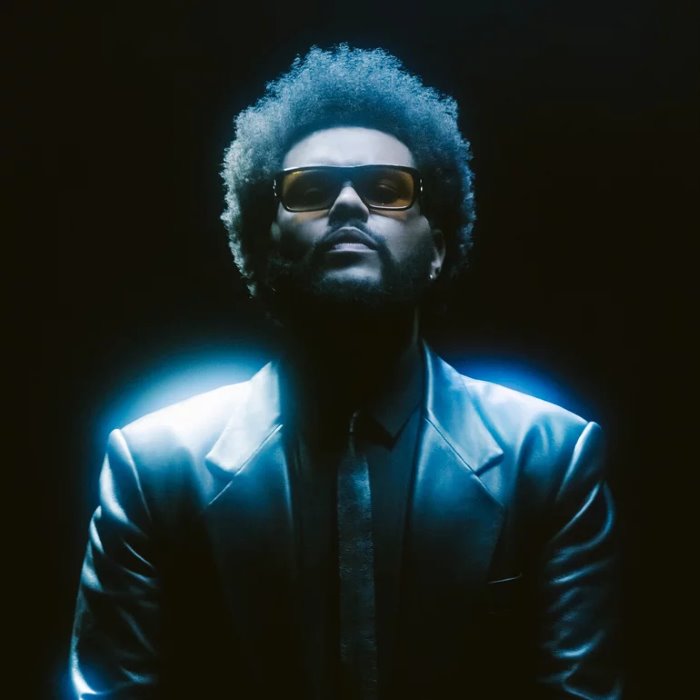
The Weeknd’s Hurry Up Tomorrow (2025) arrives as the sixth and potentially final studio album under Abel Tesfaye’s stage name — a 22-track, 84-minute opera of synth-pop, R&B, and self-mythology that closes out one of the most structurally ambitious trilogies in 21st-century pop.
The album is the final installment of a trilogy following the Weeknd’s previous two studio albums, After Hours (2020) and Dawn FM (2022).
Released on January 31, 2025, through XO and Republic Records, it opened with stratospheric commercial numbers while drawing a nuanced, sometimes fractured critical response — one that illuminates both the ceiling and the limits of Tesfaye’s chosen persona.
Album Credits
| Artist | The Weeknd (Abel Tesfaye) |
| Released | January 31, 2025 |
| Genre | Synth-Pop / Alternative R&B / Hip-Hop |
| Label | XO / Republic Records |
| Producer(s) | The Weeknd, Mike Dean, Max Martin, Oscar Holter, Cirkut, DaHeala, Metro Boomin, OPN (Oneohtrix Point Never), Prince85 |
| Tracks | 22 (standard edition) |
| Runtime | approx. 84 minutes |
| Lead Single(s) | “Timeless” (feat. Playboi Carti), “São Paulo” (feat. Anitta), “Cry for Me” |
Performance Snapshot
| Global Listeners | 1,526,508 |
| Total Scrobbles | 78,870,700 |
| Countries Charting | 43 |
| Strongest Market | United States — 198,921 listeners |
| Top 3 Markets | United States (198,921) · Brazil (84,725) · United Kingdom (41,034) |
Production Architecture: Synth-Pop Maximalism Meets Cinematic Gravity
Production on Hurry Up Tomorrow was primarily handled by the Weeknd himself and his regular collaborators including Cirkut, DaHeala, Max Martin, Mike Dean, Metro Boomin, Prince85, and OPN, alongside various other producers.
That roster reads less like a feature list and more like a deliberate assembly of distinct sonic philosophies — and the album’s internal friction is largely a product of that design. Max Martin and Oscar Holter bring the compressive sheen of Stockholm pop engineering, visible in the melodic scaffolding of “Cry for Me,” where ascending chord progressions are counterweighted by sidechain-heavy low end that keeps the track floor tethered. Mike Dean functions here not merely as mixer or engineer but as the album’s architectural conscience —
Dean’s contributions earned public praise from Metro Boomin, who said Dean was “sitting high on that all-time producer/composer list.”
Hurry Up Tomorrow is primarily a synth-pop and R&B album, while exploring a wide variety of genres such as Brazilian funk and hip-hop.
That range is not ornamental. The Brazilian funk registers on “São Paulo” as a genuine formal decision: the baile-influenced percussion and vocal call-and-response with Anitta shifts the harmonic tonal center to a brighter, more percussive register — a departure from the claustrophobic minor-key settings that dominate the record’s middle section. Meanwhile, Daniel Lopatin (Oneohtrix Point Never) contributes textural disruption — arpeggiating synthesizer passages that recall modular synthesis more than conventional pop production, particularly in the album’s more nocturnal second half.
Italian composer Giorgio Moroder, known for his film scores like Midnight Express and Scarface, was a major influence on the album, particularly for the “operatic synths” used in the latter. The Weeknd himself described the album as “gothic” and “operatic.”
The album features Moroder’s contributions on keyboards, arrangements, and vocals.
His presence on “Big Sleep” lands the record’s most explicit vintage-electronics moment — parallel processing on the synthesizer patches recalls the dry, chamber-resonant disco textures of late-1970s Eurodisco without sliding into pastiche. The mastering chain, handled in full by Mike Dean at Dean’s List House of Hits in Cypress, TX, gives the album a consistently wide stereo image and a high-SPL ceiling that rewards playback on a proper monitoring chain. For a record comparing itself to the cinematic, the technical treatment is appropriately maximal. Fans of Jhené Aiko’s introspective R&B architecture on Chilombo will find familiar emotional territory, though Tesfaye operates at a considerably higher production-density and a more fractured formal logic.
Songwriting and Voice: The Performance of Exhaustion
The album explores existential and self-referential themes, while also exploring death, redemption, and rebirth.
Tesfaye’s lyrical posture here is one of high-decibel vulnerability — a performer standing at the edge of his own mythology and narrating the view. “Cry for Me” constructs its appeal around that contradiction directly: a melodically buoyant top-line delivered in Tesfaye’s signature upper-register falsetto, lyrics that describe emotional isolation with the kind of theatrical precision that makes it difficult to determine whether the writing is confession or costume. The falsetto itself — a sustained, narrow-vibrato instrument deployed with remarkable dynamic control — remains one of the most immediately recognizable vocal timbres in contemporary R&B.
The album is bogged down at points in ballad after ballad, all draped with the Weeknd’s pretty but repetitive vibrato falsetto.
That criticism is structurally legitimate: when a voice this distinctive appears across 22 tracks without significant timbral modulation, diminishing returns set in well before the final act.
Where the songwriting earns its keep is in its specificity of feeling rather than precision of language.
When Tesfaye tells us that “fame is a disease” on “Drive” or laments being trapped in a “penthouse prison” on “Cry for Me,” these are hardly original ideas.
The writing does not pretend otherwise — it leans into the archetypal nature of the themes, treating the Weeknd character as a figure to be observed rather than a person to be understood. “Reflections Laughing,” which features Florence Welch’s soaring soprano against Travis Scott’s low-end cadence and Tesfaye’s falsetto midrange, deploys the three voices as a kind of tonal chorus — three distinct registers occupying the same emotional space with contrasting degrees of resolution. It is one of the album’s most formally inventive moments, an arrangement decision that production credits confirm as a Weeknd/DaHeala co-construction.
Fans have speculated that the new trilogy is inspired by Dante Alighieri’s Divine Comedy, reflecting its themes, symbolism, and narrative arc. According to this theory, the albums represent a journey through Hell (After Hours), Purgatory (Dawn FM), and Paradise (Hurry Up Tomorrow).
If that reading holds, then the album’s lyrical turn toward rebirth — audible in the closing stretch leading to “Without a Warning” — carries structural weight beyond surface-level introspection.
The album takes its name from the song “Hurry Up Tomorrow” by the soul group the Nu’rons, a track sampled on “Without a Warning.”
That sample grounds the record’s finale in a lineage of soul music that precedes Tesfaye by decades, a quiet acknowledgment that the character was always in conversation with history, not in isolation from it.
Market Note: Catalog Longevity and the IP Value of a Staged Retirement
With 1,526,508 global listeners and 78,870,700 total scrobbles, Hurry Up Tomorrow operates at a listener-to-scrobble ratio of approximately 51.7 plays per listener — a figure indicating deep catalog re-engagement rather than casual audience sampling.
Upon release, Hurry Up Tomorrow accumulated 58 million streams globally within its first day of availability on Spotify, and 302 million streams within its first week, becoming the Weeknd’s largest streaming debut for all his studio projects on the platform.
The album opened with first-week sales of 490,500 album-equivalent units in the U.S. and debuted at number one on the Billboard 200, marking the Weeknd’s fifth number-one album on the chart.
The narrative of a “final album” under a specific persona functions as a demand driver in catalog terms: it incentivizes completionist consumption across the trilogy, amplifying streaming velocity on After Hours and Dawn FM retroactively. Sync potential is considerable — the cinematic production palette, absence of topical lyrical references, and Giorgio Moroder’s keyboard contributions render multiple tracks format-agnostic for placement in film, TV, and luxury brand contexts. The geographic breadth of 43 charting countries, anchored by the U.S. (198,921 listeners), Brazil (84,725), and the U.K. (41,034), reflects an IP with genuinely multi-market depth, not a single-territory phenomenon.
Cultural and Geographic Context: A Global Register with Brazilian Coordinates
The album’s geographic reception reveals something structurally interesting about the Weeknd’s audience construction. The United States’ position as strongest market (198,921 listeners) is expected — Tesfaye built his fanbase through American streaming infrastructure and radio formatting. But Brazil’s second-place ranking (84,725 listeners) is not incidental.
During the show in São Paulo on September 7, 2024, Tesfaye performed songs solely from the new trilogy, including the new track “São Paulo” featuring Anitta.
That concert — alongside the “São Paulo” single featuring Anitta — was a calculated act of geographic acknowledgment that converted a fanbase segment into an active album constituency. The collaboration with Anitta is not merely a feature: it maps directly onto the territory where it lands hardest, and the Brazilian funk register within that track functions as the album’s most explicit cross-cultural production gesture.
Internationally, Hurry Up Tomorrow topped the charts in 16 countries, including Canada, France, Norway, Belgium, Australia, the United Kingdom, and New Zealand.
The United Kingdom’s third-place Last.fm position (41,034 listeners) aligns with a broader tradition of British audience investment in American R&B — a lineage running from mid-1960s Atlantic soul through the PBR&B wave of the early 2010s that Tesfaye himself helped define. The comparative strength of Germany (14,670 listeners) and Poland (11,648 listeners) within the European cluster — both countries with established electronic music cultures — suggests that the album’s synth-pop architecture is a meaningful demand driver in markets where the production sensibility has its own local resonance, separate from the celebrity cultural weight of the artist.
India’s presence at 14,036 listeners tracks with the rapid expansion of Spotify’s subscriber base in South Asian markets, where Tesfaye’s falsetto-led, cinematic-scale production tends to index alongside Bollywood’s own tradition of melodically heightened emotional register. The album’s avoidance of topical American cultural references — it is more preoccupied with the internal architecture of a mythology than with any specific moment — gives it a kind of lyrical portability that amplifies its international traction.
The album also serves as a companion piece to a film of the same name
, extending the IP into visual media and providing an additional distribution channel across streaming services globally. That multimedia dimension reinforces audience retention in secondary markets where the album might otherwise plateau early in its release cycle.
Critical Assessment: Precision Without Economy
According to the review aggregator Metacritic, Hurry Up Tomorrow received “generally favorable reviews” based on a weighted average score of 75 out of 100 from 11 critic scores.
That number is honest. The album functions at two distinct registers: a production register, where it is nearly unassailable, and a formal economy register, where it is genuinely flawed. Those two registers are not irreconcilable, but the tension between them defines the listener’s experience.
The production case is straightforward.
Clocking in at nearly 90 minutes, the 22-track Hurry Up Tomorrow is by turns dazzling and frustrating, with moments of lyrical clarity and sonic density that stand out amidst the heavy-hearted reflections and even heavier synths.
“Baptized in Fear” deploys a low, sustained synthesizer pad beneath a heavily compressed vocal double — the parallel processing on Tesfaye’s falsetto here creates an almost organ-like harmonic thickness, situating the track firmly in the gothic-operatic mode he described in interviews. “Without a Warning” earns its position as the album’s closing statement through accumulated restraint — after 21 tracks of escalating synthetic density, the relative sparseness of its arrangement registers as a formal resolution rather than a dropped energy.
The structural problems, however, are real.
The main thing holding Hurry Up Tomorrow back from being a truly euphoric swan song is its lack of great hooks. Midway through, the album settles into a slow-to-moderate tempo that begins to feel like a slog.
Tracks 11 through 15 in particular — “Given Up on Me,” “I Can’t Wait to Get There,” “Timeless,” “Niagara Falls,” “Take Me Back to L.A.” — occupy similar dynamic and harmonic territory without sufficient differentiation to justify their sequential placement. The issue is not individual track quality but sequencing logic: a 22-track runtime demands editorial discipline that was not applied with full rigor here.
The Guardian’s review described the album as both “captivating” and “exhausting,” with the Weeknd’s great musical production often undermined by shallow, self-pitying lyrics about fame.
Where the album fully succeeds is in its most formally ambitious moments. “Reflections Laughing” is the kind of track that justifies a 22-song runtime — a three-voice arrangement of striking sophistication. “São Paulo” demonstrates that Tesfaye’s commercial instincts are still active and precise when allowed to cross genre boundaries.
The album received positive reviews from critics, with praise for its production, lyrical content, and vocal performances; some critics described Hurry Up Tomorrow as a “powerful finale” to the trilogy and alter ego of the Weeknd.
As a closing document to a decade-plus of persona construction, it is coherent, expensive-sounding, and occasionally genuinely affecting. As a trimmed ten-to-fourteen track record, it would have been something closer to a career peak. Listeners interested in the R&B-meets-electronic intersection might also find value in 6LACK’s 2023 album Since I Have a Lover, which operates with considerably more formal economy on adjacent emotional terrain, or the boundary-pushing Afropop-electronic crossover of Amaarae’s Fountain Baby, released in 2023.
Frequently Asked Questions
Where can I stream Hurry Up Tomorrow by The Weeknd?
Hurry Up Tomorrow is available on all major streaming platforms including Spotify, Apple Music, Tidal, and Amazon Music. The album is also available for digital purchase through standard digital storefronts. Physical editions — including multiple vinyl variants and a standard CD — were released simultaneously, and a “Pharrell Williams” bonus edition with an additional track, “Closing Night,” followed on February 5, 2025. You can explore the album’s full profile on our catalog page at getmusic.com.tr/album/hurry-up-tomorrow/.
How was Hurry Up Tomorrow received commercially and critically?
The album opened with first-week sales of 490,500 album-equivalent units in the U.S. and debuted at number one on the Billboard 200, marking the Weeknd’s fifth number-one album on the chart.
On Metacritic, it received “generally favorable reviews” with a weighted average score of 75 out of 100.
Critical consensus broadly praised the production and vocal performance while registering concerns about the album’s 84-minute runtime and occasional shortage of melodic differentiation in its middle section.
Which tracks stand out on Hurry Up Tomorrow?
The album’s most formally distinctive tracks include “Cry for Me” (Max Martin co-production, melodic precision), “São Paulo” featuring Anitta (Brazilian funk register, high percussive energy), “Reflections Laughing” (three-voice arrangement with Florence Welch and Travis Scott), “Baptized in Fear” (gothic synthesizer construction), and “Without a Warning” (the album’s structural closing statement, sampling the Nu’rons soul track from which the album title derives). “Big Sleep” with Giorgio Moroder is the album’s most direct connection to late-1970s Eurodisco electronics and earns special attention for production history alone.
What albums are similar to Hurry Up Tomorrow?
Listeners drawn to the album’s R&B-meets-electronic-maximalism might explore 6LACK’s emotionally precise Since I Have a Lover (2023) for a more minimal treatment of similar themes, or Jhené Aiko’s genre-crossing Chilombo (2020) for its own brand of produced-to-the-bone introspective R&B. Both share the Weeknd’s orientation toward emotional interiority as structural subject matter, though with notably different production philosophies and formal economies.
Girls Choice Music · Curation and Analysis
authored on May 25, 2026
Listen with 30-sec previews
Previews served by iTunes. Press play on any track.
Similar albums



Released the same week
Other albums released near this date, across years.