At a glance
Where the world is listening
FRIEND OF MINE (FROM THE SMURFS MOVIE SOUNDTRACK): THE RETURN NOBODY PREDICTED, PRECISELY AS IT SHOULD HAVE BEEN
Rihanna’s “Friend of Mine (From the Smurfs Movie Soundtrack)” is the Barbadian superstar’s first R&B-dance release in three years — and its structural economy makes it far more interesting than its premise suggests.
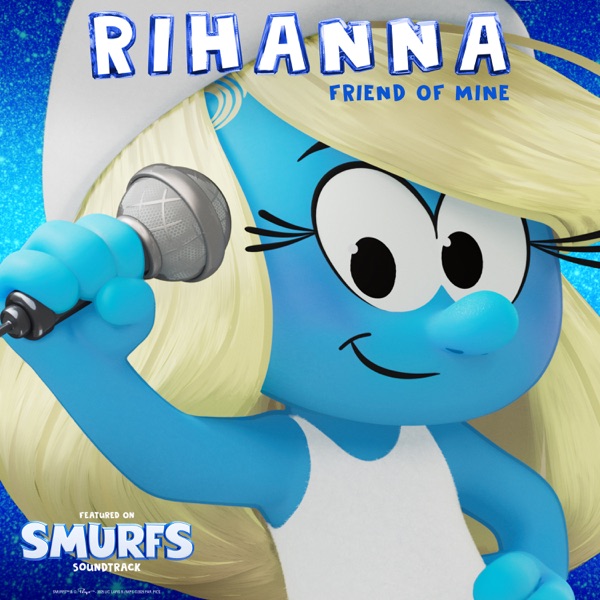
Released on May 16, 2025, as the second single from the soundtrack to the animated film Smurfs, in which she voices the character Smurfette
, the track arrived not with the weight of a long-awaited solo album, but with something more disarming: a club-floor refrain built for maximum spatial diffusion and minimum lyrical overhead. Produced at a Hamptons writing camp by Jon Bellion, Pete Nappi, and Fallen, it is a meticulous reduction — melody stripped to vocal loop, groove elevated to architecture. Whether that economy constitutes artistic intent or a product limitation is the real question this release forces.
Album Credits
| Artist | Rihanna |
| Released | May 16, 2025 |
| Genre | R&B / Dance-Pop |
| Label | Roc Nation Distribution |
| Producer(s) | Jon Bellion, Pete Nappi, Fallen (Beautiful Mind Projects) |
| Writers | Rihanna, Jon Bellion, Pete Nappi, Fallen, Elijah Noll, Elkan, Tenroc |
| Tracks | 1 (single; part of 14-track Smurfs Movie Soundtrack) |
| Lead Single(s) | “Friend of Mine” — 2nd single from the Smurfs soundtrack |
Performance Snapshot
| Global Listeners | 69,647 |
| Total Scrobbles | 273,033 |
| Countries Charting | 43 |
| Strongest Market | United States — 197,295 listeners |
| Top 3 Markets | United States · Brazil · United Kingdom |
Production Architecture: Four Chords, One Loop, Zero Filler
The track was produced by Fallen, Jon Bellion, and Pete Nappi
, all operating under
Beautiful Mind Projects, Bellion’s management, publishing, and label company.
That institutional context matters. Beautiful Mind is less a traditional label structure than a creative compound — the kind of organization where production decisions carry collective ethos rather than isolated A&R directives. The result, on “Friend of Mine,” is a track whose construction feels unusually coherent for a soundtrack commission.
Unlike the superstar’s previous soundtrack work for films like Black Panther: Wakanda Forever and Home, which tended to veer toward sweeping pop balladry, “Friend of Mine” is a thumping club track, with Rihanna’s voice positioned as an elliptical refrain over a house beat.
The rhythmic chassis is built on a four-on-the-floor kick locked tightly against an offbeat hi-hat pattern that invites the kind of open-floor movement you get in European club architecture — Ibiza-adjacent but not sonically derivative of any single scene. The harmonic palette is strikingly compact:
Bellion noted that “you don’t get such major chords and such a positive message over a dance record” very often
, and that observation holds structurally. The tonal center stays relatively static, favoring resolution over tension. There is no conventional bridge, no modulation into a key change for emotional escalation. The track earns its momentum through rhythmic density and incremental textural layering rather than harmonic movement.
The song was created in the summer of 2024, during one of Jon Bellion’s writing camps at his vacation home in the Hamptons.
Fallen worked with Bellion on the production for about three days, only focusing on “refining and dialing it in.”
That compressed timeline is audible in the finished product — not as roughness, but as a kind of deliberate restraint. Every production element feels placed rather than accumulated.
Bellion himself described the song as “raw,” noting Rihanna “didn’t really mix it further than the two track that we sent out.”
What reads in promotional language as spontaneous authenticity is, structurally, a master class in knowing when to stop processing. The sidechain compression between the kick and the bass stays perceptibly light, preserving air in the low register instead of manufacturing the over-pumped dynamic that dominated Anglophone dance-pop through the mid-2010s. Compared to the maximalist frequency war of something like FLO’s AAA, the mix on “Friend of Mine” feels like a deliberate step toward analog restraint — even if it is entirely digital in execution.
Songwriting and Vocal Strategy: The Refrain as Statement
The writing credit on “Friend of Mine” runs to seven names —
Rihanna, Jon Bellion, Pete Nappi, Fallen, Elijah Noll, Elkan, and Tenroc all receive co-writing credits.
For a track with what critics noted is
“when you get to the number of writers credited on the record, you might start to get a little confused — after all, it’s what, five or six original lines max?”
That ratio — seven writers to perhaps thirty distinct words — is not a scandal but a diagnostic. The song is structured around gesture rather than narrative. Its lyrical function is closer to chant than verse-chorus architecture: a recurring phrase designed for spatial diffusion, optimized for environments where clarity of meaning matters less than sonic imprinting.
Rihanna’s vocal delivery operates in a register she has rarely used this openly.
Her voice is auto-tuned to give a kind of electronic sound that matches the psychedelic character of the song.
The pitch correction here is not corrective but textural — a choice to blur the organic-synthetic boundary rather than conceal a tuning limitation.
The signature Rihanna vocals emerge more recognizably toward the end, when she vocalizes certain notes
in a way that sounds less like a performance and more like a signature. That restraint, placed late in the track, functions as a reveal rather than a centerpiece — the listener earns it rather than receiving it upfront.
Craig Jenkins of Vulture observed that the track “reaches that simplicity and repeated phrasing and melody” that earns playroom replay, “but gets there peeling through American ballroom and European club music,” and that “you can read it as a wholesome word on fast friendship or an ode to a party encounter” — like “‘Higher Love,’ ‘Friend of Mine’ is catchy enough for the kids but makes sure to wink to Mom and Dad in the back of the room.”
That dual-register legibility is architecturally intentional. The lyrical ambiguity — the déjà vu of instant connection, the warmth of a stranger who already feels familiar — maps cleanly onto both children’s-movie themes of belonging and the adult club experience of finding unexpected intimacy on a dance floor. Bellion articulated the strategic upside of that crossover directly:
from a product standpoint, the major chords and positive message over a dance record is a combination that “doesn’t sound like a kids movie too often.”
What the songwriting does not do is extend metaphor, complicate its central image, or develop across the track’s runtime. The refrain appears early, repeats frequently, and exits without transformation.
Considering that Rihanna’s output has been scant since her 2016 album ANTI
, the audience’s appetite for any vocal presence from her amplifies even minimal lyrical content — a fact the production team clearly understood and calibrated around.
Market Note: Soundtrack IP as Re-Entry Vehicle
The strategic positioning of “Friend of Mine” as a soundtrack single rather than a standalone album cut is a deliberate demand-driver calibration.
The track precedes the full Smurfs soundtrack released through Roc Nation Distribution, positioning Rihanna’s return as embedded within a pre-existing IP framework
— the Smurfs franchise — that carries multigenerational recognition. This reduces the reputational risk of a first post-ANTI release: the album’s commercial fate is not entirely dependent on the single’s chart performance. Chart results bear that out:
the track reached No. 1 on Billboard’s Dance Digital Song Sales chart, marking the third time Rihanna has claimed the crown on that tally.
It also debuted at No. 3 on the Billboard Hot Dance/Electronic Pop Songs chart — her highest-ever ranking on that tally.
While it didn’t reach the Hot 100, it topped the Bubbling Under Hot 100 list.
With 43 charting countries and 273,033 total scrobbles on Last.fm from just 69,647 global listeners, the play-to-listener ratio signals above-average catalog engagement: fans are returning to the track repeatedly, not just sampling it once. That kind of depth suggests genuine sync potential and catalog longevity well beyond the theatrical window of the Smurfs film.
Listen with 30-sec previews
Previews served by iTunes. Press play on any track.
Similar albums






Released the same week
Other albums released near this date, across years.