
Listen / Follow
Tags
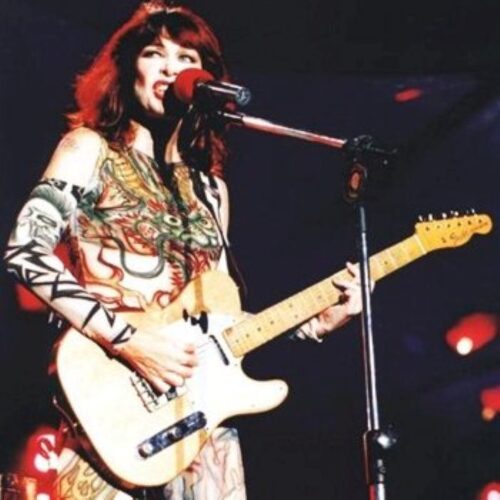
About Rita Lee
Rita Lee Jones de Carvalho was born in São Paulo, Brazil, on 31 December 1947, and passed away in her hometown on 8 May 2023. Best known as Rita Lee, she was a Brazilian MPB singer, composer, multi-instrumentalist, actress, writer, TV host and animals rights activist of American and Italian descent, being regarded as the "Queen of Brazilian Rock". Rita helped to incorporate the rock revolution into the creative explosion of tropicalismo, formed the most celebrated Brazilian rock band in the world
Rita Lee: The São Paulo Signal That Rewired Brazilian Rock
Rita Lee, the Brazilian singer-songwriter and multi-instrumentalist born in São Paulo on 31 December 1947, remains the defining architect of Brazilian rock — an artist whose catalog moved more than 55 million units worldwide.
She rose to national prominence as vocalist and multi-instrumentalist for the tropicalist group Os Mutantes,
before carving a solo arc that redefined what popular music could mean in Portuguese. Her work traversed glam rock, blues-inflected boogie, synth-pop, and irreverent MPB with a compositional intelligence that never settled into formula. She passed away in São Paulo on 8 May 2023, at the age of 75, leaving behind one of the most consequential catalogs in Latin American music history.
Artist Profile
| Origin | São Paulo, Brazil |
| Years Active | 1966–2023 |
| Genre | Brazilian Rock, MPB, Glam Rock, Pop |
| Labels | Philips · Phonogram · Polydor · Som Livre · EMI · Universal Music · Deckdisc · Biscoito Fino |
| Notable Collaborators | Roberto de Carvalho · Gilberto Gil · Arnaldo Baptista · Sérgio Dias Baptista · Andy Mills (producer) · Tutti Frutti |
| Notable Awards | Latin Grammy Award, Best Rock Album — 3001 (2001) · Sharp Music Award for Lifetime Achievement (1997) · Latin Recording Academy Musical Excellence Award (2022) |
| Brazilian Certifications | “Lança Perfume” — 2× Platinum (Pro-Música Brasil, 1,000,000 units) |
| Studio Albums in Catalog | 22 studio albums · 7 live albums · 8 compilation albums |
Performance Snapshot — Get Music Catalog
| Total Listeners | 181,720 |
| Country Reach | 2 countries |
| Albums in Catalog | 1 (Reza, 2012) |
| Top Market | Brazil · Portugal |
From Tropicália to Tutti Frutti: Building the Foundation
Born and raised in São Paulo, she began her musical career in 1963 with Tulio’s Trio and later the Teenage Singers, which evolved into Os Seis.
In a city already crackling with post-bossa nova energy and absorbing the noise of British Invasion records, the teenage Rita Lee chose percussion over debutante balls —
in place of the traditional adolescent debut ball, she asked for a drum set.
That early insistence on instrument over ornament signals something essential about her sensibility: she built her art from the inside out.
She co-founded Os Mutantes in 1966 with brothers Arnaldo and Sérgio Baptista. This groundbreaking trio quickly became a cornerstone of the Tropicália movement, a cultural phenomenon that blended traditional Brazilian music with international pop, rock, and avant-garde elements.
The band’s studio method — theremins colliding with berimbaus, electric fuzz draped over samba rhythms, lyrical absurdism that confounded military censors — was not mere eclecticism. It was a principled aesthetic program, and Rita Lee was one of its chief architects. Her vocal delivery, playful in timbre but precise in intonation, gave Os Mutantes their emotional center of gravity even as the arrangements spun outward into psychedelic free-fall.
She left Os Mutantes in 1972, and
between 1973 and 1978, with leading guitarist Luís Sérgio Carlini, the band Tutti Frutti accompanied Rita Lee in her shows after she had left Os Mutantes.
This transition marked a compositional maturation: the experimental impulse of the Mutantes years was channeled into more direct, commercially viable rock architecture, while retaining the wit and subversive edge that had always been Lee’s signature. The guitar tones grew harder, the rhythmic pocket tighter, and Lee’s voice — already distinctive in its mid-range clarity — began to operate as a hook-delivery system of exceptional efficiency.
Throughout the 1970s she performed solo backed by a band called Tutti Frutti.
The partnership was productive and generative, culminating in the record that would define her commercial identity.
Discography Highlights: The Albums That Built a Canon
Solo stardom came with the album Fruto Proibido (Forbidden Fruit) (1975), recorded with the band Tutti Frutti and regarded as a landmark of Brazilian rock.
Produced by Andy Mills at Eldorado Studios in São Paulo, the record fused glam rock textures with blues-rock drive — a combination that felt genuinely new in the Brazilian context.
Lee’s fourth studio album, Fruto Proibido, peaked at number seven on the IBOPE albums chart and sold 700,000 copies. It became the best-selling album by a woman in Brazil that year and was the first Brazilian rock release to achieve high sales, helping to popularize the genre in the country.
That last point carries enormous historical weight: before Fruto Proibido, Brazilian rock was largely a critical conversation; after it, it was a commercial reality.
The Gilberto Gil collaboration Refestança (EMI, 1977), produced by Guto Graça Mello, demonstrated Lee’s willingness to work across tropicália’s internal divides, pairing her stadium-facing hard rock instincts with Gil’s increasingly melodic sensibility. Then came the era that would cement her commercial dominance.
In 1979, she released the LP Rita Lee — which included classics such as “Mania de Você,” “Lança Perfume,” and “Caso Sério” — in collaboration with her husband, the multi-instrumentalist Roberto de Carvalho, in an artistic partnership that continued into the 1980s with a long list of radio hits and massive concerts.
“Lança Perfume” in particular became a cultural artifact,
charting number one on the Brazilian Albums (Pro-Música Brasil) chart in 1981
and
earning 2× Platinum certification in Brazil for one million units.
Rita Lee e Roberto de Carvalho (1982) became one of the best-selling albums in Brazilian music history.
In 2012, she had her comeback with the album Reza, a major commercial success.
Available now in the Get Music catalog at https://getmusic.com.tr/album/reza/, Reza was
her last album of original studio recordings, and her first work of new material in nine years.
Co-written and co-produced with Roberto de Carvalho, the record was nominated for a Latin Grammy in the Best Contemporary Pop Album in Portuguese category in 2012. The title track, which Lee described as a protective prayer against envy and ill will, carried both autobiographical and structural weight — its modal melody and unhurried arrangement standing in deliberate contrast to the compressed tempos of contemporary pop production.
The album was also nominated at the MTV Video Music Awards Brasil 2012 for Best Female Artist and Song of the Year.
Market Note
With over 55 million units sold worldwide, Lee is the most successful Brazilian female artist of all time in record sales.
That figure translates into IP strength of the highest order within the Lusophone market, with catalog longevity underpinned by decades of radio rotation, TV exposure, and generational loyalty.
Lee’s visibility increased through year-end TV specials on TV Globo
— a distribution channel that functioned as a pre-streaming velocity mechanism, embedding her songs in the cultural memory of multiple Brazilian generations. Her repertoire carries substantial sync potential: tracks like “Lança Perfume” and “Baila Comigo” occupy the same kind of instantly recognizable, genre-flexible territory as canonical Anglo-American pop-rock from the same era. The A&R angle here is straightforward — her back catalog, held across Philips, EMI, Universal, and Biscoito Fino, represents a licensing portfolio with strong documentary, advertising, and streaming placement value. Fan base demography skews 35–65 in Brazil and Portugal, with growing secondary interest from Latin alternative audiences who discovered her through Os Mutantes reappraisals in the late 2000s.
Geographic Reception and Cultural Reach
Rita Lee’s audience was, for most of her career, principally Brazilian — but the depth and durability of that domestic presence is remarkable by any comparative standard.
She is one of the highest-selling Latin music artists of all time, and a pioneer of large-scale national tours, becoming the first Brazilian artist to tour gymnasiums and stadiums.
That infrastructure-building role was not merely logistical. By demonstrating that Portuguese-language rock could fill arenas, she created the commercial template that every subsequent Brazilian rock act inherited. Without Lee’s 1970s and 1980s touring work, the trajectory of Titãs, Paralamas do Sucesso, and Legião Urbana — the bands that would define the following decade — looks significantly different.
Her 1995 opening slot for the Rolling Stones’ Brazilian tour placed her in direct dialogue with the Anglo-American rock lineage she had always engaged with on her own terms. The symbolism was precise: Lee had spent three decades absorbing and reprocessing the British Invasion’s formal vocabulary — the power chord, the blues-inflected pentatonic phrase, the stadium-ready chorus — and returning it to the stage as something unmistakably Brazilian.
TV Globo specials throughout the early 1980s
extended her reach beyond concert-going demographics into every household with a television, functioning as a cultural force multiplier that no single record could replicate.
Outside Brazil, her reception followed two distinct vectors. In Portugal, the shared language created a natural market for her pop output; her 1980 self-titled album charted at number ten in Belgium and France, indicating that her appeal was not purely rooted in Lusophone cultural specificity but in the pop craftsmanship of the Roberto de Carvalho collaborations. Internationally, the Os Mutantes association brought her to the attention of the post-punk and indie scenes in the late 1990s and early 2000s, when critics and labels began systematically reappraising the Tropicália archive. David Byrne’s Luaka Bop compilations and Kurt Cobain’s public advocacy for Os Mutantes created a critical infrastructure for Lee’s early work that she had never fully accessed during its original release window.
Lee remains a major influence on multiple generations of artists, particularly women,
a fact that has expanded her geographic footprint well beyond what her original chart performance in any single territory would suggest.
Critical Legacy: The Honest Accounting
Assessing Rita Lee’s critical standing requires holding two different reception histories in mind simultaneously. Within Brazil, her reputation has been effectively uncontested since the mid-1980s — she is the “Rainha do Rock Brasileiro” (Queen of Brazilian Rock), a title that functions less as honorific than as structural description. The term acknowledges something real: she occupied a position in Brazilian rock that had no clear precedent and has had no true successor.
Known for her irreverent lyrics, experimental sound, and fearless personality, Rita Lee transformed from a psychedelic pioneer with Os Mutantes into the undisputed “Queen of Brazilian Rock,” leaving an indelible mark on the nation’s cultural identity.
The more interesting critical question concerns which part of her catalog receives the emphasis. Academic and critical discourse has tended to privilege the Os Mutantes period and Fruto Proibido — the records that fit most comfortably into a narrative of rock’s global counterculture moment. The commercial peak of 1979–1983, when she and Roberto de Carvalho were producing some of the most sophisticated pop-rock the Brazilian market had ever heard, has been somewhat undervalued by the same critical framework that rewards formal rupture over formal mastery. This is a familiar problem in rock historiography: the avant-garde is legible as art, the pop hits as entertainment. Lee’s actual achievement sits in the refusal of that distinction.
She staged a comeback in 2001 with the release of 3001, an album that earned her the Latin Grammy Award for Best Rock Album in 2001.
Diagnosed with lung cancer in 2021, she was honored with a Latin Grammy Lifetime Achievement Award
— subsequently confirmed as the Latin Recording Academy Musical Excellence Award in 2022 — a recognition that arrived while she was still alive to receive it, and that the Academy clearly intended as a definitive statement on her place in the canon.
She received five additional nominations to that prize over the course of her career.
Her production choices across five decades are worth examining on their own technical terms. The glam-rock arrangements of the Tutti Frutti period — full rhythm section, clean lead guitar, double-tracked vocals — gave way in the 1980s to a denser pop-rock palette in which Roberto de Carvalho’s multi-instrumental role allowed for tighter control over tonal texture. The keyboards on the 1980 and 1982 records occupy the high-mid register with deliberate precision, leaving the low-mid space for rhythm guitar — a frequency division that contributed to the clarity of those records on radio, which was still the primary delivery format. By Reza in 2012, the production had loosened somewhat, favoring a warmer, more analog-adjacent texture that suited the reflective quality of the songwriting. The album read less as a bid for chart placement than as a statement of artistic continuity — a record made on her terms, by an artist who had long since earned the right to set them.
What remains most striking, surveying the full arc, is the consistency of her compositional identity across wildly different production contexts. The interval choices, the melodic phrase lengths, the way her vocal lines tend to resolve a beat earlier than expected — these are the fingerprints of a specific musical intelligence, not a performer adapting to trend cycles. That identity is what has allowed her catalog to retain its coherence across more than five decades and across the full range of formats from vinyl to streaming.
In total, forty albums — six with Os Mutantes and thirty-four across her solo career
— constitute a body of work with few analogues in Latin American popular music.
Frequently Asked Questions
Where should I start with Rita Lee’s catalog?
The most efficient entry point is Reza (2012), her final studio album and one of the most focused statements of her mature voice — available directly in the Get Music catalog. For historical context, Fruto Proibido (1975) is the structural starting point for her solo career: the record that established Brazilian rock as a commercially viable form. From there, the 1979–1982 trilogy — Rita Lee (1979), Rita Lee (1980), and Rita Lee e Roberto de Carvalho (1982) — maps the commercial peak. Those arriving via Os Mutantes should move from the band’s 1968–1972 catalog directly into Fruto Proibido to understand the continuity of her compositional sensibility.
Is Rita Lee still active?
Rita Lee passed away on 8 May 2023, in São Paulo, at the age of 75, following a lung cancer diagnosis in 2021. Her final studio album, Reza, was released in 2012. In the intervening years she remained a cultural presence through interviews, her autobiography (published in 2016), and the posthumous appreciation that has only grown since her death.
The UBC (Brazilian Music Union) awarded a posthumous lifetime achievement prize to Rita Lee and Roberto de Carvalho in 2024,
confirming that the institutional recognition of her legacy continues to expand.
Who has Rita Lee collaborated with?
Ex-Mutantes vocalist Rita Lee and tropicália legend Gilberto Gil performed together live on Refestança (EMI, 1977), mixing their two bands and their material.
Her most sustained and consequential collaboration was with multi-instrumentalist Roberto de Carvalho,
with whom she co-wrote much of her repertoire
across more than three decades and whom she married in 1996. Earlier in her career she worked with the Tutti Frutti ensemble, with producer Andy Mills on Fruto Proibido, and with her Os Mutantes bandmates Arnaldo and Sérgio Dias Baptista, whose contributions to the Tropicália project were inseparable from her own early artistic formation.
Which artists are similar to Rita Lee?
Artists operating in adjacent creative territory include Gilberto Gil (shared tropicália roots and a parallel commitment to formal evolution over decades), Caetano Veloso (whose Tropicália-era experiments share a common intellectual DNA with Os Mutantes), and, within the Brazilian rock scene Lee helped build, Titãs and Paralamas do Sucesso. Internationally, her mid-period rock-pop output shares production sensibility with contemporaries like Stevie Nicks and Chrissie Hynde — artists who combined structural command with a strong individual vocal identity in a format that was nominally commercial but compositionally distinctive. For listeners approaching from the psychedelic end, the Os Mutantes catalog itself remains the most direct parallel text. Explore the full Rita Lee artist page at https://getmusic.com.tr/artist/rita-lee/.
Setenay Mira Kaya — Girls Choice Music · setenaymirakaya.com.tr
Published: October 8, 2026
Follow the channel on Telegram for new releases, editorial picks, and catalog discoveries: t.me/ViralSubmissions
1 album in our catalog
All releases
Complete release history from MusicBrainz — albums, EPs, singles, live, and more.
Album (23)
- 2015Rock Your Babies
- 2012Reza
- 2003Balacobaco
- 2001Aqui, ali, em qualquer lugar
- 20003001
- 1998Santa Rita de Sampa
- 1993Rita Lee
- 1990Rita Lee e Roberto de Carvalho
- 1988Zona zen
- 1987Flerte fatal
- 1985Rita e Roberto
- 1983Bombom
- 1983Baila Conmigo
- 1982Rita Lee & Roberto de Carvalho
- 1981Saúde
- 1980Rita Lee
- 1979Rita Lee
- 1978Babilônia
- 1976Entradas e bandeiras
- 1975Fruto proibido
- 1974Atrás do porto tem uma cidade
- 1972Hoje é o primeiro dia do resto da sua vida
- 1970Build Up
Album (Compilation) (2)
- 1994Lança perfume e outras manias
- 1988Grandes sucessos de Rita Lee e Roberto