
About Peter, Paul & Mary
One of the best of the Folk era groups...They were liberal leftist in message, however the music was universal. They had many hit records and continued to tour for many years into the modern era. The recent death of Mary has ended the group, but their music will remain as their legacy.
Peter, Paul & Mary: Three Voices, One Movement, and the Weight of a Decade
Peter, Paul & Mary — the New York folk trio who defined the American folk revival — built a catalog of uncommon social weight across more than four decades of recorded music.
Formed in New York City in 1961 during the American folk music revival
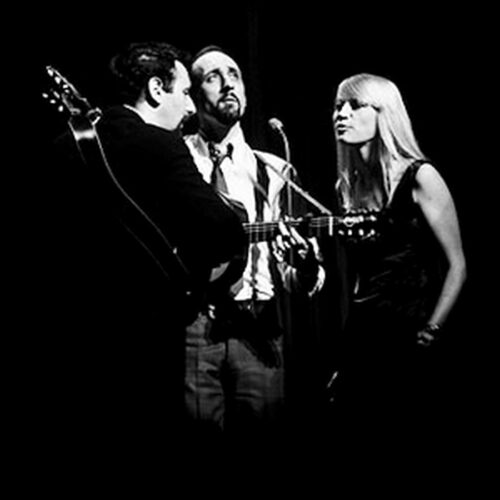
, they never mistook accessibility for compromise. Their three-part harmony was the delivery mechanism for some of the most politically loaded music the mainstream American charts ever absorbed. The machinery of that sound — two acoustic guitars, three voices in close register — was deceptively simple. What it carried was not.
Artist Profile
| Origin | Greenwich Village, New York City, USA |
| Years Active | 1961–1970; 1972; 1978; 1981–2009 |
| Genre | Folk, Contemporary Folk, Folk Pop |
| Labels | Warner Bros. Records; Gold Castle; Rhino/Warner Bros. |
| Members | Peter Yarrow (guitar, tenor vocals); Noel “Paul” Stookey (guitar, baritone vocals); Mary Travers (contralto vocals) |
| Notable Collaborators | Bob Dylan, Pete Seeger, Albert Grossman (manager), John Denver |
| Grammy Awards | 5 Grammy Awards (1962–1969) |
| RIAA Certifications | 2× Platinum (debut LP); Platinum (Album 1700); Gold ((Moving), In the Wind, A Song Will Rise, See What Tomorrow Brings, Peter, Paul and Mommy); 8 Gold + 5 Platinum total across catalog |
| Albums in Catalog | 7 studio albums; 8 live albums; 13 compilation albums; 2 children’s albums |
Performance Snapshot
| Albums in Get Music Catalog | 1 |
| Top Markets | United States, Canada, United Kingdom, Germany, Australia |
| Chart Legacy | 12 Billboard Top 40 singles; 5 albums in the Billboard 200 Top 10; 3 albums simultaneously in the Top 6 (1963) |
| Total Units Sold | More than 8 million albums (US catalog) |
Greenwich Village to the National Mall: Formation and the Sound That Stuck
Manager Albert Grossman created Peter, Paul and Mary in 1961 after auditioning several singers in the New York folk scene — including Dave Van Ronk, who was rejected as too idiosyncratic and uncommercial — eventually booking the rehearsed trio into The Bitter End, a coffeehouse and popular folk music venue in New York City’s Greenwich Village.
The audacity of the project was structural from the start: Grossman wasn’t looking for a commune of committed revivalists. He wanted something commercially viable that could carry the weight of the protest tradition without alienating mainstream radio.
The trio consisted of Peter Yarrow on guitar with tenor vocals, Paul Stookey on guitar with baritone vocals, and Mary Travers delivering contralto vocals.
Those three registers — stacked in close harmony, rarely straying into ornament — produced a blend that sounded inevitable in retrospect and was, in fact, methodically constructed.
They spent the next seven months rehearsing eighteen songs
before playing a single public date. There was nothing spontaneous about it, which made the spontaneity of the finished product all the more useful as mythology.
The group’s name and music came to the attention of Warner Bros. Records, and in early 1962 they recorded the single “Lemon Tree,” which charted on May 5, 1962, reaching number 35.
A modest beginning. What followed was anything but.
The new trio scored instant success with its self-titled 1962 debut album, which featured such popular tunes as “Lemon Tree,” “500 Miles,” and Pete Seeger’s “If I Had a Hammer,” and spent ten months in Billboard’s Top Ten.
They followed up quickly with the Seeger/Lee Hayes-penned protest anthem “If I Had a Hammer,” which won them two Grammy Awards in 1962 for best folk recording and best performance by a vocal group; they were also nominated for best new artist that year.
The velocity of that ascent — from first rehearsal to Grammy-nominated act in under two years — had as much to do with Grossman’s curation as with any individual talent, though Travers’s contralto was never merely a commercial instrument. It had grain. It had authority. It did not soften the material it delivered.
Peter Yarrow, Noel Paul Stookey, and Mary Travers came up through the same Greenwich Village folk scene that spawned Dylan, Phil Ochs, and Dave Van Ronk, and didn’t allow commercial considerations to stop them from being active on behalf of a variety of sociopolitical causes.
That dual positioning — commercially structured but politically serious — was precisely the tension that made them interesting and, to some purists, suspicious.
The Catalog: A Decade of Recorded Conviction
The self-titled Peter, Paul and Mary (1962) held the number 1 position for six consecutive weeks in fall 1962 and returned to number 1 on October 26, 1963. It was certified double platinum by the RIAA in February 2001 for U.S. sales exceeding 2 million units.
For a debut, that is a statement of demand rather than a lucky opening. The album’s production — credited to Milt Okun — kept the arrangements minimal: acoustic guitar, upright bass, voices. No studio lacquer. The decision aged better than almost anything else released in the same commercial register that year.
Their second album, (Moving), was released in January 1963 and peaked at number 2 on the Billboard 200, receiving RIAA Gold certification. Their third studio album, In the Wind (October 1963), reached number 1 on the Billboard 200 and earned RIAA Gold certification as well.
Three albums in under two years, each chart-performing at the top of the Billboard 200 — a pace that no contemporary folk act has since replicated. In the Wind also contained their cover of Bob Dylan’s “Don’t Think Twice, It’s All Right,” continuing the group’s role as the primary conduit between Dylan’s writing and the American mainstream.
They picked up two more Grammys the following year in the same categories for their cover of Bob Dylan’s “Blowin’ in the Wind,” and a fifth one in 1969 for the Peter, Paul and Mommy LP.
That children’s record now available in our catalog as the 2004 documentary and retrospective release Carry It On — serves as an artifact of the group’s range: they could write and perform for children without condescending to them, a skill that most adult-market folk acts lack entirely.
The 1967 album Album 1700 reached number 15 on the Billboard 200 and earned RIAA Platinum certification.
By that point the group was operating in a somewhat altered cultural landscape — rock’s psychedelic turn had shifted the mainstream’s center of gravity — but their catalog had enough institutional weight to keep them relevant.
The group scored their highest-charting hit, and only number 1 single, in 1969 with the John Denver-penned “Leavin’ On a Jet Plane.”
It was an unexpected commercial peak so late in the decade, and the irony is that the song was not a protest piece at all — just a clean, elegiac departure narrative that the trio’s harmonic precision made indelible.
They released three multi-platinum or platinum albums and six gold albums on Warner Bros.
That is a catalog profile — across studio, live, and children’s releases — that few acts from any genre of the 1960s can match in sustained commercial consistency.
Market Note
Peter, Paul & Mary’s IP profile is among the most durable in the American folk catalog. Their recordings retain substantial sync potential across documentary, political campaign, and prestige drama contexts — “Blowin’ in the Wind” and “If I Had a Hammer” in particular are licensed perennially for civil rights retrospectives and educational content. The Warner Bros. catalog ownership means institutional archival stability; the Rhino imprint has maintained compilation quality at the premium tier.
Their debut album, Peter, Paul and Mary (1962), topped the Billboard 200 for seven weeks and achieved twelve Billboard Top 40 singles, six of which reached the Top 10.
That level of chart penetration, achieved on acoustic folk material before the album-rock era fully consolidated, speaks to a demand profile that is structural rather than seasonal.
Fan demography skews toward the 55–75 age bracket in North America, with secondary streaming interest from younger listeners discovering the catalog through social context (protest cycles, folk revival micro-trends). Catalog longevity is high; streaming velocity is modest but stable.
The Movement Was the Market: Cultural Reach and Geographic Reception
The American folk revival was, structurally, a New York City phenomenon with national distribution. Its coffeehouses were Greenwich Village; its labels were Manhattan; its ideological infrastructure was rooted in the urban left. Peter, Paul & Mary were its most commercially successful export to the American heartland, which is worth sitting with for a moment. They made protest music that charted in states where protest was not especially welcome. That is not a small achievement.
They were early champions of Bob Dylan and performed his “Blowin’ in the Wind” at the August 1963 March on Washington.
That performance — in front of an audience that would hear Martin Luther King Jr.’s “I Have a Dream” speech hours later — is one of the defining moments in the intersection of recorded music and civic action in the twentieth century. The trio did not stumble into that moment. They were politically deliberate at a time when political deliberation carried material risk for mainstream entertainers.
At one point in 1963, three of their albums were in the top six Billboard best-selling LPs as they became the biggest stars of the folk revival movement.
That is a market saturation figure that even rock acts of the era rarely achieved. It indicates an audience that was buying albums as cultural objects — as statements of alignment — rather than merely consuming singles.
They were vehement in their opposition to the Vietnam War, managing to stay true to their liberal beliefs while creating music that resonated in the American mainstream.
The geographic reception of that positioning was uneven in the short term and vindicating in the long term. Markets in the Northeast and West Coast embraced them immediately; the South and Midwest received them more tentatively. By the late 1960s, the catalog had crossed most of those fault lines.
In the United Kingdom,
the debut album charted at number 18 on the UK Albums Chart
, a respectable showing for an American folk act with no prior British touring profile. Their cultural influence in Canada was stronger, reflecting that country’s own folk tradition and proximity to the American protest milieu. Germany and the Benelux markets absorbed the catalog through the late 1960s Warner Bros. European distribution network, and the group maintained a loyal audience there through subsequent reunion cycles.
They remained politically active as well, performing in 1995 on the anniversary of the Kent State shootings and performing for California strawberry pickers.
Their audience, in other words, aged with them and expected them to keep showing up for causes. That is a specific kind of artist–audience covenant, and it held for nearly half a century.
Critical Legacy: What the Record Actually Shows
The standard critical objection to Peter, Paul & Mary has always been the same: too smooth, too managed, too palatably arranged to qualify as authentic folk.
While that success led some to dismiss them as overly smooth and lacking in folk “authenticity,” it’s inarguable that the enduringly popular threesome — who remained a popular attraction for nearly half a century — were instrumental in popularizing the form, and in exposing the songs of Bob Dylan and other folk luminaries to mainstream listeners.
The authenticity critique is worth examining briefly, because it contains a class assumption: that the urban, well-rehearsed, management-assembled folk group is somehow less legitimate than the self-taught rural traditionalist. That is a romantic distinction that the history of recorded music has largely failed to sustain.
What Yarrow, Stookey, and Travers actually did was technically sophisticated. The three-part harmonic arrangements — Travers’s contralto anchoring the low end, Yarrow’s tenor pushing the melodic line, Stookey’s baritone providing the harmonic fill — required precise intonation in live performance contexts. They delivered it consistently for decades. The production choices on the early Warner Bros. albums, while clean and accessible, were never artificially sweetened in the manner of the pop-folk crossover acts that followed them. There is no strings section on the debut. No background vocalists. The minimalism was intentional and it was structural to the aesthetic.
The group were inducted into the Vocal Group Hall of Fame in 1999, and received the Sammy Cahn Lifetime Achievement Award from the Songwriters Hall of Fame in 2006.
The critical community, which occasionally dismissed them in the 1960s as the commercial face of a movement, has largely revised that assessment in retrospect. The catalog evidence supports the revision.
Their relationship with Bob Dylan’s songbook was not parasitic — it was curatorial at a moment when Dylan’s recordings were still too idiosyncratic for mainstream radio.
“Blowin’ in the Wind” moved them into the top five and collected Grammys for best pop vocal group and best folk record.
Without that cover — and the trio’s subsequent advocacy for Dylan within the industry they had access to — the timeline of Dylan’s mainstream recognition almost certainly looks different.
In the 2004 documentary Peter, Paul & Mary: Carry It On — A Musical Legacy, members of the Weavers discuss how Peter, Paul and Mary took over the torch of social commentary in folk music in the 1960s.
That lineage — Guthrie to Seeger to the Weavers to Peter, Paul & Mary — is the through-line of the American protest folk tradition, and the group sit squarely within it rather than adjacent to it.
Mary Travers died at age 72 after a battle with leukemia
in September 2009, ending the trio’s active configuration.
Following Travers’s death, Yarrow and Stookey continued to perform as a duo. Yarrow died in 2025, leaving Stookey the sole surviving member of the group.
The group’s recorded legacy, however, has its own ongoing life — as archival documentation of the folk revival’s political conscience, as educational material, and as a body of harmonic arrangement that holds up to close listening without the assistance of nostalgia. The catalog’s survival is not sentimental. It earned it.
Frequently Asked Questions
Where should I start with Peter, Paul & Mary’s catalog?
The self-titled 1962 debut is the obvious entry point, and for good reason:
it went straight to number 1, remaining in the Billboard Top 10 for 10 months. Peter, Paul and Mary’s self-titled 1962 debut on Warner Bros.
remains the most complete single-album statement of their early aesthetic. From there, In the Wind (1963) covers the Dylan interpretations in depth. For career overview, the Carry It On retrospective available in our catalog gives the broader arc.
Is Peter, Paul & Mary still active?
No.
Mary Travers died at age 72 after a battle with leukemia
in September 2009, effectively ending the group.
Yarrow died in 2025, leaving Stookey the sole surviving member of the group.
The trio as a performing and recording unit ceased with Travers’s passing. Stookey has continued performing under his own name.
Who did Peter, Paul & Mary collaborate with?
Their most consequential collaborative relationship was with Bob Dylan — they shared manager Albert Grossman and were among the first artists to bring Dylan’s compositions to mainstream audiences.
The group’s repertoire included traditional songs, songs written by Yarrow and Stookey, early songs by Bob Dylan, and songs of other folk-revival musicians such as Pete Seeger.
John Denver’s “Leavin’ On a Jet Plane” became their only number 1 single, representing one of the more fruitful songwriter-interpreter relationships in the folk era.
Which artists sound similar to Peter, Paul & Mary?
Listeners drawn to the trio’s harmonic precision and protest sensibility will find natural points of comparison in the Kingston Trio, Joan Baez, and the early Simon & Garfunkel — all of whom operated within the same Greenwich Village–adjacent folk milieu of the early 1960s. For more on folk catalogs with similar lineage and political register, explore the Peter, Paul & Mary artist page on Get Music for further recommendations within the catalog.
Written by Ceren YALIN — Girls Choice Music Editorial, Get Music
Published: October 8, 2026
Got a release we should cover? Submit via Telegram: t.me/ViralSubmissions
1 album in our catalog
All releases
Complete release history from MusicBrainz — albums, EPs, singles, live, and more.
Album (19)
- 2018Blowin' in the Wind
- 2017Deep Water
- 2003In These Times
- 1999Songs of Conscience & Concern
- 1995LifeLines
- 1990Flowers and Stones
- 1988A Holiday Celebration
- 1986No Easy Walk to Freedom
- 1982Such Is Love
- 1978Reunion
- 1969Peter, Paul and Mommy
- 1968Late Again
- 1967Album 1700
- 1966The Peter, Paul and Mary Album
- 1965See What Tomorrow Brings
- 1965A Song Will Rise
- 1963In the Wind
- 1963(Moving)
- 1962Peter, Paul and Mary
Album (Compilation) (6)
- 1990The Very Best of Peter, Paul and Mary
- 1983Best Collection
- 1975Golden Star Portrait
- 1972The Most Beautiful Songs of Peter, Paul and Mary
- 1970Ten Years Together: The Best of Peter, Paul & Mary
- 1967The Best Of Peter, Paul And Mary