Listen / Follow
Tags
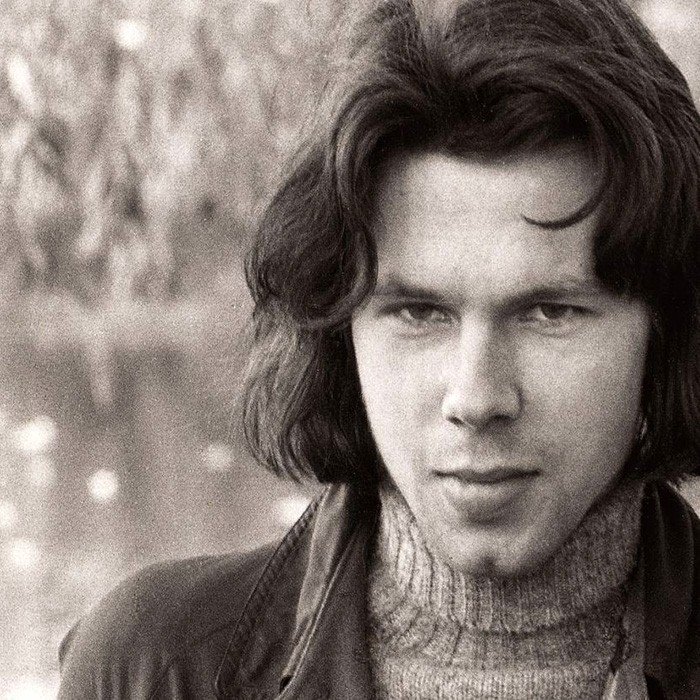
About Nick Drake
Nick Drake (Nicholas Rodney Drake, Yangon, Myanmar, June 19, 1948 - Tanworth-in-Arden, Warwickshire, England, November 25, 1974) was an English folk singer known for his gentle, enigmatic songs and his virtuosic right-hand finger picking technique. Although he recorded only three albums, critics and fellow musicians hold his work in very high esteem. Drake failed to find a wide audience during his lifetime and had a strong aversion to performing. Since his death, however, Drake's music has gained a significant cult following.
Nick Drake: Three Albums, No Audience, and the Longest Slow Burn in Folk History
Nick Drake, the English folk singer-songwriter born in Rangoon in 1948, built one of the most durable catalogs in post-war British music from just three studio albums recorded before his death at 26. In a career that produced no charting singles, no tour momentum, and a total indifference to self-promotion, Drake somehow became one of the most-cited influences in contemporary folk and indie songwriting — a reputation assembled entirely after the fact, through reissues, a Volkswagen advertisement, and the accumulated testimony of artists who found him years too late. That arc — invisibility in life, ubiquity in legacy — is not incidental to the music. It is inseparable from it.
Artist Profile
| Full Name | Nicholas Rodney Drake |
| Origin | Rangoon, Burma (now Yangon, Myanmar); raised in Tanworth-in-Arden, Warwickshire, England |
| Born / Died | June 19, 1948 — November 25, 1974 (age 26) |
| Years Active | 1968–1974 |
| Genre | Folk; Chamber Folk; Folk-Pop; Baroque Pop |
| Label | Island Records; Hannibal Records (posthumous); Universal Music Catalogue (posthumous) |
| Key Collaborators | Joe Boyd (producer), John Wood (engineer/producer), Robert Kirby (string arranger), John Cale, Richard Thompson, members of Fairport Convention |
| BPI Certifications | Five Leaves Left — Platinum (UK); Bryter Layter — Gold (UK); Way to Blue compilation — Gold (UK) |
| Albums in Catalog | 3 studio albums (1969–1972) |
Performance Snapshot
| Total Listeners (Get Music) | 141 |
| Countries Reached | 3 |
| Albums in Catalog | 1 (N. R. Drake, 69) |
| Top Markets | United Kingdom, Western Europe, North America |
The Shape of the Career: Cambridge, Island Records, and a Refusal to Perform
Nick Drake’s biography runs to barely six years of professional activity, and those six years contain less conventional career-building than most musicians manage in a single promotional cycle. He was at Cambridge University studying English literature when the American producer Joe Boyd — already running Witchseason Productions and overseeing Fairport Convention — heard him play and signed him immediately.
Drake’s debut album, Five Leaves Left, was recorded over the course of roughly a year and released on Island Records in July 1969.
The sessions took place at Sound Techniques in London
, a studio that would remain Drake’s primary recording home for all three albums.
The record arrived with almost no promotional infrastructure behind it, partly by design and partly by temperament.
Drake’s inherent shyness made him reluctant to be interviewed, and he cut an awkward figure when he performed live — often spending a long time tuning up his guitar and largely ignoring the audience.
Island’s promotional apparatus had no obvious strategy for an artist who declined interviews and abandoned mid-set. The album sold modestly and vanished from shelves without fanfare.
Boyd produced Drake’s first two albums, in 1969 and 1970.
For the second, Bryter Layter, the production approach shifted noticeably.
Drake was accompanied by musicians including members of Fairport Convention and John Cale of the Velvet Underground, as well as Beach Boys session musicians Mike Kowalski and Ed Carter.
According to arranger Robert Kirby, Drake had intended for the arrangements to evoke the Beach Boys’ Pet Sounds.
The resulting album is Drake’s most complex production — the one that sounds most like it belongs to a particular industry moment — and the one that sold worst on release.
The third album, Pink Moon, was the radical contraction. Recorded over two nights in late 1971 with only Drake and engineer John Wood in the studio, it was delivered to Island Records without announcement and
upon its completion Drake withdrew from both performance and recording, retreating to his parents’ home in rural Warwickshire, where he died on November 25, 1974, at the age of 26, from an overdose of antidepressants.
The posthumous story is, in many respects, longer and more eventful than the living one.
Discography Highlights: Three Records, Three Completely Different Propositions
Five Leaves Left (1969) is the album where Drake’s guitar technique is most legible as technique. The open and alternate tunings he favored — some so idiosyncratic that
arranger Robert Kirby had to sit with him and work through exactly how he played his chords, because Drake always detuned his guitar in strange, non-standard ways with very complicated fingerings
— produce a harmonic language that sits outside standard folk register. The string arrangements Kirby provided are chamber folk in the most precise sense: they reinforce without doubling, they add color without obscuring the tonal center.
Five Leaves Left has since been certified Platinum by the BPI in the UK.
Bryter Layter (1971) is the most contested entry in the catalog. Melody Maker’s contemporary review called it “an awkward mix of folk and cocktail jazz” — a description that is both accurate as a surface reading and completely wrong as an evaluation.
Drake tentatively agreed to Boyd’s suggestion to include bass and drum tracks and to experiment with a more pop or jazzy sound, which Boyd admitted he imagined would be “more commercial.”
Yet the album essentially retains Drake’s original acoustic style, anchored by Robert Kirby and John Wood’s spare engineering and production values.
The tension between the commercial ambition and the inward-facing songwriting is precisely what makes the record interesting fifty years on.
Bryter Layter has been certified Gold by the BPI.
Pink Moon (1972) needs no defense and, frankly, no explanation.
The third album was much stripped down from the previous two efforts, and as such had no string arrangements on it at all.
Eleven songs in under thirty minutes, guitar and voice, with a single piano overdub on the title track — it is the most concentrated distillation of Drake’s compositional logic, and the one that has proven hardest to locate in any specific scene or genealogy. The album did not chart on release. It has outsold everything that competed with it at the time.
All three of Drake’s studio albums, and the compilation Way to Blue: An Introduction to Nick Drake, have been certified Gold or above by the British Phonographic Industry.
Market Note
Nick Drake’s catalog presents an unusual IP profile: three studio albums of consistent quality, each with distinct sonic identity, and a posthumous commercial curve that has moved steadily upward for five decades without a new release of original material. The sync licensing potential is high and well-documented —
a 1999 Volkswagen advertisement featuring “Pink Moon” found Drake a wide audience decades after his death
,
sparking a resurgence of interest in his work and inspiring legions of young musicians.
That single placement effectively demonstrated the catalog’s extraordinary sync value: unobtrusive timbral richness, emotional restraint, and a production aesthetic that reads as “authentic” to contemporary ears conditioned by lo-fi and chamber folk. The fan base skews older but feeds continuously from younger listeners arriving through recommendations, film, television, and streaming algorithm discovery. Reissue and box set activity — most recently a 2025 expanded edition of Five Leaves Left — indicates active estate management and sustained label interest from Universal. Catalog longevity at this level, built on three records, is statistically rare.
Geographic Reception: Where the Audience Lives and Why It Took So Long to Arrive
Drake’s primary market during his lifetime was, in theory, the UK folk scene of the late 1960s and early 1970s — a scene centered on Island Records, the Fairport Convention milieu, and venues like Les Cousins in London’s Soho. In practice, he was peripheral to it. He shared a label with Traffic, Free, and Cat Stevens, none of whom had any difficulty filling rooms. Drake’s audience, such as it was, consisted largely of other musicians and a small group of committed listeners who had found the albums in specialist shops.
Drake’s music remained available through the mid-1970s
, sustained by Island’s catalog distribution, before posthumous reissues began the slow process of reassembly. The 1979 retrospective collection Fruit Tree — a four-LP box set released by Hannibal Records — was the first serious attempt to frame the catalog as a coherent artistic statement rather than a commercial afterthought. It found a readership in the UK and, crucially, in the United States, where the college radio ecosystem of the early 1980s proved receptive to introspective British folk with chamber production values.
The Volkswagen moment in 1999 was the inflection point.
“Pink Moon” found a wide audience thanks to that advertisement, sparking a revival in Drake’s entire body of work — music overlooked in his day, now inspiring legions of musicians.
The ad ran in the United States during the Academy Awards broadcast and introduced Drake’s name to an audience that had never encountered the albums.
Compilations of his music have since charted worldwide — including in the United Kingdom, Belgium, Ireland, and the United States — and rereleases of his singles have entered the UK Singles Chart.
That is a chart trajectory built entirely without the artist’s participation, on catalog over two decades old at the time.
The contemporary geography of Drake’s audience maps roughly onto the markets for artisanal folk and indie-adjacent songwriting: the UK, Germany, the Netherlands, France, Australia, and the American coastal cities. It is a listener profile characterized by high per-stream engagement and low skip rate — the catalog rewards close attention, and its audience tends to deliver it.
Brad Pitt is among the more publicly noted devotees, and hundreds of bands cite Drake’s influence
, which has contributed to a steady stream of editorial coverage that functions as organic discovery infrastructure.
Critical Legacy: What Three Albums Actually Establish, and What the Mythology Obscures
The Nick Drake critical legacy has a problem that his producer Joe Boyd identified more precisely than most journalists have managed.
Of the imitators who send Boyd their recordings claiming Drake’s influence, he notes that ninety-nine percent consist of breathy vocals and guitar form without essence — nothing of Nick’s wit or subtlety or the sophistication of his musical vision, which drew Boyd not to the subject matter but to the tremendous originality and freshness of the musical vision.
This matters because the dominant critical narrative around Drake has tended to emphasize the biographical tragedy — the depression, the withdrawal, the early death — at the expense of the thing that actually makes the records worth playing: the musicological specificity.
Drake’s guitar work is not impressionistic folk strumming. The alternate tunings he employed — some designed to produce a single correct voicing on a single note in a single song — demanded a technical command that is easy to miss because the results sound effortless.
He was a talented technical guitarist and a painstaking musician: for example, he tuned his bottom string down to a low A specifically to get the right fret on one line of “Free Ride,” to emphasize a particular phrase.
That is the behavior of someone thinking about production and tonal placement, not someone transcribing moods into chord shapes.
The string arrangements Robert Kirby produced for Five Leaves Left and Bryter Layter deserve separate accounting.
John Wood engineered all three of Nick Drake’s albums, and was one of the few people the notoriously withdrawn singer trusted
, while Kirby’s contribution was to translate Drake’s harmonic thinking — built on unusual guitar voicings — into orchestral parts that retained the same tonal logic. The chamber folk label gets applied lazily to anything with strings and an acoustic guitar, but the Kirby-Drake collaboration has a specific character: the strings are rarely in unison with the vocal melody, preferring a countermelody relationship that adds density without obviousness.
Drake is now understood as “a real musician’s musician” — an English folk artist who died long before his songs found a wide audience, with his producer Joe Boyd later releasing albums of live tribute performances as a testament to his enduring influence on working musicians.
His legacy amounts to little more than two hours of music, yet the influence he continues to exert over singer-songwriters and string arrangers is considerable.
That ratio — minimal output, maximal downstream effect — places him in rare company: Gram Parsons, Arthur Russell, Judee Sill. Artists whose catalogs function less as complete statements than as source materials, perpetually reactivated by whoever encounters them next.
What the mythology obscures is that the music does not require the mythology. The records hold up on purely formal grounds: the compositional economy of Pink Moon, the production ambition of Bryter Layter, the chamber-folk architecture of Five Leaves Left. Strip out the biography and what remains is three albums with a coherent aesthetic position, each distinct in approach, none with a wasted track. That is an uncommon achievement by any metric, and it has nothing to do with dying young.
Frequently Asked Questions
Where should I start with Nick Drake’s catalog?
Five Leaves Left (1969) is the most logically coherent entry point — it presents the full range of Drake’s approach, from unaccompanied guitar to chamber folk with string arrangements, and establishes his compositional logic before the production experiments of Bryter Layter complicate the picture. If you prefer the stripped-down version first, Pink Moon is eleven songs long and requires no patience for orchestration. The compilation Way to Blue is useful only if you want a curated introduction before committing to full albums. You can explore the catalog entry available in our database at N. R. Drake, 69 on Get Music.
Is Nick Drake still active?
Drake died on November 25, 1974, at the age of 26, from an overdose of antidepressants.
His estate, managed by Bryter Music, has remained active in catalog stewardship — authorizing reissues, box sets, and sync placements. A 2025 expanded edition of Five Leaves Left was announced as the most recent significant catalog release. No original recordings are expected; the three studio albums represent the entirety of his formal recorded output.
Who did Nick Drake collaborate with?
Joe Boyd produced Drake’s first two albums.
John Wood engineered all three of Drake’s studio albums.
String arranger Robert Kirby, a friend from Drake’s Cambridge years, provided the orchestral arrangements on Five Leaves Left and Bryter Layter.
On Bryter Layter, Drake was joined by members of Fairport Convention, John Cale of the Velvet Underground, and Beach Boys session musicians Mike Kowalski and Ed Carter.
Richard Thompson also contributed guitar on the Way to Blue compilation recordings.
Which artists sound similar to Nick Drake?
Listeners who respond to Drake’s guitar approach and chamber folk production tend to find common ground with John Martyn (whose early Island period shares the same studio and engineer), Vashti Bunyan, Judee Sill, and Tim Buckley. Within more recent output, artists like Bon Iver, José González, and Sufjan Stevens have cited Drake as a structural reference point — though the resemblance is usually one of atmosphere rather than technique. The folk-baroque lineage Drake belongs to also connects to Sandy Denny, Bert Jansch, and John Renbourn, all active on the same London scene during the same period. Explore the broader folk category on Nick Drake’s artist page at Get Music for catalog adjacencies.
Ceren YALIN — Girls Choice Music, Get Music: The Atlas of Recorded Music
Published: October 8, 2026
Submit your release for editorial consideration: t.me/ViralSubmissions
1 album in our catalog
All releases
Complete release history from MusicBrainz — albums, EPs, singles, live, and more.
Album (4)
- 2024Rachel Portman: Tipping Points
- 1972Pink Moon
- 1971Bryter Layter
- 1969Five Leaves Left
Single (2)
- 2004Magic
- 2004River Man
EP (Live) (1)
- 2014The John Peel Session
Album (Compilation) (17)
- 2025The Making of Five Leaves Left
- 2014A Day Gone By…
- 2013Nick Drake
- 2010N. R. Drake, 69.
- 2007Family Tree
- 2006Time Has Told Me, Volume Two
- 2005Time Has Told Me
- 2004Made to Love Magic
- 2004A Treasury
- 2001Second Grace: Alternate Versions and Unreleased Songs
- 1998The Complete Home Recordings
- 1994Tanworth‐in‐Arden 1967/68
- 1994Way to Blue: An Introduction to Nick Drake
- 1992The Hannibal Sampler
- 1986Time of No Reply
- 1985Heaven in a Wild Flower: An Exploration of Nick Drake
- 1979Fruit Tree: The Complete Recorded Works
Broadcast (1)
- 20212021-03-28: Radio 3: Círculos excéntricos: La soledad de Nick Drake