Listen / Follow
Tags
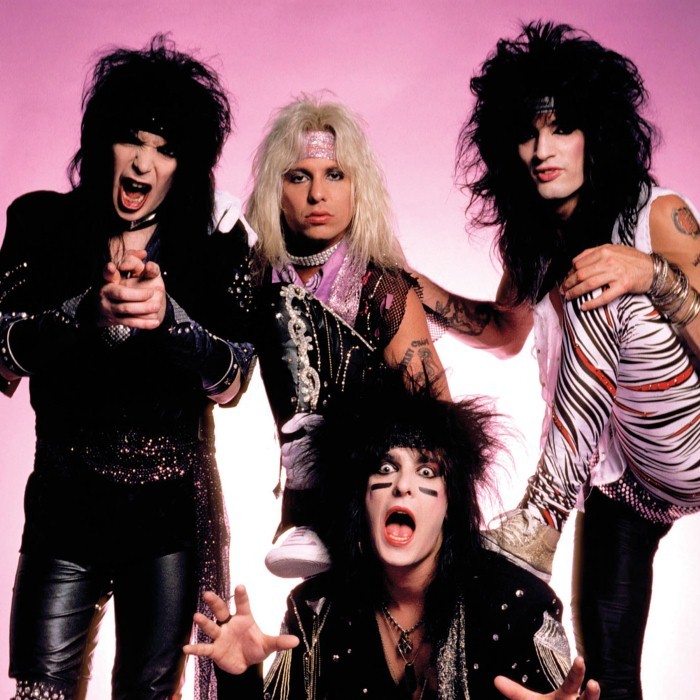
About Mötley Crüe
Mötley Crüe is an American heavy metal band formed in Hollywood, California, in 1981 by bassist Nikki Sixx and drummer Tommy Lee, with guitarist Mick Mars and vocalist Vince Neil joining shortly after. The band has sold over 100 million records worldwide and achieved seven platinum or multi-platinum certifications, nine Top 10 albums on the Billboard 200 chart—including "Dr. Feelgood" (1989), their only studio album to reach number one—twenty-two Top 40 mainstream rock hits, and six Top 20 pop singles.
MÖTLEY CRÜE: FOUR DECADES OF CONTROLLED DETONATION ON HOLLYWOOD’S HARDEST STAGE
Mötley Crüe, the Hollywood glam metal band formed in 1981, sold over 100 million records worldwide and redefined arena rock excess with nine Billboard 200 Top 10 albums. From a self-pressed debut on a micro-label to a six-times-platinum commercial peak engineered by Bob Rock, the band’s career arc traces the full lifespan of an American heavy metal institution — collapse, resurrection, and ongoing reinvention included. Their catalog remains a high-velocity case study in IP longevity, fan loyalty, and the stubborn durability of a perfectly calibrated rock spectacle.
Artist Profile
| Origin | Hollywood, California, USA |
| Years Active | 1981–2002; 2004–2015; 2018–present |
| Genre | Glam Metal; Heavy Metal; Hard Rock |
| Labels | Leathür Records; Elektra Records; Beyond Music; Eleven Seven Music; Big Machine Records |
| Members |
Nikki Sixx (bass, primary songwriter); Tommy Lee (drums); Vince Neil (vocals); John 5 (guitar, 2020–present) |
| Past Members | Mick Mars (guitar, 1981–2022); John Corabi (vocals, 1992–1996); Randy Castillo (drums, 1999–2002) |
| RIAA Certifications | Dr. Feelgood: 6× Platinum; Shout at the Devil: 4× Platinum; Girls, Girls, Girls: 4× Platinum; Theatre of Pain: 4× Platinum; Too Fast for Love: Platinum; Decade of Decadence 81–91: 2× Platinum |
| Albums in Catalog | 9 studio albums; 3 live albums; 8 compilation albums |
| Notable Collaborators | Bob Rock (producer, Dr. Feelgood); Tom Werman (producer, Theatre of Pain, Girls, Girls, Girls); John 5 (guitar, co-writer) |
Performance Snapshot (Get Music Catalog)
| Total Listeners | 149,279 |
| Country Reach | 3 countries |
| Albums in Catalog | 1 (The Dirt Soundtrack, 2019) |
| Top Markets | North America, Western Europe |
From Leathür to Elektra: The Architecture of a Hollywood Metal Machine
The origin story matters here.
The band secured management through Allan Coffman, who financed recording sessions for a debut album initially released in November 1981 by Leathür Records — a small independent label launched by Coffman and the band — which sold a surprising 20,000 copies.
That number, modest by any mainstream metric, was sufficient signal.
Elektra Records, impressed by the band’s traction in local venues, signed Mötley Crüe and released a remastered version of Too Fast for Love, followed by the sophomore effort Shout at the Devil in 1983.
The sonic logic of early Mötley Crüe was blunt and deliberate: drop-tuned rhythm guitar from Mick Mars, Tommy Lee’s wide-open drum timbre with enough transient attack to cut through arena reverb, Nikki Sixx’s low-end functioning more as rhythmic glue than melodic counterpoint, and Vince Neil’s high-register vocals — thin at the top but aggressive in the chest range — riding the mix with a nasal brightness that suited AM radio and car stereos equally well. The formula was not subtle. It was not supposed to be.
*Shout at the Devil* received its RIAA Gold certification in January 1984, followed by Platinum in February 1984, and eventually climbed to 4× Platinum by May 1997.
The record peaked at No. 17 on the Billboard 200 — a genuine breakthrough for a band still being dismissed by the rock press as a novelty act. Theatre of Pain (1985) arrived with producer Tom Werman and moved the band into glossier arena-pop territory, producing “Home Sweet Home,” a piano-anchored ballad that became a Headbangers Ball staple and demonstrated that the Crüe could operate with restraint when commercial logic demanded it.
*Theatre of Pain* reached 4× Platinum certification by June 1995.
Girls, Girls, Girls (1987), again produced by Werman, pushed the band to No. 2 on the Billboard 200 on its debut week and consolidated their status as the defining act of the Sunset Strip ecosystem. The production on that record — compressed midrange, heavy use of chorus effects on Mars’s guitar, and Neil’s multi-tracked doubles — captured the milieu of late-1980s Hollywood with an almost documentary fidelity.
*Too Fast for Love* was the earliest of seven consecutive Mötley Crüe studio albums to be certified Gold or Platinum by the RIAA — every album up to and including Generation Swine (1997) achieved at least Gold status.
That streak across seven records represents a commercial consistency that the band’s detractors rarely acknowledge with appropriate specificity.
Catalog Landmarks: The Records That Defined the Argument
If any single production event defines Mötley Crüe’s discographic arc, it is the engagement of Bob Rock for 1989’s Dr. Feelgood.
A combination of rehabilitation, time off the road, and upgraded pop production from Bob Rock resulted in Dr. Feelgood — the band’s fifth, most successful, and arguably best album.
Rock recorded the sessions at Little Mountain Sound Studios in Vancouver, and his approach was methodical to the point of confrontation: parallel compression on the drum bus, extreme attention to guitar doubling and phase alignment, and a vocal methodology that prioritized tonal accuracy over raw delivery energy.
It was also the record that turned Bob Rock from the house engineer at a Vancouver studio into the most in-demand metal producer of the following decade — the man Metallica would contact the very next year to make their Black Album.
The results were commercially unambiguous. Dr. Feelgood debuted at No. 1 on the Billboard 200 — the only Mötley Crüe studio album to reach that position — and
has sold more than six million copies in the U.S., also going Gold in the U.K.
Its UK Albums Chart peak was No. 4, with additional strong placements in Australia (No. 5), New Zealand (No. 5), Sweden (No. 6), and Canada (No. 7).
The title track remains the band’s highest-charting single, peaking at No. 6 on the Billboard Hot 100.
“Kickstart My Heart,” the album’s structural centerpiece — built on a descending guitar figure, a sidechain-punched rhythm section, and Neil’s most committed vocal performance — remains the most licensed and synced track in the Mötley Crüe catalog, its intro drop still appearing in sports broadcast packages and trailer cuts.
The 1990s brought institutional turbulence.
The classic lineup fractured in 1992 when vocalist Vince Neil left and was replaced by John Corabi, before the band reunited with Neil in 1997.
The 1994 self-titled album, recorded with Corabi,
debuted at No. 7 on the Billboard 200 and was certified Gold by the RIAA.
Critics largely ignored it; the audience had moved on to grunge and post-grunge, and the record’s harder, less radio-friendly production — a deliberate departure from the *Dr. Feelgood* formula — landed in a market no longer tuned to its frequency.
Five years had passed since the band’s last full studio album, and grunge and alternative rock had crossed into the mainstream, leaving many glam metal acts struggling to generate sales.
The 2019 The Dirt Soundtrack served as the band’s formal reentry document following their Netflix biopic.
In September 2018, news broke that the Crüe were back together and recording new songs to be used for the film adaptation of the band’s biography, The Dirt.
The soundtrack mixed classic catalog recordings with four new original tracks — including “The Dirt (Est. 1981)” featuring Machine Gun Kelly — and introduced the band’s story to a generation that had processed their mythology through streaming rather than vinyl or cassette. The project functioned simultaneously as A&R repositioning and catalog reactivation, pulling older albums back into streaming playlists and reigniting discovery-mode listening.
Market Note — Catalog & IP Positioning
Mötley Crüe operates from an IP position that few rock acts of their era can match. With over 100 million records sold globally and seven albums holding multi-platinum RIAA certifications, the catalog’s sync potential is evergreen — particularly “Kickstart My Heart,” “Girls, Girls, Girls,” and “Home Sweet Home,” each of which carries broad demographic recognition across 35–65 age ranges and is cleared regularly for sports, film, and advertising placements.
The band remain a major global draw, having wrapped up a two-year world stadium tour in late 2023.
In 2024, the band signed to Big Machine Records and released the single “Dogs of War,”
signaling continued investment in original studio work rather than passive catalog coasting. Fan base demography skews male, 30–55, North American and Western European, with strong secondary markets in Scandinavia and Australia. The theatrical live production — pyrotechnics, LED scaffolding, Tommy Lee’s drum roller-coaster rig — preserves the band’s premium ticket pricing at amphitheater and arena scale.
Geography of a Scene: Where the Crüe Lands and Why
Mötley Crüe is, in the most specific sense, a Los Angeles product — not just in origin but in the social logic that structured their audience. The Sunset Strip milieu of the early 1980s was a particular geography: neon-lit, chemically maintained, and commercially calculated beneath its apparent abandon. The band emerged from that environment and sold it back to suburban America with extraordinary efficiency. Their largest and most durable audiences are concentrated in the American Midwest and Southeast, regions where the band’s blue-collar hedonism translated cleanly across economic and cultural distances that their Hollywood mythology otherwise implied.
In Europe, the band’s strongest historical reception has been in the United Kingdom, Scandinavia, Germany, and Australia — territories where arena rock’s melodic directness and production maximalism have maintained consistent commercial traction across multiple generations.
*Dr. Feelgood* peaked at No. 4 in the UK, No. 5 in Australia and New Zealand, No. 6 in Sweden and Finland, and No. 7 in Norway and Canada
— market performance that reflects a specifically Northern European appetite for the hard rock sensibility that Mötley Crüe refined most acutely on that record.
The band’s 2026 touring activity celebrates both the 20th anniversary of their original “Carnival of Sins” tour and the 45th anniversary of the band itself.
The 33-city North American tour, dubbed “The Return of the Carnival of Sins,” kicked off July 17th in Burgettstown, Pennsylvania, and runs through a September 26th date in Ridgefield, Washington.
Produced by Live Nation, the tour features support from Tesla and Extreme.
This routing — amphitheaters rather than stadiums — represents a structurally intelligent recalibration: premium ticket prices in mid-capacity outdoor venues generate higher per-head revenue than a partial-fill stadium scenario, while the visual production retains full spectacle.
2025 saw Mötley Crüe return to the Las Vegas Strip for the band’s third Sin City residency — their first since 2013 — with ten nights at Dolby Live at Park MGM.
The residency format suits their production requirements: fixed rig, no load-in losses, repeat visitation from a tourist demographic that fuels premium hospitality spend alongside ticket revenue. The band’s continued capacity to fill both formats — touring and residency — within the same eighteen-month window is a strong indicator of demand density, not a sign of career contraction.
The Netflix adaptation of their memoir The Dirt (2019) was a significant cultural reach event. It introduced the band’s narrative arc to a streaming audience whose primary contact with the 1980s hard rock scene had been filtered through retrospective playlists and algorithmically assembled “rock classics” channels. The film’s reception was polarized critically but broadly effective commercially: it drove measurable streaming velocity spikes across the catalog, revived playlist inclusion for tracks that had largely migrated to legacy radio formats, and created a new entry cohort of younger fans who then attended the 2022–2023 stadium tour.
Critical Legacy: The Honest Accounting
The critical establishment has never fully known what to do with Mötley Crüe, and that uncertainty is itself instructive. The band arrived at a moment when rock criticism was developing its own high/low snobbery — a tendency to reward austerity and penalize spectacle, to elevate Dylan and undervalue Diamond. Mötley Crüe occupied the most unfashionable possible position: they were loud, they were successful, they were theatrical, and they had no discernible interest in any critical framework that did not directly expand their box office.
AllMusic’s assessment of *Dr. Feelgood* positioned it as “the band’s fifth, most successful, and arguably best album,”
giving the record an archetypal 90 out of 100, their highest score in the catalog.
Rolling Stone awarded the album 80 points in their 1989 assessment
— a score that reads more generously in retrospect, given the publication’s historical skepticism toward glam metal as a form. The record’s aggregate critical score of 80, drawn from a limited review pool, understates its structural achievement: Bob Rock engineered a sonic environment in which every production decision — from the gated reverb on Lee’s snare to the doubled-and-panned guitar layers Mars spent weeks perfecting — served the song first and the production aesthetic second.
The longer arc of critical reappraisal has been gradual but legible. Grunge’s own commercial exhaustion by the mid-1990s, followed by the post-Napster fragmentation of mainstream rock, created conditions under which the 1980s hard rock catalog could be re-examined without the defensive contempt that originally accompanied it. Critics began separating the Crüe’s self-mythologizing biography — which, in fairness, they marketed aggressively — from the actual recorded work. On that reading, Dr. Feelgood holds up as a tightly produced hard rock record with a coherent tonal center, consistently strong songwriting from Sixx, and a rhythm section whose live-room energy survived Rock’s precision-engineering process with enough spontaneity intact to prevent it from sounding clinical.
The post-2015 era introduced a different critical question: what does it mean when a band officially ends, signs a cessation-of-touring contract, and then resumes operations four years later?
The band announced their retirement in 2013 and played what was planned to be their final concert on December 31, 2015. In 2019, the band officially reunited.
The intellectual honesty deficit that move created was significant, and critical coverage of the reunion era reflected it — largely positive on the evidence of strong live performance metrics and the catalog’s enduring draw, but consistently skeptical about the sincerity of any “final chapter” framing.
The Los Angeles hard rock veterans dropped their first original song in years with new guitarist John 5 and are openly discussing a louder, heavier future for the band.
That future — John 5’s technical facility on guitar is substantially more sophisticated than the straight-ahead rhythm and blues feel Mars deployed — raises a legitimate production question: can the post-Mars Mötley Crüe generate a studio record that credibly extends the catalog rather than simply appending to it? The “Dogs of War” single offered tentative evidence of directional intent. Whether the band assembles a full studio record capable of standing beside *Dr. Feelgood* in the same conversation remains the most interesting unresolved question in their discography. On catalog evidence alone — six platinum or multi-platinum studio albums, 22 Top 40 mainstream rock hits, and a live production apparatus that continues to move large quantities of tickets — the argument for their place at the top of the glam metal genre requires no special pleading. The records do that work themselves.
Frequently Asked Questions
Where should I start with Mötley Crüe’s catalog?
Dr. Feelgood (1989) is the structural entry point. Produced by Bob Rock with a clarity and punch that none of their earlier records achieve at the same level, it represents the band at their most focused and sonically coherent. “Kickstart My Heart” and “Without You” demonstrate the full range of their commercial instincts within a single album sequence. From there, work backward to Shout at the Devil (1983) for the rawer, more aggressive early character, and forward to The Dirt Soundtrack (2019) for the reunion context and the band’s current presentation of their own mythology.
Is Mötley Crüe still active?
Yes.
The band’s years active run 1981–2002, 2004–2015, and 2018–present.
Their 2026 touring activity marks the 45th anniversary of the band
, with
a 33-city North American amphitheater tour running from July through September 2026.
In 2024, the band signed to Big Machine Records and released new original material.
The lineup currently features Nikki Sixx, Tommy Lee, Vince Neil, and guitarist John 5, who replaced Mick Mars following the latter’s 2022 departure.
Who has Mötley Crüe collaborated with?
The band’s most significant external creative relationship has been with producer Bob Rock, whose work on Dr. Feelgood remains the defining production event of their catalog. Tom Werman shaped the mid-period sound across Theatre of Pain and Girls, Girls, Girls. On the 2019 The Dirt Soundtrack, the band collaborated with rapper Machine Gun Kelly on “The Dirt (Est. 1981).” Guitarist John 5 — formerly of Marilyn Manson and Rob Zombie — has co-written new material with the band since joining in 2020, bringing a considerably more technically demanding guitar vocabulary to sessions. Individual members have run parallel projects including Sixx:A.M. (Nikki Sixx), Methods of Mayhem (Tommy Lee), and extensive solo work from Vince Neil.
Which artists sound similar to Mötley Crüe?
Within the glam metal lineage, Poison, Ratt, Cinderella, and Warrant occupy adjacent sonic territory — melodic hard rock with an emphasis on guitar timbre, hook-driven choruses, and anthemic production. For listeners drawn specifically to the Bob Rock production era, Bon Jovi’s late-1980s records and Def Leppard’s Hysteria share the same hyper-compressed, radio-optimized sensibility. Fans interested in the band’s theatrical performance aesthetic and extreme stage production will find common ground with KISS and Alice Cooper, both of whom operated in the same arena-as-theater framework that Mötley Crüe adopted and scaled. You can explore more releases from this era and genre on Mötley Crüe’s artist page at Get Music.
Setenay Mira KAYA — Girls Choice Music Editorial, Get Music
October 8, 2026
Interested in being featured or submitting a release? Contact us on Telegram: t.me/ViralSubmissions
1 album in our catalog
All releases
Complete release history from MusicBrainz — albums, EPs, singles, live, and more.
Album (9)
- 2008Saints of Los Angeles
- 2000New Tattoo
- 1997Generation Swine
- 1994Mötley Crüe
- 1989Dr. Feelgood
- 1987Girls, Girls, Girls
- 1985Theatre of Pain
- 1983Shout at the Devil
- 1981Too Fast for Love
Album (Compilation) (16)
- 2023Crücial Crüe: The Studio Albums 1981–1989
- 2009Greate$t Hit$
- 2007Rock Legends
- 2007Colour Collection
- 2005Greatest Video Hits
- 2005Red, White & Crüe
- 2004The Universal Masters Collection
- 2004Classic Mötley Crüe
- 2004Music to Crash Your Car To, Volume II
- 2003Music to Crash Your Car To, Volume 1
- 2003Loud as Fuck!
- 200320th Century Masters: The Millennium Collection: The Best of Mötley Crüe
- 1999Supersonic Relics
- 1999Supersonic and Demonic Relics
- 1998Greate$t Hit$
- 1991Decade of Decadence ’81–’91