Listen / Follow
Tags
About KMFDM
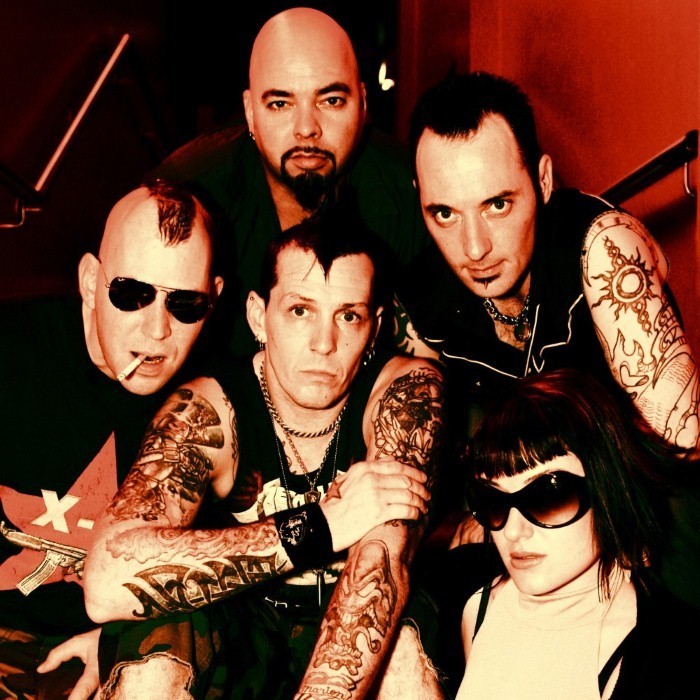
KMFDM (originally Kein Mehrheit Für Die Mitleid, "loosely" translated by the band as "no pity for the majority") is an industrial rock band led by German multi-instrumentalist Sascha Konietzko, who founded the group in 1984 as a performance art project in Hamburg, Germany. The group's earliest incarnation included German drummer En Esch and British vocalist Raymond Watts, the latter of whom left and rejoined the group several times over its history.
KMFDM: Forty Years of the Ultra Heavy Beat — Industrial Music’s Most Disciplined Dissidents
KMFDM, the Hamburg-born industrial metal group led by Sascha Konietzko, has sustained one of the most methodical and uncompromising careers in electronic-adjacent rock since forming in 1984. Rooted in performance art and propaganda aesthetics, the band crossed from European underground circuits to American industrial’s commercial edge in the 1990s before reconstituting — and refusing to stop releasing records. With their 2026 album ENEMY now in hand, KMFDM remain an active, politically explicit machine still running on its own design principles. Their catalog rewards forensic listening: production decisions are deliberate, lineup changes are structural rather than cosmetic, and the political content has never softened for format.
Artist Profile
| Origin | Hamburg, Germany |
| Years Active | 1984–1999; 2002–present |
| Genre | Industrial Metal, Industrial Rock, Electro-Industrial |
| Labels | Z; Skysaw; Wax Trax!; TVT; Sanctuary; earMUSIC; Metropolis; KMFDM Records |
| Current Members | Sascha Konietzko, Lucia Cifarelli, Andy Selway, Tidor Nieddu |
| Notable Past Members | En Esch, Günter Schulz, Raymond Watts, Tim Sköld, Bill Rieflin, Mark Durante |
| Albums in Catalog | 24 studio albums (1984–2026) |
| Notable Sync Placements | “Juke-Joint Jezebel (Metropolis Mix)” — Mortal Kombat (1995 film) |
Performance Snapshot
| Total Listeners (Get Music Catalog) | 14,303 |
| Countries Reached | 5 |
| Albums in Get Music Catalog | 1 (ENEMY, 2026) |
| Catalog Depth (Total) | 24 studio albums, 40+ years continuous |
From Paris Performance Art to Chicago’s Wax Trax!: The Architecture of a Career
KMFDM was originally founded in Paris by Konietzko and German painter and multimedia performer Udo Sturm, and the duo made their concert debut on February 29, 1984, performing at a Grand Palais exhibition — Sturm on feedback synthesizer, Konietzko on five-string bass.
The conceptual character of that premiere never fully left: KMFDM has always treated the album as a designed object rather than a collection of songs, and the live set as an argument rather than entertainment.
That same year, KMFDM issued their debut release, Opium, after which Sturm exited and Konietzko was joined by drummer En Esch, who would remain with the group until 1999.
The band’s name — Kein Mehrheit Für Die Mitleid (grammatically approximate German that the band has loosely rendered as “No Pity for the Majority”) — established their rhetorical register from the first pressing. The phrase’s deliberate grammatical incorrectness was always part of the joke.
The earliest lineup included British vocalist Raymond Watts, who left and rejoined multiple times over the group’s history. The trio recorded KMFDM’s earliest albums in Germany before Konietzko and Esch relocated to the United States, where they found far greater traction with the Chicago industrial label Wax Trax!
Wax Trax! was doing for industrial music what Chess Records did for the blues — it was the nerve center of American industrial, home to Ministry, Front 242, My Life with the Thrill Kill Kult, Front Line Assembly, and Pigface.
German guitarist Günter Schulz joined in 1990,
and the quartet that emerged from that period — Konietzko, Esch, Schulz, Watts in rotation — produced the sequence of albums that would define KMFDM’s critical and commercial ceiling. Konietzko’s production methodology was already distinctive by this phase: heavy sidechain-compressed kick transients driving loops, sampled political speech fragments layered beneath distorted guitar, and vocal parts treated as rhythmic instruments rather than melodic leads.
Their first major tour came in 1990, opening for Ministry,
a placement that confirmed their peer status within the genre’s emerging hierarchy.
Differences in vision and drive led to KMFDM disbanding in 1999.
In 2002, Konietzko resurrected the project on Metropolis Records.
The return boosted Lucia Cifarelli to a permanent co-vocalist position, kicking off the new era with Attak.
That reconfiguration — Cifarelli’s contralto as a structural counterpoint to Konietzko’s processed baritone — has remained the tonal center of every subsequent record.
Discography in Depth: From Nihil to ENEMY
The commercial and creative peak of KMFDM’s first era arrived with back-to-back Wax Trax! releases.
Nihil, recorded in 1994 at Bad Animals in Seattle with producers Sascha Konietzko and Chris Shepard, arrived April 4, 1995.
It sold over 120,000 copies by August 1996, reached No. 16 on the Billboard Heatseekers chart,
and its profile was amplified considerably by a critical sync placement:
“Juke Joint Jezebel (Metropolis Mix)” was featured in the 1995 film Mortal Kombat,
making it KMFDM’s most widely known song, with approximately three million copies sold across various releases.
The production on Nihil is among the band’s most focused — parallel compression on the drum bus, mid-scooped guitar tones that create space for Konietzko’s programmed low-end, and Shepard’s influence pressing the whole mix toward a harder transient attack than earlier records.
Xtort (stylized XTOЯT) followed in June 1996, again on Wax Trax!, produced by Konietzko, Schulz, and Shepard and tracked between Hole in the Wall in Seattle and Chicago Recording Company.
The album debuted at No. 92 on the Billboard 200 for the week of July 13, 1996 — the first KMFDM album to enter the main albums chart.
It features a variety of guest artists from the industrial scene alongside studio musicians from other genres.
The mixolydian guitar riffs on “Power” and “Rules” illustrate Schulz’s contribution to the mid-decade sound: a fifth-relation-heavy approach that provided the harmonic anchor the rhythm programming alone couldn’t supply.
The 2002 resurrection on Metropolis produced a disciplined run of near-annual studio releases.
Let Go, the 22nd studio album, arrived February 2, 2024 — the month of the band’s fortieth anniversary.
It features a guest verse from rapper MC Ocelot,
extending the band’s long practice of importing voices from adjacent scenes to add timbral contrast. You can explore ENEMY, the most recent entry in the catalog, directly at Get Music — ENEMY (2026), and the full artist page at Get Music — KMFDM.
ENEMY, released February 6, 2026, on Metropolis, is the 23rd studio album — spanning 44 minutes and working across electro-industrial, industrial rock, and industrial metal registers.
The core lineup of Konietzko and Cifarelli is joined by drummer Andy Selway, with London guitarist Tidor Nieddu making his studio debut with the band following their 40th-anniversary tour.
Annabella Konietzko contributes her first songwriting credit on the track “Yoü,”
suggesting a degree of generational continuity that few bands from the 1984 Hamburg underground could have anticipated.
Market Note
KMFDM occupies a rare position in the industrial catalog economy: a band with forty-plus years of continuous IP whose audience is demographically skewed toward collectors and long-term catalog consumers rather than algorithmic discovery. Their self-operated KMFDM Records label — running alongside their Metropolis relationship — means a portion of their back catalog generates direct revenue without label intermediary, a model that gives them unusual autonomy at this stage of a career.
The release of ENEMY via Metropolis, available as a double vinyl edition at 45 RPM, CD, and digital, alongside an almost sold-out European tour,
confirms the band’s live market in continental Europe and North America is structurally intact. Sync potential remains strong in gaming and action-film contexts — “Juke-Joint Jezebel” established that template in 1995 and it holds. The fan base skews male, 30–55, politically engaged, and format-loyal; vinyl sell-through is consistent. For A&R and licensing desks, the catalog between Angst (1993) and Xtort (1996) represents the highest-value sync window in their discography.
1 album in our catalog
All releases
Complete release history from MusicBrainz — albums, EPs, singles, live, and more.
Album (25)
- 2022Hyëna
- 2020Apart
- 2019Paradise
- 2018Hamburg 1984
- 2017Hell Yeah
- 2014Our Time Will Come
- 2013Kunst
- 2011WTF?!
- 2009Blitz
- 2009Skold vs. KMFDM
- 2007Tohuvabohu
- 2005Hau Ruck
- 2003WWIII
- 2002Attak
- 1999Adios
- 1997[symbols]
- 1996Xtort
- 1995Nihil
- 1993Angst
- 1992Money
- 1990Naïve
- 1989UAIOE
- 1988Don’t Blow Your Top
- 1986What Do You Know, Deutschland?
- 1984Opium