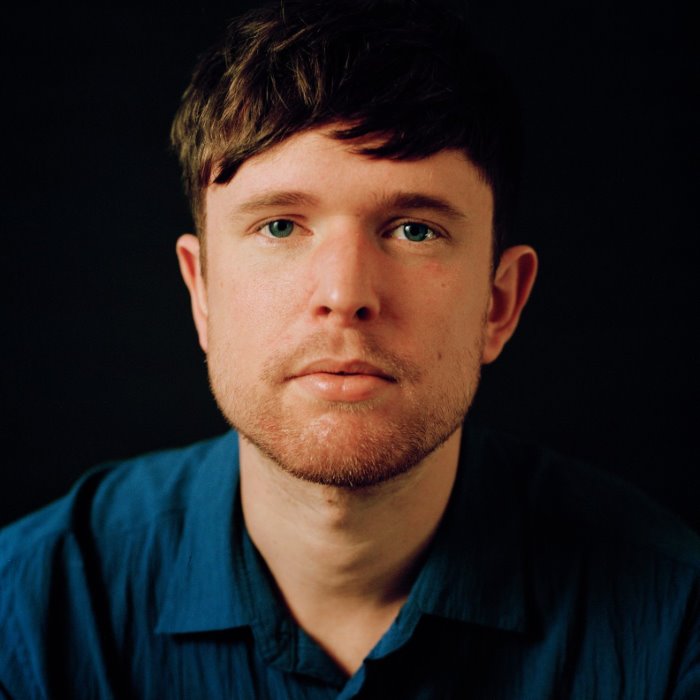
Listen / Follow
Tags
About James Blake
James Blake Litherland (born 26 September 1988) is an English singer, songwriter and record producer. He is known for his emotive vocal style, often employing a light head voice and falsetto. He first gained wider attention in 2010 with the extended plays "The Bells Sketch", "CMYK" and "Klavierwerke". He subsequently signed with A&M Records and released his self-titled debut album "James Blake" in 2011, which received critical acclaim and reached the top ten of the UK Albums Chart.
James Blake: From Bedroom Dubstep to the Architecture of Feeling
James Blake, the English singer-songwriter and producer from Enfield, has spent fifteen years refining one of the most structurally distinctive voices in contemporary electronic music. Where his early post-dubstep experiments mapped the outer limits of UK bass, his subsequent catalog traced an inward arc — sparser arrangements, deeper introspection, and a falsetto so controlled it functions less like a vocal register and more like a compositional instrument. With seven solo studio albums spanning Polydor, Republic, and his own Good Boy Records imprint, Blake’s body of work sits at an unusual intersection: rigorous enough for the critical establishment, melodically accessible enough to sustain a genuinely international audience across more than seven countries in our catalog alone.
Artist Profile
| Origin | Enfield, London, England |
| Years Active | 2009 – present |
| Genre | UK Bass, Post-Dubstep, Electronic Soul, Ambient, Art Pop |
| Labels | Hemlock; R&S Records; Hessle Audio; A&M; Polydor; Republic; Good Boy Records |
| Notable Collaborators | Beyoncé, Kendrick Lamar, Bon Iver, Lil Yachty, Frank Ocean, Dave, Jameela Jamil |
| Certifications | BPI: Silver × 2 (self-titled; Overgrown); IFPI DEN: Gold × 2 |
| Albums in Catalog | 7 solo studio albums; 2 collaborative albums |
Performance Snapshot
| Total Listeners (Get Music) | 122,855 |
| Country Reach | 7 countries |
| Albums in Catalog | 1 (Trying Times, 2026) |
| Top Markets | UK, Germany, Belgium, France, Netherlands |
The Architecture of a Career: Early Years and Signature Sound
Blake began his music career by releasing his debut 12″ record, “Air & Lack Thereof,” in the United Kingdom during July 2009, while recording persistently in his bedroom.
Released on the Hemlock imprint, the extended play became a favourite of BBC Radio 1 DJ Gilles Peterson
— an early signal that Blake’s work occupied a credible space between DJ culture and songwriter craft. That first record established the tension that would define everything to follow: machine-tooled low frequencies beneath a vocal presence of almost disarming fragility.
Blake took inspiration from early UK dubstep artists like Burial, Distance, and Skream, merging it with influences from textural R&B innovators like D’Angelo while developing his first original tracks.
The synthesis was not obvious in 2009. Dubstep’s dominant discourse at the time was oriented toward maximum sub-bass weight; Blake’s instinct was to hollow that architecture out, introducing silence as a structural element rather than a gap between events. His falsetto, deployed sparingly, landed inside those silences like a tuning fork struck against an empty room.
As a second-year composition assignment for his studies at Goldsmiths, he submitted the Klavierwerke EP, which was awarded high marks.
The academic grounding shows in the formal precision of his arrangements — he approaches vocal processing the way a conservatory-trained composer approaches counterpoint, treating Auto-Tune artifacts and sidechain compression not as production shorthand but as tonal events with harmonic consequences.
In December 2010, Blake had been made runner-up behind Jessie J at the BRIT Awards’ “Critic’s Choice,” and in January 2011 he was awarded Single of the Year for “CMYK” at Gilles Peterson’s Worldwide Awards.
His self-titled debut, issued in February 2011,
was released through ATLAS, A&M, and Polydor, reaching number 9 on the UK Albums Chart and earning a BPI Silver certification.
The record’s center of gravity — a sparse cover of Feist’s “Limit to Your Love” built almost entirely on sub-bass and breath — demonstrated that Blake’s production economy was not minimalism for its own sake but a kind of precision rationing: every frequency present because its absence would be felt.
Discography Highlights: Seven Albums, One Coherent Voice
His second album, 2013’s Overgrown, earned him the Mercury Prize, and commercial success worldwide came in the mid-2010s, with high chart placings — as well as critical praise — for 2016’s The Colour in Anything and 2019’s Assume Form.
Overgrown was the record that established Blake as something more than a UK bass specialist. With Brian Eno contributing to its ambient geography and RZA appearing on “Take a Fall for Me,” the album positioned Blake as a connector figure — someone capable of sustaining credibility across scenes without being absorbed by any of them.
Overgrown won the Mercury Prize, and Blake’s songwriting was further acknowledged when “Retrograde,” one of the album’s highlights, won an Ivor Novello Award in the category of Best Contemporary Song.
The album charted at number 8 in the UK, number 5 in Australia, and reached number 2 in both the Belgian (Flemish) and Danish charts, earning BPI Silver and IFPI Denmark Gold certifications.
These figures matter because they trace the outlines of his audience: a Northern and Western European listenership with an ear for emotional precision and production restraint.
Assume Form (2019) remains his highest-charting entry on both the UK Albums Chart and Billboard 200.
That record introduced a more extrovert register — features from Travis Scott, Rosalía, and Moses Sumney, production that nodded toward contemporary R&B’s spatial logic — without abandoning the chamber-music intimacy that his most devoted listeners return to.
In 2024, Blake released the collaborative album Bad Cameo with American rapper Lil Yachty,
a lateral move that demonstrated his continued appetite for genre friction, pairing his processed vocals and glacial harmonic rhythm against trap’s more percussive cadence.
His most recent solo work, Trying Times (2026), is available in our catalog at getmusic.com.tr/album/trying-times/.
Released on 13 March 2026 through Good Boy Records, it marks his first independent full-length release after leaving Polydor,
with production credits shared between Blake, Chris Trowbridge, Dominic Maker, Jameela Jamil, and YouthXL.
Largely recorded at Real World Studios, founded by Peter Gabriel, the record marks a turning point in the British producer’s career.
Market Note
James Blake’s IP is unusually durable across format cycles. His catalog has moved cleanly from vinyl-oriented physical sales through streaming without losing critical standing — a rare alignment of analog credibility and digital performance. The BPI Silver certifications on his first two albums and the consistent European chart presence (Belgium, Denmark, Germany, France) indicate a listener base that leans toward the premium-attentive: catalog buyers, sync supervisors, and streaming subscribers who complete albums rather than cherry-pick singles. His sync potential is high: the sparse, mid-tempo harmonic palette of tracks like “Retrograde” and “Limit to Your Love” travels easily into TV drama, luxury advertising, and film, where emotional register matters more than tempo matching. The shift to Good Boy Records — his own imprint — reorients the IP question: back-catalog negotiations are simplified, and royalty structures favor long-term catalog appreciation over advance recoupment. Fan base demography skews 25-40, graduate-educated, with measurable overlap in post-dubstep and art pop communities.
Geographic Reception and Cultural Positioning
Blake’s audience map has never conformed to the conventional Anglo-American axis that governs most UK pop exports. His chart performance suggests a specific cultural alignment:
the self-titled debut reached number 1 in Belgium (Flemish region), number 2 in Denmark, number 6 in the Netherlands, and number 9 in Switzerland,
while performing comparatively modestly on the US Billboard 200. This is not a failure of American market penetration so much as an accurate reflection of where his aesthetic registers most deeply — Northern and Central European music cultures with a higher institutional tolerance for electronic music that prizes negative space and harmonic ambiguity over hook density.
The UK remains his foundational market, and London specifically functions as both biographical origin and cultural referent.
After two and a half years of introspection and a return to his London roots — he was previously living in Los Angeles — the musician unveiled thirteen intimate tracks on Trying Times, filled with the uncertainties of our time.
That return, and the decision to record in part at Real World Studios in rural Wiltshire, signals a deliberate re-rooting in British geography after years of working within the Los Angeles session ecosystem that shaped Assume Form and Friends That Break Your Heart.
Germany’s sustained engagement is worth noting separately.
Trying Times reached number 7 on the German chart,
consistent with the deep roots that UK post-dubstep and art-electronic music have developed in Berlin and Hamburg’s club-adjacent listening communities. The Belgian Flemish chart performance — number 3 on Trying Times — continues a pattern established across multiple albums and speaks to the same audiophile-leaning cultural infrastructure. These are markets that treat a producer’s discography as a body of work to be engaged longitudinally, not a series of discrete singles events.
His renown continued to expand over the next several years, and he collaborated with pop icons like Beyoncé, Kendrick Lamar, and Bon Iver,
which extended his name recognition into listener communities that might never encounter his solo catalog directly. The Beyoncé and Kendrick connections, in particular, gave him structural visibility in the US market at a level that his own chart positions never fully communicated — a form of soft market penetration through featured credit that has become one of the more reliable tools available to producers who operate in the art-electronic space.
Critical Legacy: The Problem and the Precision of James Blake
Few artists of Blake’s generation have maintained as consistent a critical posture without becoming a critical pet project. The Mercury Prize for Overgrown in 2013 and the Ivor Novello for “Retrograde” in the same cycle are two distinct kinds of institutional endorsement — one aesthetic, one compositional — and the fact that he received both suggests a rare coherence between what the press hears and what the industry’s internal evaluation systems reward.
He was nominated for Best New Artist at the 56th Annual Grammy Awards and for the Brit Award for British Male Solo Artist at the 2014 Brit Awards,
recognition that placed him squarely within the mainstream conversation without obligating him to its commercial logic.
The critical reading of his mid-period — the trio of Colour in Anything, Assume Form, Friends That Break Your Heart — is more contested. These are larger-sounding records, with more demonstrably commercial feature lists and a production palette that absorbed contemporary streaming-era R&B’s aesthetic conventions. Some critics read this as evolution; others as a softening of the formal rigor that made the early work so arresting. The honest assessment lies somewhere between: the production craft remained consistent, but the conceptual stakes lowered, and the tension between accessibility and formal ambition that animated his best work loosened perceptibly.
The dancehall-inspired “Big Hammer” was released as the first single from Playing Robots Into Heaven, and the album marked a return to his early club material on UK bass labels like Hemlock and Hessle Audio.
Critics received that record as a recalibration — a restatement of the algorithmic, percussive sensibility of his early EPs, filtered through a decade of songwriting muscle. It was not a nostalgia exercise; it was a structural argument that the two modes of his practice had never been as separate as his major-label period implied.
Trying Times consolidates both arguments and refuses to choose between them.
As The Independent noted, this is “the producer-songwriter’s first album as an independent artist — after he left Republic Records in 2024 — and the liberation is audible.”
Self-released through his own Good Boy imprint, it foregoes much of his previous record’s density for a curated selection of the individual elements that have driven his career: the rhythmic simplicity of “Walk Out Music,” his trademark genre-hopping on the Dave-featuring “Doesn’t Just Happen,” and the largely lyricless underground fever dream of “Rest of Your Life.”
The album earned a critic score of 78 based on 19 reviews and a user score of 79 based on nearly 7,000 ratings
— a tighter-than-usual alignment between press and audience opinion that is itself meaningful. Blake’s critical legacy is ultimately that of a producer-songwriter who expanded the formal vocabulary of UK bass without sacrificing melodic intelligence, who worked within major-label structures without becoming legible by them, and who arrived at genuine independence — label, aesthetic, geographic — with enough accumulated credibility to make independence a viable long-term position rather than a retreat.
Frequently Asked Questions
Where should I start with James Blake’s catalog?
The self-titled debut (2011) is the most concentrated statement of his core aesthetic — sparse arrangements, processed falsetto, sub-bass as structural argument. Overgrown (2013) is the more emotionally spacious second step. For his most recent work, Trying Times (2026) is available in our catalog and represents his fullest synthesis of the songwriter and the electronic producer. Those who want to understand the early UK bass influence should seek out the CMYK EP (2010) on R&S Records.
Is James Blake still active?
Blake has been active from 2009 to the present.
Trying Times was released on 13 March 2026
and represents his seventh solo studio album.
He has also announced live dates including shows at New Century Hall in Manchester in October 2026,
confirming his continued presence as a live performer alongside his studio work.
Who has James Blake collaborated with?
Blake has collaborated with pop icons like Beyoncé, Kendrick Lamar, and Bon Iver.
In 2024 he released the collaborative album Bad Cameo with American rapper Lil Yachty, and he has written and produced work for other artists, often doing so jointly with his partner Jameela Jamil.
His production credits also extend to Frank Ocean, Travis Scott, Rosalía, and Moses Sumney, among others. On Trying Times,
the UK rapper Dave appears on “Doesn’t Just Happen.”
Which artists are similar to James Blake?
Listeners drawn to Blake’s production methodology and emotional register tend to gravitate toward Burial, Bon Iver, Four Tet, Arca, and Moses Sumney — artists who share his interest in using electronic texture as an emotional carrier rather than a spectacle. His UK bass roots connect him to Actress and Darkstar, while his R&B absorption aligns him with Blood Orange and How to Dress Well. For further listening, explore related titles in our electronic and post-dubstep catalog at getmusic.com.tr/artist/james-blake/.
Setenay Mira KAYA — setenaymirakaya.com.tr
Girls Choice Music / Get Music — The Atlas of Recorded Music
Published: October 9, 2026
Follow our editorial channel and submit your release for consideration: t.me/ViralSubmissions
1 album in our catalog
All releases
Complete release history from MusicBrainz — albums, EPs, singles, live, and more.
Album (10)
- 2026Trying Times
- 2024Bad Cameo
- 2023The Cover Mix: James Blake
- 2023Playing Robots Into Heaven
- 2022Wind Down
- 2021Friends That Break Your Heart
- 2019Assume Form
- 2016The Colour in Anything
- 2013Overgrown
- 2011James Blake
EP (9)
- 2024CMYK 002
- 2020Covers
- 2020Before
- 2014200 Press
- 2011Enough Thunder
- 2011Love What Happened Here
- 2010The Bells Sketch
- 2010CMYK EP
- 2010Klavierwerke EP
Album (Live) (2)
- 2023Boiler Room London: Soulection
- 2020Boiler Room: James Blake pres. Before
Album (Compilation) (1)
- 2011Electronic Explorations 130: James Blake Mix
Album (Remix) (2)
- 2024Playing Robots Into Heaven: Endel Focus Soundscape
- 2023Playing Robots Into Heaven: Endel Chillout Soundscape
EP (Compilation) (1)
- 2017BRAiNMATHs (bonus mix)