Listen / Follow
Tags
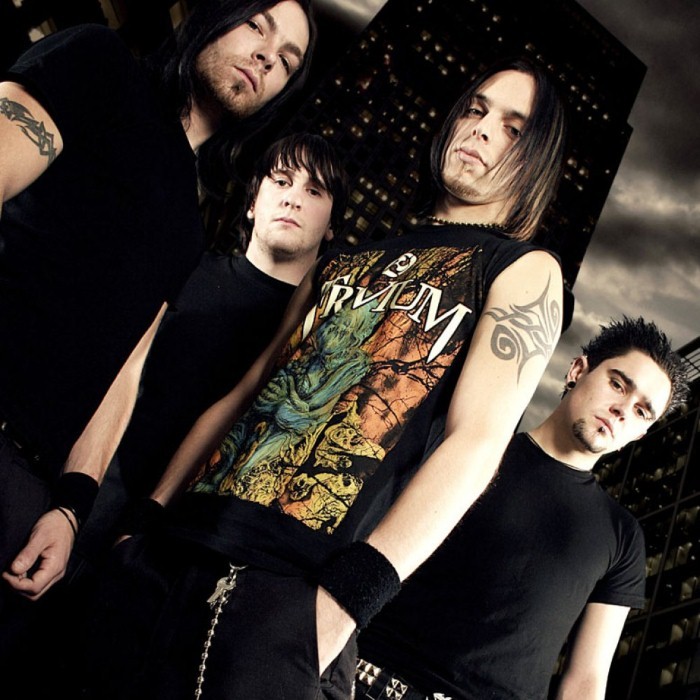
About Bullet for My Valentine
Bullet For My Valentine (sometimes shortened to "Bullet" or "BFMV") are a metalcore band from Bridgend, Wales in the United Kingdom. Formed in 1998 under the name "Jeff Killed John", they originally played Metallica and Nirvana covers. They initially struggled to find success, and tensions arose when other Welsh bands such as Lostprophets and Funeral For A Friend were getting noticed and became more popular. When it came to the band recording a demo
Bullet for My Valentine: From Bridgend Basements to the Frontline of British Heavy Metal
Bullet for My Valentine, the Welsh heavy metal band from Bridgend, are one of the most commercially durable acts in British heavy music history — charting seven studio albums across two decades.
The band has sold over one million albums in the United States and over three million worldwide, and holds the record as the most successful act in the Kerrang! Awards category of Best British Band, with three wins.
That kind of sustained market presence does not happen by accident. It is the product of a particular sonic formula — melodic metalcore built on thrash-derived riffing, clean-to-scream vocal dynamics, and arena-ready song architecture — executed with enough structural discipline to cross demographic lines without erasing genre credibility. This is their story.
Artist Profile
| Origin | Bridgend, Wales, United Kingdom |
| Years Active | 1998 – present |
| Genre | Melodic Metalcore · Heavy Metal · Thrash Metal |
| Labels | Visible Noise · Trustkill · Jive · RCA · Sony Music · GUN · Spinefarm |
| Current Members | Matthew Tuck · Michael Paget · Jamie Mathias · Jason Bowld |
| Former Members | Nick Crandle · Jason James · Michael Thomas |
| RIAA Certifications | The Poison — Gold (certified January 30, 2009) |
| Albums in Catalog | 7 studio albums · 4 live albums · 5 EPs |
| Awards | Kerrang! Best British Band × 3 · Kerrang! Best British Newcomer |
Performance Snapshot
| Total Listeners (Get Music) | 16,331 |
| Countries Reached | 6 |
| Albums in Our Catalog | 1 (Omen deluxe single / 2022) |
| Top Markets | United Kingdom · United States · Germany · Australia |
From Jeff Killed John to the Front Row of British Metal
Jeff Killed John was the forerunner band to Bullet for My Valentine, formed in 1998 by Matthew Tuck, Michael “Padge” Paget, Nick Crandle, and Michael “Moose” Thomas while studying music at Bridgend College.
The curriculum was essentially two bands:
they started playing Nirvana and Metallica cover songs.
It was an education in low-register riffing, dynamic contrast, and the structural logic of a hook that earns its release.
Jeff Killed John recorded six songs that were not released; two of these tracks were reworked later in the band’s career as Bullet for My Valentine.
That recycling instinct — the willingness to cannibalize earlier material and refine it — would become a recurring feature of how Tuck approaches songwriting.
Financial difficulties dictated the name change, which was followed by a change in music direction. In 2002, the band secured a five-album deal with Sony BMG.
The rename also brought a crucial lineup adjustment.
Regrouping under the new name Bullet for My Valentine, the band reworked their sound and were signed at their second gig by London’s Visible Noise.
Few UK metal signings in the mid-2000s were quite so swift or consequential.
They released a self-titled EP in the UK in November 2004, and their debut album, The Poison, appeared the next fall.
The Poison established the template that would carry Bullet for My Valentine through seven studio cycles: twin-guitar interplay built on harmonized lead lines borrowed from the NWOBHM lineage of Iron Maiden, overlaid onto post-hardcore rhythmic aggression, with Tuck’s vocal register alternating between compressed melodic phrasing on verses and open-throated belting on choruses. Producer Colin Richardson — whose credits with Napalm Death and Machine Head positioned him as the definitive British extreme metal engineer — gave the record a dense, controlled low-end without sacrificing pick-attack definition.
That same year, Bullet for My Valentine won Kerrang!’s Best British Newcomer Award and headlined the magazine’s XXV tour.
Bridgend had already exported Lostprophets and Funeral for a Friend; BFMV arrived with a tighter commercial instinct than either.
Discography Highlights: The Architecture of a Long Career
Bullet for My Valentine’s second studio album, Scream Aim Fire, was released on 29 January 2008 and debuted at number four on the Billboard 200.
It peaked at number five on the UK Albums Chart.
Recorded again with Colin Richardson, Scream Aim Fire leaned harder into thrash metal pacing — the palm-muted gallops are tighter, the tempo maps more ruthless. It remains the record most frequently cited by the band’s early adopters as the essential document: the moment where their live energy and studio precision achieved close parity.
Fever, the band’s third album, was released on 26 April 2010 and debuted at number three on the Billboard 200.
Produced by Don Gilmore — whose prior work with Linkin Park made him fluent in the grammar of arena-aimed hard rock — Fever traded some of the thrash density for a broader midrange and more prominent vocal production. The commercial calculus worked. It generated the band’s widest American radio reach to date, though a portion of the metalcore fanbase read the move as a tonal concession. That tension between genre fidelity and mainstream accessibility would shadow BFMV for the next decade.
Venom (2015) represented a deliberate course correction.
The record hit number one in Australia on the ARIA chart, peaked at number two in Germany, number three in the UK, and reached number eight on the US Billboard 200, also topping the US Top Hard Rock Albums chart.
It was produced by Colin Richardson alongside Carl Bown, and the return of Richardson’s low-end discipline was audible throughout — tighter gating on the snare, more aggressive pick-transient definition in the guitar chain. By the time of Venom, Bullet for My Valentine had effectively rebuilt the production architecture that had made Scream Aim Fire compelling, but with considerably more studio experience behind them.
Their seventh and most recent studio album, the self-titled Bullet for My Valentine (2021), arrived via Spinefarm Records — their current label home — produced by Carl Bown.
The album was written during the Covid-19 pandemic, a difficult time for the band which inspired a lot of the lyrics. “It’s quite an intense lyrical record, but then it was made through intense times,” said Matt Tuck.
The deluxe expansion in 2022 added five tracks, including the single “Omen.” You can explore that release in our catalog: Omen (2022) on Get Music.
Market Note
The band has sold over two million albums in the United States and over five million albums worldwide, and are the most successful act in the Kerrang! Awards category of “Best British Band” with three wins.
That catalog depth — seven studio albums across labels including Trustkill, Jive, RCA, and Spinefarm — creates substantial IP breadth with meaningful sync potential across action, sports, and gaming verticals. The band’s production approach (high-definition transient guitar attack, layered clean-to-scream vocal stacks) translates cleanly to trailer and in-game placements. Their demographic skews male, 18–35, with strong index in the UK, Germany, Australia, and the United States — geographies with well-developed streaming and physical metal consumption habits.
In 2024, the band announced they were back in the studio working on their eighth album, set for release in 2025
— a pipeline event that carries meaningful streaming velocity implications for their back catalog.
Geographic Reception and the Anatomy of a Metal Fanbase
Bullet for My Valentine’s genres span melodic metalcore, heavy metal, thrash metal, and hard rock
— a palette wide enough to find footholds across multiple market segments simultaneously. Their chart history reveals a band unusually distributed across geographies.
Scream Aim Fire debuted at number four on the Billboard 200, and Fever debuted at number three
— performances that placed them among the very few British metal acts to crack the American mainstream chart at that level in the streaming era’s early phase.
Germany has been a consistent stronghold. Scream Aim Fire peaked at number three on the German Albums chart, Venom at number two, and Temper Temper at number five — a sustained presence across three consecutive cycles that speaks to the structural loyalty of the German Rockfabrik audience, a demographic that rewards melodic precision and live-show consistency in roughly equal measure. Australia has shown comparable commitment: Scream Aim Fire reached number four there, Venom number one. Fever and Temper Temper also charted in the Australian top five. That Australia-Germany-UK axis has formed the commercial spine of the band’s European and Antipodean touring circuit for nearly two decades.
In the UK,
the band has achieved three top-ten albums on the Official Albums Chart
— a record that places them comfortably above most of their Bridgend-era peers. The metalcore scene that birthed BFMV largely failed to sustain commercial trajectories into the 2010s; Bullet for My Valentine are one of the few outfits from that milieu to expand rather than contract their market position across successive decades. The reasons are structural: Tuck’s songwriting consistently prioritizes the chorus as the gravitational center of the arrangement, a discipline that mainstream rock radio rewards. The lead guitar work, handled by Michael Paget, provides the genre credential — his harmonic soloing and alternate-picked runs reference thrash’s Bay Area period without sounding derivative.
Japan has also maintained notable engagement, with multiple BFMV records charting on the Oricon: Scream Aim Fire at number fifteen, Temper Temper at seventeen, Venom at thirty-four. The Japanese heavy rock audience, which has historically shown strong affinity for melodically legible metal with technical guitar content, maps well to BFMV’s core proposition. The band’s vinyl visibility — the self-titled album peaked at number seven on the UK Vinyl Albums Chart — also signals a physical-format fan loyalty that streaming metrics alone would undercount.
Critical Legacy: What Twenty-Five Years of Metalcore Actually Built
Critical reception of Bullet for My Valentine has historically tracked an interesting inverse of their commercial curve. The Poison arrived at a moment when metalcore carried genuine critical novelty in the UK press — Kerrang! positioned the band as heirs to a tradition running from Iron Maiden through Pantera, and the industry responded accordingly.
The band won Kerrang!’s Best British Newcomer Award and headlined the magazine’s XXV tour.
That early goodwill was substantial, and Scream Aim Fire largely maintained it by doubling down on the aggression rather than softening toward radio formats prematurely.
The critical consensus fractured around Fever and Temper Temper, the period during which producer Don Gilmore’s preference for a wider, more compressed master and Tuck’s increasing emphasis on ballad-structured dynamics read to genre-specific critics as a retreat from the band’s metalcore identity. The charge was not entirely unfair — the pick-attack definition that characterized Richardson’s work had given way to a smoother, more homogeneous low-end, and the songwriting on Temper Temper in particular offered diminishing structural variation across its runtime.
Venom (2015) recalibrated the relationship. The return of Colin Richardson’s production philosophy —
as Metal Hammer noted, “for a band who released their debut a decade ago, their fire still burns bright”
— and the album’s willingness to accelerate tempos and reintroduce thrash-grade snare velocity earned wider critical re-engagement. The record’s chart performance confirmed that the fanbase had not migrated away; it had simply been waiting for the band to return to form.
The self-titled seventh album (2021), produced by Carl Bown at Metropolis Studios in London and Treehouse Studios in Derbyshire, drew the strongest consensus response since the early catalog.
Kerrang! described the band as “Brit metal veterans screaming back to action on their heaviest album ever.”
The publication awarded it four out of five stars.
In their assessment, the album is “far from one-dimensional in its structure and compositions but the defining element remains that of raging aggression and heaviness.”
Bown’s production approach — retaining clarity in the high-mids where Paget’s lead work operates while reinforcing Tuck’s vocal weight with parallel processing — achieved a balance that Richardson-era records occasionally compressed out of reach.
What the critical arc of Bullet for My Valentine ultimately reveals is a band whose best work occurs when production philosophy and songwriting discipline are aligned. When either component drifts — when compression homogenizes the guitar chain, or when the chorus-to-verse ratio tips too far toward melodic accessibility — the result is competent but dimensionally flat. When both are engaged, as on Scream Aim Fire, Venom, and the self-titled record, BFMV produce heavy metal that functions simultaneously as genre document and commercial vehicle. That dual operation, rarely easy and rarely credited, is the quiet achievement at the center of their catalog.
Frequently Asked Questions
Where should I start with Bullet for My Valentine’s catalog?
Scream Aim Fire (2008) is the most efficient entry point: it concentrates the band’s core elements — thrash-informed riffing, layered vocal dynamics, and Colin Richardson’s kinetic production — at their most structurally economical. For listeners who prefer melodic entry, The Poison (2005) offers a broader tonal range, including the early singles that established the band’s international fanbase. For the most recent iteration of the sound, the self-titled seventh album (2021) and its deluxe expansion — including “Omen” (2022), available in our catalog — demonstrate the current lineup at full operating capacity.
Is Bullet for My Valentine still active?
Bullet for My Valentine are listed as years active 1998 to present.
In 2024, the band announced they were back in the studio working on their eighth album, set for release in 2025.
The current lineup — Matthew Tuck, Michael Paget, Jamie Mathias, and Jason Bowld — has been stable since Bowld’s arrival following Michael Thomas’s departure in 2016.
Who has Bullet for My Valentine collaborated with?
BFMV’s most consequential collaborator relationships have been with their producers. Colin Richardson (Napalm Death, Machine Head) shaped the sonic identity of The Poison, Scream Aim Fire, and Venom. Don Gilmore (Linkin Park) produced Fever and Temper Temper. Carl Bown has served as the band’s in-house producer and engineer across their most recent output, including the self-titled 2021 album.
The band has cited as influences classic metal acts such as Metallica, Iron Maiden, and Slayer.
Mixer Chris Lord-Alge handled the mixing duties on Temper Temper, with Ted Jensen mastering at Sterling Sound.
Which artists sound similar to Bullet for My Valentine?
Bridgend functioned as “a breeding ground for like-minded groups like Funeral for a Friend and LostProphets.”
Beyond that immediate geography, listeners drawn to BFMV’s particular synthesis of melodic metalcore and thrash-derived riffing will find points of overlap with Avenged Sevenfold, Trivium, and Killswitch Engage — bands operating in the same structural space of clean-verse/aggressive-chorus alternation with technically proficient lead guitar content. For listeners specifically drawn to the Richardson production aesthetic, early-period Machine Head and Trivium’s Ascendancy period occupy adjacent sonic territory. You can explore more within the Get Music heavy metal artist pages via the official Bullet for My Valentine artist page.
Written by Setenay Mira KAYA — Girls Choice Music · Get Music: The Atlas of Recorded Music
Published: October 9, 2026
Follow new releases and editorial picks on Telegram: t.me/ViralSubmissions
1 album in our catalog
All releases
Complete release history from MusicBrainz — albums, EPs, singles, live, and more.
Album (7)
- 2021Bullet for My Valentine
- 2018Gravity
- 2015Venom
- 2013Temper Temper
- 2010Fever
- 2008Scream Aim Fire
- 2005The Poison
EP (6)
- 2022No More Tears to Cry
- 2021Rainbow Veins
- 2008Road to Nowhere
- 2007Rare Cuts
- 2005Hand of Blood
- 2004Bullet for My Valentine
Single (5)
- 2006All These Things I Hate (Revolve Around Me)
- 2006Tears Don’t Fall
- 2005Suffocating Under Words of Sorrow (What Can I Do)
- 2005Hand of Blood / 4 Words
- 20054 Words (To Choke Upon)
Album (Live) (3)
- 2017Live from Brixton: Chapter Two
- 2017Live from Brixton: Chapter Two, Night Two, Performing the Poison in Its Entirety
- 2006The Poison: Live at Brixton
EP (Live) (2)
- 2015Live From Kingston
- 2006Hand of Blood: Live at Brixton
Album (Compilation) (2)
- 2015Original Album Classics
- 2013Scream Aim Fire / Fever