
Listen / Follow
Tags
About 6ix9ine
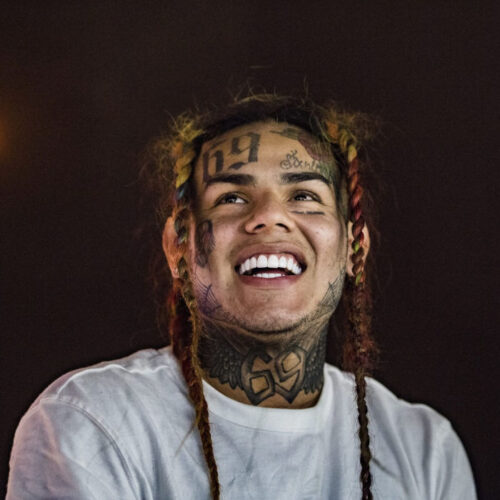
Daniel Hernandez (born May 8, 1996) and professionally known as 6ix9ine, Tekashi69, or Tekashi 6ix9ine, is an American rapper. He emerged in the late 2010s with an aggressive vocal style and a highly visible public persona, characterized by distinctive rainbow-colored hair, extensive tattoos, frequent use of social media, and involvement in public controversies and feuds. Hernandez first gained attention in 2017 through a guest appearance on Trippie Redd’s single "Poles 1469".
6ix9ine: Chaos as Strategy — How a Bushwick Kid Rewired Hip-Hop’s Attention Economy
6ix9ine, born Daniel Hernandez in Bushwick, Brooklyn, is hip-hop’s most polarizing demand-driver of the late 2010s — an artist who fused maximalist vocal aggression with a near-algorithmic mastery of controversy.
Known professionally as 6ix9ine (pronounced “six nine”) or Tekashi69, he is an American rapper and internet personality
whose career trajectory defies any clean narrative arc. He arrived loud, departed under federal prosecution, returned louder still, and then pivoted — repeatedly — toward Latin urban markets with a structural confidence few English-language rappers have demonstrated. Whether that constitutes artistic range or commercial opportunism is a question his catalog keeps refusing to resolve.
Artist Profile
| Legal Name | Daniel Hernandez |
| Origin | Bushwick, Brooklyn, New York City, NY, U.S. |
| Years Active | 2014 – present |
| Genre | Hip-Hop, Trap, Latin Urban, Reggaeton |
| Labels | FCK THEM (early), ScumGang, Tr3yway (former), 10K Projects, Create Music Group, La Corporación, Planet Records |
| Notable Collaborators | Nicki Minaj, Murda Beatz, Anuel AA, Bobby Shmurda, Kanye West, Lil Baby, Trippie Redd, Lenier, Bebeshito, Grupo Firme |
| RIAA Certifications | Platinum — Dummy Boy (album); Platinum — Day69 (mixtape); 9 platinum singles, 2 gold singles |
| Albums in Catalog | 3 studio albums, 2 mixtapes, 2 EPs |
Performance Snapshot (Get Music Catalog)
| Total Listeners | 2,206 |
| Country Reach | 5 countries |
| Albums in Catalog | 1 (Papita Frita, 2024) |
| Top Format | Digital streaming / Latin Urban |
From Bushwick to the Algorithm: Career Arc and Signature Sound
Hernandez began his career as a rapper in 2014, releasing songs such as “69” and “Scumlife.”
Those early records were essentially functional — rough, low-budget documents produced on the fringes of Brooklyn’s trap underground.
Over the next three years, he released multiple tracks including “Scumlife,” “Yokai,” and “Hellsing Station,” drawing attention for his aggressive rapping style and use of anime as music video visuals — many of those early songs released by FCK THEM, a music label based in Slovakia.
That transatlantic infrastructure, modest as it was, gave Hernandez an early lesson in how regional distribution pipelines can be routed around the traditional U.S. major-label gating system.
The inflection point arrived in November 2017.
“Gummo,” his commercial debut single, was released on November 10, 2017, and eventually peaked at number 12 on the US Billboard Hot 100.
The song peaked at number 12 on the US Billboard Hot 100 and was certified 2x Platinum by the RIAA.
More than any production choice, it was the delivery that registered: a strangled, coercive vocal timbre operating somewhere between a yell and a bark, anchored to a mid-tempo trap grid that left enormous space for the voice to dominate. There was no melodic cushion, no harmonic variation to speak of — the track’s tonal center barely moved, which was precisely the point. The monotony of the production became a canvas for aggression rather than a limitation of it.
By early 2018, the velocity was undeniable.
His second mixtape, Day69 (2018), debuted at number four on the US Billboard 200 with 55,000 album-equivalent units, of which 20,000 were pure album sales.
The label infrastructure expanded accordingly: from the home imprint ScumGang into a distribution arrangement with 10K Projects, which had the marketing muscle to push trap product across DSPs at scale.
He earned his first top-five entry on the Billboard Hot 100 with “Fefe,” featuring Nicki Minaj and Murda Beatz, which peaked at number three on the chart.
Murda Beatz’s production on that single — compressed 808s, a skeletal melodic figure running in an upper register — gave 6ix9ine’s vocal assault a cleaner commercial wrapper than anything he had released before. The contrast between Minaj’s technical fluency and Hernandez’s blunt-force cadence was itself a production decision, even if an unspoken one.
Then came the arrest, the racketeering case, the federal cooperation — and, after his 2020 release, an immediate return to charts.
The Brooklyn artist became perhaps most famous for his 2020 collaboration with Nicki Minaj, the Hot 100-topping “Trollz.”
Few artists have managed to chart a number-one single while under house arrest; the achievement illustrated something essential about 6ix9ine’s market function: he operates as a media event as much as a recording artist, and the noise around his person generates streaming velocity independently of the music’s formal qualities.
Discography Highlights: Aggression, Reinvention, and the Latin Pivot
Dummy Boy (2018), his debut studio album, debuted at number two on the US Billboard 200 with 66,000 units, including 10,000 pure album sales.
Released under ScumGang, 10K Projects, and Create Music Group, it earned RIAA Platinum certification alongside BPI Gold in the UK and IFPI DEN Gold in Denmark.
The record arrived under chaotic circumstances —
released on November 27, 2018, after being delayed a week due to his arrest
— and yet it charted across multiple European territories simultaneously, reaching number one in Finland and number two in both the US and Canada. That geographic spread was not accidental. 6ix9ine’s confrontational visual brand and social-media saturation had already built international name recognition before most of those markets encountered his music in any sustained format.
TattleTales (2020), released through ScumGang and Create Music Group, arrived during his post-incarceration period and debuted at number four on the Billboard 200. The album’s commercial performance — reaching the top five in the US, Canada, Norway, and Australia — confirmed that the audience had not dispersed during his absence. If anything, the controversy surrounding his federal testimony had intensified public attention on him, however negatively distributed.
The third studio album marked the sharpest pivot.
Leyenda Viva (“Living Legend”) is a reggaeton, dembow, and Latin trap record released June 16, 2023, through La Corporación.
Production was handled by Mauro “El Código Secreto,” Boris Arencibia, J Prod, El Keretumba, Angel Sandoval, Isael Gutierrez, and Evert Gutierrez
— a production committee drawn almost entirely from the Latin urban ecosystem rather than the New York trap milieu.
The album features guest appearances by Lenier, Secreto “El Famoso Biberón,” Ángel Dior, Yailin La Más Viral, and Grupo Firme.
The vocal approach adapted accordingly: where the English-language records leaned into tonal abrasion, Leyenda Viva found Hernandez working within dembow’s rhythmic grid — a two-bar kick-snare pattern with subdivisions on the offbeat — a structure that demanded melodic engagement rather than percussive shouting. It was a genuine recalibration.
The most recent entry in our catalog, Papita Frita (“Fried Potato Chips”), is a single released October 18, 2024.
Produced by Ernesto Losa and released under Planet Records, it sits in the urbano latino genre
and
features vocalists Bebeshito and Lenier, with production by Ernesto Losa and Mauro El Código Secreto.
The track reflects a sustained commitment to the Cuban and broader Caribbean urban market — Lenier is a Havana-born singer with strong streaming presence across Latin America, and Bebeshito operates firmly within the Cuban dembow lane. At two minutes and forty-seven seconds, the record is tightly formatted for DSP placement: no wasted bars, no extended outro, the kind of structural economy that playlist curators reward.
Market Note — Career Positioning
6ix9ine’s IP strength is paradoxical: his brand recognition is among the highest of any artist who emerged in the 2010s SoundCloud-to-streaming transition, yet that recognition is heavily inflected by extracurricular notoriety rather than catalog depth. His RIAA footprint —
nine platinum-certified singles and two gold singles
— reflects genuine consumer demand across his commercial peak (2017–2020), and the album certifications confirm multi-territory reach rather than U.S.-only performance.
The post-2022 Latin pivot introduces a second revenue thesis: Latin urban streaming has outpaced English-language hip-hop in total global plays for several consecutive years. By embedding in the dembow and reggaeton ecosystem through producers like Mauro “El Código Secreto” and collaborators like Lenier, 6ix9ine has accessed a listener base whose demographic profile — younger, mobile-first, concentrated in the Americas and parts of Southern Europe — is structurally distinct from the audience that drove his 2018 numbers. Sync potential remains suppressed by reputational risk, but catalog longevity across DSP playlists holds if the Latin content continues to generate editorial placements in urbano latino channels.
Fan base demography skews male, 18–29, with strong penetration in the US, Mexico, Puerto Rico, and Dominican Republic based on streaming geography across his recent releases.
Geographic Reception and Cultural Coordinates
6ix9ine’s early audience was broadly American but with distinct concentrations in urban markets outside the traditional New York hip-hop axis — Chicago, Houston, Miami — where the trap aesthetic he was refining had deep local roots. His visual brand, however, read well across cultural contexts where subtlety was not the operating register:
the Dummy Boy album charted at number one in Finland, number two in the US and Canada, and inside the top ten across Norway, New Zealand, and Sweden,
a distribution pattern that speaks to how the confrontational spectacle of his persona translated even in markets with limited engagement with New York rap’s internal social codes.
The post-incarceration phase shifted the geographic logic. “Trollz” with Nicki Minaj was a US-anchored number-one, but the Latin pivot from 2022 onward has redirected the audience center of gravity toward Latin America and the Caribbean.
The collaboration with Anuel AA on “BEBE” became one of the most-streamed Spanish-language songs on YouTube and debuted at number one on the Hot Latin Songs list.
That performance was an early signal that his vocal timbre — abrasive in English, but structurally compatible with the call-and-response dynamics of reggaeton — could work within a completely different genre convention. The move toward Cuban dembow specifically, via collaborators like Lenier and Bebeshito on Papita Frita, extends that logic into a sub-genre with an intensely loyal streaming base across Cuba, Puerto Rico, and the Cuban diaspora in South Florida.
European markets responded primarily to his 2018-2020 output.
The TattleTales album reached number four in the US, number fourteen in Austria, number five in Canada, and top-thirty positions across Finland, Norway, New Zealand, Sweden, Switzerland, and the UK
— a breadth of chart placement that most hip-hop artists of his generation could not match. The pan-European reach owed something to 10K Projects’ distribution infrastructure and something to the unignorable media presence 6ix9ine maintained through social platforms that had fully penetrated those markets by 2020.
On the Get Music platform, his five-country listener spread is modest by volume but geographically coherent with the Latin turn: the audience profile aligns with the urbano latino streaming corridor rather than the North American trap lane. This is the natural market outcome of three consecutive releases — Leyenda Viva, Blackballed, and Papita Frita — all produced within the Latin urban idiom and routed through Latin-market label infrastructure.
Critical Legacy: The Problem of Evaluating an Artist Who Is Also a Media Object
Serious critical assessment of 6ix9ine’s music has always been entangled with the difficulty of separating the work from the person producing it — not because biography is irrelevant to criticism, but because the persona is, by design, inseparable from the product. Hernandez understood, earlier than most of his peers, that in a streaming economy where discovery is driven by algorithmic amplification of engagement, controversy and outrage function as marketing instruments. The rainbow hair, the facial tattoos, the relentless feuds, the courtroom testimony — these were not incidental to the music’s reach; they were the mechanism generating it.
On formal terms, the 2017–2018 catalog deserves closer attention than it typically receives in critical circles. The early singles operated with a kind of brutal minimalism: repetitive tonal centers, distorted 808 bass as a primary melodic instrument, vocal delivery that treated pitch as irrelevant and rhythmic placement as the only variable worth controlling. This is not unsophisticated — it is a deliberate reduction of hip-hop’s formal parameters to the elements with the highest physiological impact on an audience. The absence of harmonic development in tracks like “Gummo” or “Billy” is a choice, not a limitation. The monotony is the texture.
Where critical assessment grows more complicated is in the post-2020 work.
His third studio album, Leyenda Viva, represents his first reggaeton release — dropped June 16, 2023, without prior announcement.
That structural move — full genre migration, new production team, new language register, new collaborator pool — is either evidence of genuine artistic curiosity or the most calculated market repositioning of his career, possibly both. The dembow grid demands a different relationship with melody than trap does, and the fact that Hernandez acquitted himself adequately within it suggests his musicianship is more adaptable than the early caricature allowed.
In 2019, 6ix9ine testified against fellow members of the Nine Trey Gangsters in a racketeering and firearms case in exchange for a reduced sentence,
an act that has permanently altered his standing within hip-hop’s social codes. The reputational damage within the genre’s core community is structural and unlikely to reverse. What it has done, practically, is accelerate his turn away from that community — toward Latin urban markets where his prior affiliations carry less symbolic weight, and where his chart history in the Latin space provides a more functional credential than his New York street-rap biography ever did.
The critical legacy, such as it is, will likely be assessed across two separate registers: as a formal innovator in the delivery-first, production-minimal approach of 2017 trap, and as a case study in how an artist can rebuild commercial viability through genre migration after extracurricular events have foreclosed the primary market. Neither reading is particularly comfortable. Both are, on the evidence of the catalog, accurate. Papita Frita is not a legacy statement — it is a working single, embedded in an ongoing Latin urban market strategy, produced by Ernesto Losa and Mauro El Código Secreto with the same structural economy that characterized his 2017 English-language output. The method adapts; the logic holds.
Frequently Asked Questions
Where should I start with 6ix9ine’s catalog?
If your entry point is the commercial peak, Day69 (2018) is the most concentrated representation of his early sound — the mixtape that put him on the Billboard 200 at number four and introduced his template of distorted delivery over sparse trap production. For the Latin pivot, Leyenda Viva (2023) offers the clearest document of how he repositioned within reggaeton and dembow. The 2024 single Papita Frita, available in our catalog, is a useful entry point for the contemporary Cuban urban direction.
Is 6ix9ine still active?
Yes.
*Papita Frita* was released on October 18, 2024, under Planet Records,
confirming continued recording activity. His output since 2022 has been concentrated in the Latin urban space through La Corporación and Planet Records, working with producers and vocalists based primarily in the Cuban and Puerto Rican urban scenes. He has maintained a consistent social-media presence and has released music under multiple label arrangements without a formal hiatus.
Who has 6ix9ine collaborated with?
In the course of his career, 6ix9ine has worked with Anuel AA, Murda Beatz, Nicki Minaj, A Boogie Wit da Hoodie, and Trippie Redd,
among others. His highest-charting collaborations include
“Trollz” with Nicki Minaj, which topped the Billboard Hot 100,
and
“Fefe” with Nicki Minaj and Murda Beatz, which peaked at number three.
His Latin-market collaborations include Anuel AA, Lenier, Bebeshito, Grupo Firme, and Yailin La Más Viral. On the production side, Mauro “El Código Secreto” has been his most consistent studio partner across the Latin urban catalog.
Which artists are similar to 6ix9ine?
Listeners drawn to his 2017–2020 trap output will find comparable energy in the work of Trippie Redd and ZillaKami — artists who share the delivery-first aesthetic and minimal harmonic interest. For the Latin urban dimension, Anuel AA and Bad Bunny occupy adjacent terrain, with stronger melodic development and deeper genre fluency. You can explore further hip-hop and Latin urban releases across 6ix9ine’s full artist page on Get Music for catalog context.
Written by Setenay Mira KAYA — Girls Choice Music, Get Music
Published: October 9, 2026
Have a release you want featured? Submit via Telegram: t.me/ViralSubmissions
1 album in our catalog
All releases
Complete release history from MusicBrainz — albums, EPs, singles, live, and more.
Album (6)
- 2023Leyenda Viva
- 2021SCÜM.WØRLD.ØRDER
- 2020TattleTales
- 2018DUMMY BOY
- 2018Day69
- 2017Tekashi69
EP (3)
- 2023El Rey Of Latin
- 2023Latin King | The Rat Is Back
- 2023BLACKBALLED
Single (15)
- 2018KEKE
- 2018GIGI (ZKITTLEZ)
- 2018FEFE
- 2018Scumwave
- 2018Dope
- 2018TATI
- 2018Get the Strap
- 2017No Smoke Ruff
- 2017GUMMO
- 2017KOODA
- 2016Squad Up
- 2016Hellsing Station
- 2016YOKAI
- 2016Hellsing Station
- 2015SHINIGAMI
Album (Compilation) (1)
- 2024Tekashi 6ix9ine’s Greatest Hits