At a glance
Where the world is listening
THE MOUNTAIN: GORILLAZ ARRIVE AT THE PLACE GRIEF AND JOY SHARE A BORDER
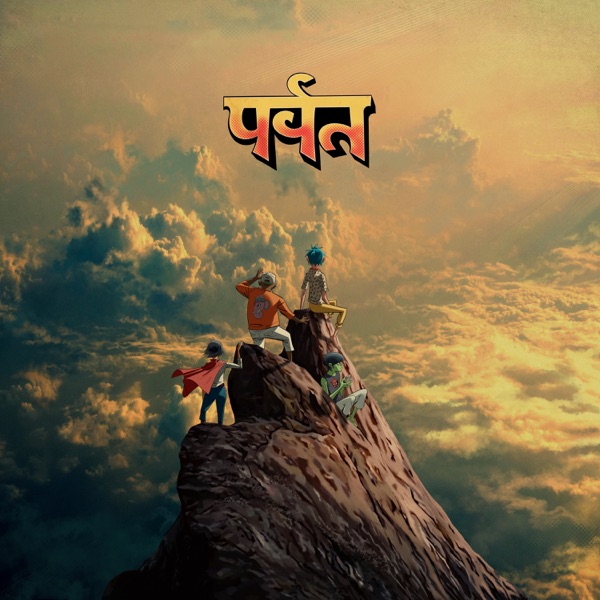
Gorillaz’s The Mountain — the British virtual band’s ninth studio album, released February 27, 2026 — is the most emotionally substantive record Damon Albarn and Jamie Hewlett have made since Demon Days, and possibly the most globally ambitious record either has ever attempted.
Drawing heavily from Indian classical instrumentation alongside the band’s usual pop and electronic influences, the album focuses thematically on death, grief, and the afterlife, inspired by the loss of both Albarn’s and Hewlett’s fathers in the midst of its production.
That biographical weight is real and audible. This is a record that earns its scale — not by being loud, but by knowing exactly when to be quiet.
Album Credits
| Artist | Gorillaz |
| Released | February 27, 2026 |
| Genre | Alternative Rock / Art Pop / Neo-Psychedelia / Hindustani Classical |
| Label | Kong (distributed by The Orchard / Sony Music) |
| Producer(s) | Damon Albarn, Remi Kabaka Jr., James Ford, Samuel Egglenton; Bizarrap (on “Orange County”) |
| Tracks | 15 |
| Runtime | 1 hour 6 minutes |
| Lead Single(s) | “The Happy Dictator” (feat. Sparks); “The Manifesto” (feat. Trueno & Proof); “The God of Lying” (feat. IDLES); “Damascus” (feat. Omar Souleyman & Yasiin Bey); “The Hardest Thing” / “Orange County” |
Performance Snapshot
| Global Listeners | 270,754 |
| Total Scrobbles | 6,368,309 |
| Countries Charting | 43 |
| Strongest Market | United States — 135,026 listeners |
| Top 3 Markets | United States · Brazil · United Kingdom |
Production Architecture: Where Hindustani Raga Meets Dub Pressure
The album was produced by Albarn, Remi Kabaka Jr., James Ford, and Samuel Eggleston
— the same core production axis that has steered Gorillaz’s more textured recent work, but here operating with conspicuously wider latitude.
The Mountain was recorded at Studio 13 in London and Devon, various locations in India including Mumbai, New Delhi, Rajasthan and Varanasi, as well as Ashgabat, Damascus, Los Angeles, Miami and New York
— a logistical sprawl that shows up directly in the record’s timbral vocabulary. The result is a production approach that refuses easy genre assignment.
A wide-reaching album that relies on classical Indian orchestral arrangements as often as it does the far-out electropop that Gorillaz have built their brand on
— that Consequence summary is about as concise as the record itself ever allows. The opening instrumental “The Mountain,” featuring Anoushka Shankar on sitar alongside bansuri flute player Ajay Prasanna and the Bangash brothers on sarod, establishes the tonal center early: there is no rush here, no hook arriving to validate your attention. The album asks you to track a slower arc.
Hewlett said people listening to the album are “supposed to listen to it from beginning to end,” saying that they were “trying to bring back that idea of taking time to invest in something, instead of this culture of scrolling.”
That editorial position — against the scroll, for the listen — is written into the production itself.
“The God of Lying” (feat. IDLES) operates in doomy dub register, Joe Talbot’s bark sitting high in the mix over a bass-led groove that owes more to Lee Perry than to Albarn’s Britpop lineage.
“Damascus” deals in doomy dub as well, while Sparks appear as autocratic rulers on “The Happy Dictator” and the Johnny Marr-assisted “The Plastic Guru” contemplates how belief and truth can be manipulated.
Marr’s guitar — clean, suspended, arriving like a question — is used as a melodic counterweight throughout his three appearances on the record. Marta Salogni’s mixing deserves its own credit: the dynamic range on this album is exceptional, the orchestral sections breathing where most contemporary records would compress them flat.
The album features artists performing in five languages: Arabic, English, Hindi, Spanish, and Yoruba.
Polyglot albums almost always fragment under their own ambition. Here, the linguistic diversity reads less as curatorial gesture and more as structural logic — the themes of death, crossing over, and the afterlife genuinely do not belong to any single cultural tradition, so the record treats them plurally. That choice is consistent enough to feel principled. For a reference point with adjacent catalog DNA, see The Death Of by Panchiko — another record that makes grief-adjacent abstraction feel formally coherent.
Songwriting and Thematics: The Living and the Posthumous, in Conversation
Thematically, the album focuses on death, grief, and the afterlife, inspired by Gorillaz creators Damon Albarn and Jamie Hewlett both experiencing the deaths of close family members during its production.
Albarn’s response to that loss was characteristically oblique — not confessional in the singer-songwriter sense, but structural. He embedded grief into the architecture of the record by actively recruiting the voices of the dead.
The album continues the band’s tradition of featuring collaborations with a wide-ranging assortment of musicians, including Asha Bhosle, Asha Puthli, Black Thought, IDLES, Johnny Marr, Anoushka Shankar, Sparks, Omar Souleyman, Trueno, and Yasiin Bey, as well as posthumous appearances from previous Gorillaz collaborators such as Dennis Hopper, Bobby Womack, David Jolicoeur (of De La Soul), Tony Allen, Proof, and Mark E. Smith.
The mechanics of that posthumous inclusion deserve scrutiny. “The Moon Cave” places Black Thought’s contemporary rap delivery alongside the archived voice of Dave Jolicoeur — two friends, one of whom is gone.
Afrobeat legend Tony Allen gently says “Oya, e dide erori” (Yoruba for “Oh, wake up my dear”) on “The Hardest Thing,” while Mark E. Smith comes bowling and bellowing through the celestial calm of “Delirium,” and this life dovetails with the next on “The Moon Cave,” which carries the voice of Bobby Womack and also features Black Thought swapping bars with the late Dave Jolicoeur of De La Soul.
The editorial decision to frame these inclusions thematically — rather than as archive nostalgia — gives them a weight they might otherwise lack.
Albarn’s own vocal performance here is subdued, often pushed back in the mix behind the collaborators. This is not a failure of confidence — it is a compositional position. He is less the protagonist than the convener. On “Casablanca,” featuring Paul Simonon and Johnny Marr, his melody arrives late, almost as afterthought, and the song is stronger for it. The lyrical register across the record tends toward the lapidary rather than the explicit: images of rivers, mountains, departure, dust.
The record, like Albarn’s 2021 solo album The Nearer the Fountain, More Pure the Stream Flows, explores loss and transformation — themes you become more sensitive to the older you get. While there aren’t huge signs of wear on the animated faces that front Gorillaz, Albarn and Hewlett, both well into their fifties, lost their fathers while working on The Mountain.
The record has the cadence of men processing something slowly. That is not a complaint.
Some of the deepest wellsprings of renewal come from places of profound loss, and The Mountain proves it.
“The Shadowy Light,” featuring Asha Bhosle — whose six-decade career in Bollywood playback singing gives her voice a register no Western studio approximation could replicate — is the most formally beautiful track on the record. Her melodic phrasing against the Ali Bangash brothers’ sarod creates a kind of chiaroscuro that no amount of production trick could manufacture; it had to be recorded where it was, by who it was.
Market Note: Independent Release, Global IP, and the Kong Catalog Play
Kong is Gorillaz’s own label, and The Mountain is KONG’s first release, with global digital and physical distribution via The Orchard.
The significance of that move is more than contractual autonomy — it repositions the entire Gorillaz catalog IP within a structure the artists control directly. For a band whose first eight albums were issued via Parlophone and Warner, the leverage shift is material.
The streaming demand profile supports that confidence. With 270,754 global Last.fm listeners generating 6,368,309 scrobbles — a per-listener scrobble ratio of roughly 23.5, indicating sustained deep listening rather than passive discovery — the catalog is behaving less like a singles vehicle and more like a long-form engagement asset. Forty-three countries charting simultaneously represents exceptional geographic depth for an alternative-leaning release in early 2026.
Sync potential here is significant: the record’s multilingual, multi-temporal framework gives music supervisors wide surface area — from the dub urgency of “The God of Lying” for prestige drama, to the sitar-pop of “The Shadowy Light” for international co-productions.
The Mountain debuted at number one on the UK Albums Chart and number seven on the US Billboard 200, earning Gorillaz their third number one album in the UK
— that chart performance, combined with the independent release structure, sets a commercially compelling precedent for the Kong label’s next moves.
Listen with 30-sec previews
Previews served by iTunes. Press play on any track.
Similar albums

Released the same week
Other albums released near this date, across years.