At a glance
Where the world is listening
THE CAR: ARCTIC MONKEYS LEAN ALL THE WAY INTO THE LOUNGE AND DARE YOU TO FOLLOW
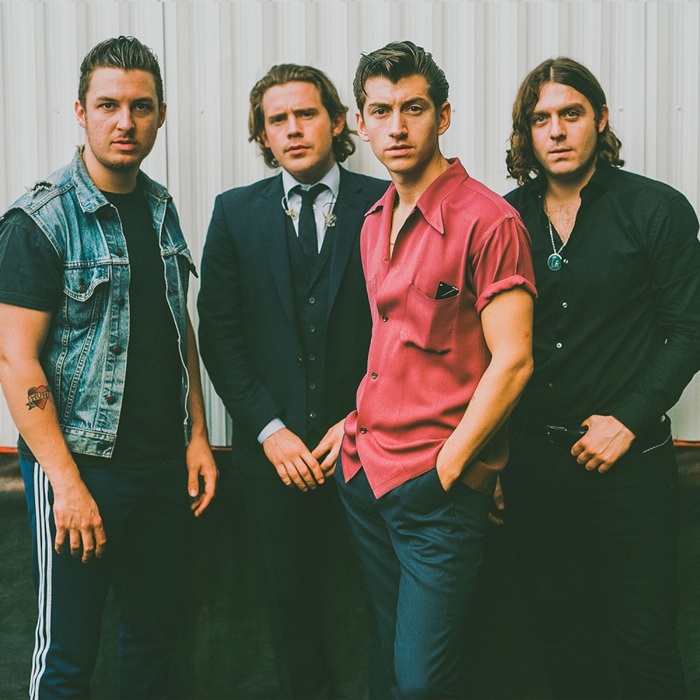
The Car, the seventh studio album by Arctic Monkeys, released October 21, 2022 on Domino, is the most deliberate left turn in a career built on left turns — a baroque-pop, orchestral-rock record that is cool to the touch and dares the listener to keep up.
Written primarily by frontman Alex Turner in his Los Angeles home and in Paris, the album arrived via Domino Recording Company on 21 October 2022.
It followed four years of silence that felt longer than they were — a gap wide enough for the band to shift aesthetics without explanation and trust the audience to catch up. Some did. Some are still standing at the curb, watching it pull away.
Album Credits
| Artist | Arctic Monkeys |
| Released | October 21, 2022 |
| Genre | Art Rock / Orchestral Rock / Baroque Pop / Lounge Pop |
| Label | Domino Recording Company |
| Producer(s) | James Ford |
| Tracks | 10 |
| Runtime | 37:18 |
| Lead Single(s) | “There’d Better Be a Mirrorball” / “Body Paint” / “I Ain’t Quite Where I Think I Am” |
Performance Snapshot
| Global Listeners | 552,145 |
| Total Scrobbles | 20,114,354 |
| Countries Charting | 43 |
| Strongest Market | United States — 145,478 listeners |
| Top 3 Markets | United States · Brazil · United Kingdom |
Production Architecture: Strings, Space, and the Refusal of the Hook
The album was produced in Suffolk, Paris, and London by frequent Arctic Monkeys collaborator James Ford, alongside guest musicians Tom Rowley, Loren Humphrey, and Tyler Parkford, and arranged by Bridget Samuels, Ford, and Turner.
That guest roster is worth pausing on. String arrangers don’t usually get top billing in indie-rock production credits. Ford —
credited as producer on every Monkeys album aside from their 2006 debut
— has steadily moved the band’s sonic centre of gravity away from the serrated guitar tones of their early career, and here he goes the furthest yet. The result is an album that breathes differently from anything the band has made before.
The record features a wide array of genres that include art rock, orchestral rock, lounge pop, baroque pop, and funk, as well as elements of jazz.
That description sounds like a genre-wheel spin, but Ford and Turner earn every one of those tags. The opening track, “There’d Better Be a Mirrorball,” is the most concise summation of the record’s intent: strings materialise slowly beneath Turner’s baritone, the tempo is unhurried to the point of deliberate suspension, and the dynamic between orchestra and rhythm section is handled with a restraint that most bands would have blown through to manufacture climax. The strings on this record, as Turner noted before the release,
“come in and out of focus” as a deliberate compositional move, so that “everything has its own space.”
“Sculptures of Anything Goes” deploys a brooding Moog figure under Turner’s most overtly self-interrogating lyric on the record.
The song could easily be a line off 2013’s AM, containing the same disco depression and lounge-act bravado
— but the arrangement is far more open, less guitar-forward, the low-end mixed below the orchestral mid-range in a way that creates genuine vertical space in the stereo field. “Body Paint,” the most physically immediate cut here, gets closest to the band’s earlier R&B-adjacent period without sacrificing the new chamber sensibility Ford and Samuels have constructed. The interaction between muted guitar figures and pizzicato strings on that track is the album’s most convincingly integrated production moment.
For those arriving from records like Cool It Down by Yeah Yeah Yeahs — another 2022 release that traded in careful orchestral restraint after a long hiatus — the structural logic of The Car will feel recognisable: slow tempos, textural density, absence of traditional rock momentum. Neither record is making the same argument, but they share the formal confidence of bands who stopped caring about proving themselves years ago.
Turner’s Lyric Grammar: Imagism, Incompletion, and the Romantic Evasion
Alex Turner has been performing a specific high-wire act since at least Tranquility Base Hotel & Casino: writing lyrics that feel significant and impenetrable simultaneously. On The Car, he goes further.
With regularity, Turner will begin an idea that he does not finish, or he’ll introduce something totally different just when you start following along. He has become a master of turns of phrases that don’t necessarily cohere but still feel right.
That’s accurate, and it’s also the record’s most divisive quality. Listeners who want Turner to deliver the emotional payload directly will find this maddening. Listeners who’ve made peace with obliqueness will find it magnetic.
The vehicular imagery that titles the album is not a gimmick.
The title refers to the cover and the abundance of vehicular references in the lyrics.
Cars in Turner’s lexicon function as thresholds — entry points to intimacy, escape hatches from it. “So if you wanna walk me to the car / I’m sure to have a heavy heart” on “Mirrorball” is one of his finest couplets in years: self-deprecating, deflective, and oddly tender all at once. The departure as emotional metaphor runs through the record like a structural motif rather than a recurring image, and it gives the album a tonal consistency that the genre-mixing production might otherwise have dissipated.
Turner’s vocal performance has shifted. His register sits lower than it did on AM, and the delivery is more legato, less staccato. There’s less of the theatrical swoop he favoured on Tranquility Base.
“The Car” is described by critics as the band’s most soundtrack-like work so far, flowing together in one long movement made cohesive by Bridget Samuels’ lush orchestral arrangements.
Turner’s voice is complicit in that cohesion — it functions less as a lead instrument and more as first among equals in the mix, particularly on “Hello You” and “Mr. Schwartz,” where the melody refuses resolution in a way that rewards close-listening over immediate gratification.
Critics noted that “the brutal precision of Turner’s observations and the way he relishes a smart turn of phrase brings these vignettes to life in a way that’s almost frighteningly vivid.”
That’s the best case for the record’s lyrics. The counterargument — that the imagism occasionally tips into self-indulgence, that some passages feel like Turner writing to himself — is not without merit. “Jet Skis on the Moat” in particular leans so hard into the ornate that its best lines get lost in the elaboration. But on balance, this is the work of a songwriter operating with unusual formal discipline. He is not making it easy for you. He rarely does anymore.
Market Note: A Deep Catalog Play in a Streaming-First Era
With 20,114,354 total scrobbles against 552,145 global listeners, The Car shows a per-listener depth ratio that indexes well above new-release averages — a strong signal of repeated, intentional listening rather than algorithmic passive consumption. This is the behavior profile of a catalog asset, not a singles-market release. The strongest demand driver is unsurprisingly the United States at 145,478 listeners, but the second-place position of Brazil (69,437) is notable: Latin American markets, particularly Brazil, have emerged as reliable long-tail markets for art-rock IP with strong streaming velocity and low physical-retail dependence. The United Kingdom at 44,250 follows — sentimental home territory, but not dominant, which reflects the polarised domestic reception to the record’s stylistic departure. The 43-country footprint across the Performance Snapshot, with meaningful presence in Poland (10,044), Germany (8,635), and the Netherlands (8,464), confirms the album’s strength in the European continental markets where art-rock and orchestral pop have historically maintained higher format longevity. The multi-Grammy nomination profile —
the album was shortlisted for the 2023 Mercury Prize, nominated for the 2024 Grammy for Best Alternative Music Album, and “There’d Better Be a Mirrorball” nominated for Best Alternative Music Performance at the 65th Annual Grammys
— reinforces sync potential and licensing value across prestige television and film. This is a record built for catalog, not for the weekly chart cycle.
Geography of Reception: Sheffield Ghosts, Los Angeles Light, and a Brazilian Embrace
The album’s songs were primarily written by Alex Turner in his Los Angeles home and Paris.
That’s worth stating plainly, because the geography of composition is audible. The Car doesn’t sound like Sheffield. It doesn’t try to. The milieu is a certain kind of late-evening Californian interior — midcentury furniture, slow ceiling fan, the specific diffuse light that appears in Roger Deakins cinematography. Whether that aesthetic coherence is a strength or a displacement depends on what you think a Sheffield band owes to its origins at decade seven of their career.
That the United States claims the largest single listener base — 145,478, more than double the UK’s 44,250 — is contextually interesting. American audiences, particularly on the coasts, have historically absorbed the kind of baroque art-rock Turner is now making with fewer nostalgic complications than British ones. The Manchester and Sheffield legacies don’t weigh on American listeners the same way. They can take the record on its own terms without mourning whatever preceded it.
The band played live in Istanbul in August 2022 as the tour’s opening performance, and it was their first concert since 2019
— a fact worth noting because the global tour that supported The Car reached well beyond the Anglo-American axis.
Brazil’s second-place position (69,437 listeners) deserves more than a passing mention. Brazilian audiences have been among the most vocally enthusiastic supporters of the band’s post-AM catalogue, and the sonic affinities are not entirely puzzling: the orchestral pop lineage in Brazilian music — from the tropicália tradition to the lush production of MPB — creates an audience naturally attuned to the kind of string arrangement and tonal warmth The Car deploys. Vício Elegante by Belchior, a landmark of 1970s Brazilian popular song, catalogued here at Get Music, shares with this record an investment in lyric as primary texture and arrangement as emotional climate — a coincidence worth noting for those building cross-catalog listening paths.
The European spread — Poland, Germany, the Netherlands all cracking 8,000+ listeners — maps onto the continental art-rock infrastructure that sustained acts like Portishead and Radiohead through their own late-period reinventions.
In the UK, the album became the third best-selling vinyl record and the best-selling cassette of 2022.
Physical format strength in an era of streaming dominance is a specific kind of market signal: it means a listener base willing to pay a premium to own the object. That audience doesn’t follow singles. It follows catalogs.
Critical Assessment: What Holds, What Drifts, and Why the Argument Matters
At Metacritic, the album received a score of 82, based on 25 reviews, indicating “universal acclaim.”
NME and Time Out named it the best album of 2022.
Publications including Mojo, DIY, The Sunday Times, and Kitty Empire of The Observer included the album in their top five year-end lists.
That’s a formidable critical consensus. It also tells you something about who is reviewing this record and what frame they’re bringing to it.
The case for The Car rests on coherence, craft, and controlled ambition.
Critics noted it is “a deftly constructed, lavishly produced, smooth runner of an album” that reaffirms Turner as one of the great romantic lyricists of his generation.
That’s defensible.
Others called it the band’s “most soundtrack-like work so far, flowing together in one long movement made cohesive by Bridget Samuels’ lush orchestral arrangements.”
Also defensible, and not entirely a compliment — soundtrack-like means you notice it most when it’s supporting something else. As a standalone listening experience on its own terms, that framing creates a tension the record never fully resolves.
The skeptical case is equally coherent.
AllMusic observed that Turner “seems to be angling for atmosphere, not hooks,” and that “the free-floating croon helps The Car amiably drift in space but also highlights how the record could use a couple of elements to bring it back to earth.”
That’s the most precise version of the dissent: not that the record is bad, but that it is incomplete on its own terms.
Critics pointed to tracks like “Jet Skis on the Moat” as a “limp funk snoozer” and “Perfect Sense” as an underwhelming closer.
Both charges are fair. “Jet Skis” is the one track where the aesthetic confidence curdles into self-satisfaction. “Perfect Sense” as a closing statement is weirdly deflating — it doesn’t so much resolve the album as let it exhale and go quiet.
What holds, definitively: the opening triptych of “Mirrorball,” “I Ain’t Quite Where I Think I Am,” and “Sculptures of Anything Goes” is the strongest consecutive sequence Arctic Monkeys have recorded since the first side of AM. “Big Ideas” is an overlooked album highlight — its gentle modulation and conversational melody represent Turner at his least ornate and most direct. “Hello You” closes the record’s interior with something approaching genuine warmth.
Critics complimented the band’s artistic progression, the album’s production, and Turner’s lyrics, though some felt the continued deviation from their earlier indie rock sound would remain polarising to longtime fans.
That last clause is the honest summation. The Car is not for the listener who wants the band to revisit their velocity. It is for the listener who finds a band’s refusal to repeat itself more interesting than any specific sound they’ve landed on. Whether that trade-off is worth it is, genuinely, a matter of where you stand. For what it’s worth: the record gets better on the fourth listen. Most of the good ones do.
For readers drawn to this record’s chamber-pop sensibility and orchestral patience, Desire, I Want to Turn Into You by Caroline Polachek (2023) operates in adjacent territory — maximalist arrangement, lyric as riddle, emotional register calibrated just below the surface — and rewards the same kind of close listening.
Frequently Asked Questions
Where can I stream or purchase The Car by Arctic Monkeys?
The Car is available on all major streaming platforms including Spotify, Apple Music, and Tidal. It is also available for digital purchase via Bandcamp and the Domino Records store. Physical editions — LP, CD, and cassette — were released in multiple variants including a limited custard-coloured vinyl available through independent retailers. The album page on Get Music can be found at getmusic.com.tr/album/the-car/.
How was The Car received critically and commercially?
The album received a Metacritic score of 82 based on 25 reviews, indicating “universal acclaim.”
It debuted at number two on the UK Albums Chart with 119,016 units, becoming Arctic Monkeys’ first album to not reach the top spot, ending a six-album streak at number one.
The record peaked at number two in various territories, prevented from the top spot by Taylor Swift’s Midnights.
Despite missing the chart summit, physical sales were strong:
the album became the third best-selling vinyl record and the best-selling cassette of 2022 in the UK.
Which tracks on The Car stand out most?
The consensus among critics and listeners points toward “There’d Better Be a Mirrorball,” “Body Paint,” and “Sculptures of Anything Goes” as the album’s strongest individual cuts.
All three were released as singles and peaked within the top 25 on the UK Singles Chart.
“Big Ideas” and “Hello You” are the most underrated tracks on the record — closer to the band’s earlier confessional mode than the more ornate material surrounding them.
Pitchfork described the album as “an album of love, longing, and doubt,” noting that the music matched the uncertainty of the lyrics.
What albums are similar to The Car and where can I find them?
Listeners engaged by The Car‘s chamber-pop architecture and lyric-first sensibility should look at Desire, I Want to Turn Into You by Caroline Polachek (2023) for maximalist orchestral pop with comparable lyric density, and Cool It Down by Yeah Yeah Yeahs (2022) for another 2022 record by a long-tenured band recalibrating toward restraint and atmosphere after an extended break. Both records reward the same kind of patient listening that The Car requires.
Girls Choice Music · Curation and Analysis
Authored on May 26, 2026
Follow editorial picks and new reviews on Telegram: t.me/ViralSubmissions
Listen with 30-sec previews
Previews served by iTunes. Press play on any track.
Similar albums


Released the same week
Other albums released near this date, across years.

![[untitled]](https://getmusic.com.tr/wp-content/uploads/2026/04/78ipuo1652408677-500x500.jpg)