At a glance
Where the world is listening
NOW AND THEN: THE LAST SIGNAL FROM A FREQUENCY THAT NEVER FULLY CLOSED
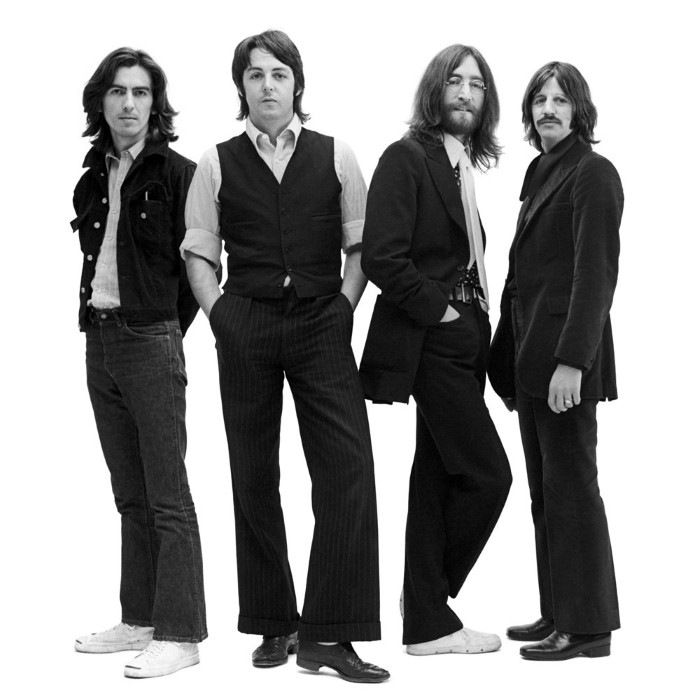
The Beatles’ Now and Then, released November 2, 2023 via Apple Corps/Capitol/UMe, is the most consequential pop single of the decade — not because its melodic architecture rivals A Day in the Life or Strawberry Fields Forever, but because its production backstory reshapes what “a Beatles recording” can legally and philosophically mean. Built on a late-1970s John Lennon home demo recorded at the Dakota Building in New York, and stalled for nearly thirty years due to technical and interpersonal friction, the single finally arrived after WingNut Films’ machine-learning audio restoration unlocked Lennon’s isolated voice from a degraded cassette. What emerged is a doleful mid-tempo ballad bearing the fingerprints of all four members across five decades, engineered by a production team straddling analog lineage and algorithmic precision. It is simultaneously an archival event, a grief object, and — depending on your critical posture — either a worthy final statement or a cautiously assembled keepsake that plays it too safe for the catalog it closes.
Album Credits
| Artist | The Beatles |
| Released | November 2, 2023 |
| Genre | Pop-Rock / Baroque Pop |
| Label | Apple Corps Ltd. / Capitol / UMe (Calderstone Productions Ltd.) |
| Producer(s) | Paul McCartney, Giles Martin; additional production: Jeff Lynne; mixed by Spike Stent |
| Tracks | 1 (double A-side single with “Love Me Do” 2023 Stereo Mix) |
| Runtime | 4:08 |
| Lead Single(s) | “Now and Then” / “Love Me Do” (2023 Mix) |
Performance Snapshot
| Global Listeners | 344,249 |
| Total Scrobbles | 2,659,834 |
| Countries Charting | 43 |
| Strongest Market | United States — 112,094 listeners |
| Top 3 Markets | United States, Brazil, United Kingdom |
Assembly as Authorship: Production Architecture and Sonic Identity
There is no precedent in pop history for the precise production chain that built “Now and Then,” and understanding that chain is essential to any honest assessment of what you are actually hearing.
The song originated as a ballad that John Lennon wrote and recorded around 1977 as a solo home demo but left unfinished.
In 1994, Yoko Ono Lennon gave the recording to Paul, George, and Ringo, along with Lennon’s demos for “Free as a Bird” and “Real Love,” which were both completed as new Beatles songs and released as singles in 1995 and 1996 as part of The Beatles Anthology project.
Paul, George, and Ringo recorded new parts and completed a rough mix with producer Jeff Lynne, but technological limitations prevented Lennon’s vocals and piano from being separated to achieve the clear, unclouded mix needed to finish the song.
The path cleared in 2021.
Lennon’s voice was extracted from the demo using the machine learning–assisted audio restoration technology commissioned by Peter Jackson for his 2021 documentary The Beatles: Get Back.
Paul McCartney and producer Giles Martin — son of the band’s original producer George Martin — were then able to assemble Lennon’s 1970s vocals with George Harrison’s 1995 guitar lines and Paul and Ringo’s new vocal and instrumental parts, as well as a string arrangement, to complete the song.
The engineering credits read like an archaeology report:
Geoff Emerick, Steve Orchard, Greg McAllister, Jon Jacobs, Steve Genewick, Bruce Sugar, and Keith Smith
are all listed, spanning decades and continents of session work.
The finished track was produced by Paul and Giles, and mixed by Spike Stent.
Sonically, the result is a slow-building piano ballad anchored by Lennon’s Mixolydian-inflected melodic phrasing — that characteristically flat-seventh resolution he favored on tracks like “Jealous Guy” and “Imagine” surfaces here in the verse contour. The string arrangement,
written by McCartney, Giles Martin, and Ben Foster and recorded at Capitol Studios in Los Angeles on 1 May 2022,
carries the song’s emotional weight in the third act, swelling beneath Harrison’s guitar figures with a register that owes something to the orchestrations on “The Long and Winding Road.”
Paul and Giles also added a subtler touch: backing vocals from the original recordings of “Here, There and Everywhere,” “Eleanor Rigby,” and “Because,” woven into the new song using techniques perfected during the making of the LOVE show and album.
That layer is the most conceptually rich decision on the entire track — a timbral palimpsest in which the past is not evoked but literally embedded. The stereo mix has attracted criticism from mastering engineers for excessive limiting;
mastering engineer Ian Shepherd noted the lack of dynamics in the stereo version, while Miles Showell confirmed that the mix he received was heavily limited
— though the Dolby Atmos version reportedly escapes that issue. For a related study in how catalog pop-rock navigates the analog-to-digital transition, The Turtles’ The Complete Original Album Collection offers an instructive contrast in how tape-era material is repackaged for streaming-era audiences.
Lennon’s Words, McCartney’s Stewardship: Songwriting and Vocal Performance
The lyrical text of “Now and Then” is uncomplicated by Beatles standards — and deliberately so. The verses move through a grammar of longing and address that reads like late-period Lennon private-journal material: direct second-person appeals, unresolved emotional accounts, an underlying tone of incompleteness that is, given the circumstances, genuinely uncomfortable to register. Critics who expected the density of “A Day in the Life” or even the wry compression of “Norwegian Wood” found the writing thin.
For The New York Times, Jon Pareles concluded that “its existence matters more than its quality” and that “the song can’t compare to the music the four Beatles made together in the 1960s. All it can do is remind listeners of a synergy, musical and personal, that’s now lost forever.”
That reading is not wrong, but it may be categorically misplaced. “Now and Then” is not an attempt to replicate the compositional ambition of 1966–1969. It is a private song — something Lennon wrote in the Dakota for reasons that were never meant for a stadium — and its plainness is arguably its most honest quality. The unfinished, repetitive quality of the lyrics, the way the bridge never quite resolves its harmonic tension, the sense that a middle eight is structurally absent: all of these feel like Lennon thinking aloud rather than crafting for an audience.
The vocal performance is the record’s most affecting element. Lennon’s cleaned-up voice occupies the center of the mix with a clarity that — despite the machine-learning processing — retains the slight upper-register push and tonal grain of his Dakota-era recordings, a timbre closer to Double Fantasy (1980) than to the studio-hardened voice of Revolver.
McCartney gives Lennon’s vocals space and prominence, blending his own voice sensitively into that wondrous brotherly harmony.
Ringo Starr’s drumming is understated to the point of minimalism — hi-hat patterns and a tambourine figure that echoes the percussion palette of “The Ballad of John and Yoko.” Harrison’s guitar work, drawn from the 1995 sessions, carries a slide-adjacent tone that places it in the lineage of his contributions to “Something” and the All Things Must Pass sessions.
The finished track simplifies Lennon’s emotional give-and-take; it has an unexpected closing flourish — a decisive, syncopated string phrase — and low in the mix, after a final shake of a tambourine, a voice says, “Good one!”
That coda detail, unscripted and caught on tape, is the single most human moment in the entire recording.
Market Note: Catalog IP and the Demand Economics of Finality
The commercial mechanics of “Now and Then” are inseparable from its IP architecture.
The single was released by Apple Corps Ltd./Capitol/UMe
— a label arrangement that consolidates streaming revenue, physical sales, and sync rights under one of the most defended catalogs in recorded music. The “last Beatles song” framing was not incidental; it is a demand driver that activated latent catalog consumption across age cohorts simultaneously. The Performance Snapshot registers 344,249 global listeners and 2,659,834 scrobbles across 43 charting countries — figures that, for a single without an album parent, indicate unusually deep catalog pull rather than playlist-algorithmic velocity. The United States leads at 112,094 listeners, followed by Brazil at 40,823 and the United Kingdom at 29,959 — a geographic distribution that mirrors the Beatles’ historical market structure while flagging Brazil’s emergence as a premium-tier catalog market.
In the U.K. alone, the single chalked up 78,200 combined chart units, including 48,600 sales — making it the fastest-selling single of 2023.
It is also the fastest-selling vinyl single of the century so far, with 19,400 copies sold on wax in the U.K.
The sync potential of this track is high but structurally constrained: the emotional gravity of the “last Beatles song” designation makes casual licensing unlikely, preserving its scarcity value. Catalog longevity for this release is essentially uncapped — the IP does not age out.
Listen with 30-sec previews
Previews served by iTunes. Press play on any track.
Similar albums


Released the same week
Other albums released near this date, across years.