
Listen / Follow
Tags
About Van Halen
Van Halen was an American rock band formed in Pasadena, California, in 1972. The band was recognized for revitalizing hard rock and for their energetic live performances and the guitar work of Eddie Van Halen. From 1974 to 1985, the lineup consisted of Eddie Van Halen on guitar, keyboards, and backing vocals, Alex Van Halen on drums, David Lee Roth on lead vocals, and Michael Anthony on bass. Their self-titled debut album, released in February 1978, reached No.
VAN HALEN: From Pasadena Garages to the Apex of American Hard Rock
Van Halen, the hard rock band from Pasadena, California, rewired the grammar of electric guitar and arena rock across a catalog that spans five decades and over 56 million US album sales. Few groups in recorded music history have managed to survive vocalist fractures, internal creative warfare, and industry seismic shifts while maintaining the commercial and critical gravitational pull that Van Halen sustained from 1978 through their final active years in the 2010s. Their story is not merely one of a guitarist’s virtuosity — it is a study in how a band’s internal tension can simultaneously destroy and produce the most commercially durable hard rock catalog in American music.
Artist Profile
| Origin | Pasadena, California, USA |
| Years Active | 1972–1999; 2003–2020 |
| Genre | Hard Rock, Heavy Metal, Pop Rock, Glam Metal |
| Labels | Warner Bros. Records; Interscope Records |
| Notable Collaborators | Ted Templeman (producer), Donn Landee (engineer/producer), Mick Jones (producer, 5150), Michael McDonald (co-writer), Andy Johns (producer) |
| RIAA Certifications | Van Halen (1978): Diamond (10× Platinum); 1984: Diamond (10× Platinum); Van Halen II: 5× Platinum; Women and Children First: 3× Platinum; 5150: 6× Platinum; Total catalog sales: 56.5M+ (US) |
| Albums in Catalog | 12 studio albums; 2 live albums; multiple compilations |
| Rock and Roll Hall of Fame | Inducted 2007 |
| Grammy Awards | Best Hard Rock Performance, 1992 (For Unlawful Carnal Knowledge) |
Performance Snapshot — Get Music Catalog
| Total Listeners | 73,853 |
| Countries Reached | 2 |
| Albums in Catalog | 1 (The Collection, 2015) |
| Catalog Entry | The Collection (2015) — View on Get Music |
The Pasadena Blueprint: Lineage, Formation, and the Emergence of a Singular Guitar Voice
Eddie and Alex Van Halen, whose father was a jazz musician, were classically trained before their family emigrated from the Netherlands to Southern California in the 1960s, where the brothers turned to rock music.
Though Eddie began as a drummer and Alex as a guitarist, the two eventually switched instruments
— a biographical detail that explains the rhythmic intelligence embedded in Eddie’s lead work, and the melodic instinct Alex brought to his drumming throughout the band’s catalog.
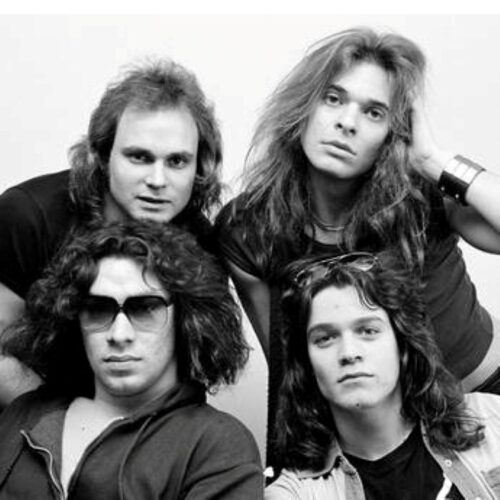
In 1972, with Alex on drums, Eddie formed the band that would become Van Halen. By 1974, it had the lineup that would make it one of the biggest groups in rock history: the two Dutch-born brothers, plus bassist Michael Anthony and singer David Lee Roth.
The four-piece gigged relentlessly across the Sunset Strip circuit, building a reputation for high-voltage live sets before securing a deal with Warner Bros. Records.
Producer Ted Templeman, who became the band’s principal architect in the studio for most of the Roth era, recognized something in those early demos that defied easy categorization.
Widely regarded as one of the greatest debut albums in rock music, the self-titled 1978 debut was a major commercial success, peaking at number 19 on the Billboard Top LPs and Tape chart.
That modest chart position belied the seismic cultural disruption happening underneath it — particularly in how Eddie’s two-handed tapping technique, showcased on the solo track “Eruption,” recalibrated every guitarist’s sense of what the electric guitar could do in a rock context.
No matter the singer, Eddie Van Halen’s high-flying guitar sound — heavy on tapping, with both hands on the neck of the instrument — was deeply influential, but also hard to imitate.
This was not merely technical showmanship. Eddie approached the guitar as a harmonic and melodic orchestration tool, layering thirds and fifth-relation intervals across his solos in ways that gave them melodic weight distinct from the pentatonic-box soloing that dominated rock in the 1970s. His tone — achieved through self-modified guitars (the so-called “Frankenstrat”), homemade amp configurations, and meticulous attention to pick attack and sustain — remains one of the most studied timbres in rock history.
During the 1980s, Van Halen, along with Heart, had more Billboard Hot 100 hits — fifteen — than any other hard rock or heavy metal band.
That figure is not a reflection of pop compromise so much as the band’s understanding of how to build a song around a hook without sacrificing weight in the low-register arrangements. Templeman’s production choices during this period — dry, punchy tracking with minimal reverb wash, prominent midrange, and an almost clinical separation between Alex’s kick drum and Eddie’s rhythm guitar — gave the recordings a physical immediacy that translated to both FM radio and arena PA systems with equal force.
Discography Highlights: The Arc from Debut Diamond to Hagar-Era Number Ones
Van Halen’s studio output is best understood in two distinct phases, separated by a vocalist change that — despite generating enormous public controversy — produced some of the band’s most commercially successful work. Their catalog entry on Get Music, The Collection (2015), offers a broad cross-section of both eras.
The 1978 debut has sold more than 10 million copies in the United States, receiving a Diamond certification from the RIAA and making it one of the best-selling albums in the country.
By 1982, the band had released four more albums — Van Halen II (1979), Women and Children First (1980), Fair Warning (1981), and Diver Down (1982) — all of which have over time been certified multi-platinum.
This run of five albums in four years represents one of the most productive and commercially consistent early-career stretches in hard rock, executed while the band maintained one of the most demanding touring schedules in the industry.
1984 (released January 9, 1984) is the Roth-era apex.
Commercially, the album reached number two on the Billboard 200 and remained there for five weeks, behind Michael Jackson’s Thriller. It produced four singles, including “Jump,” Van Halen’s only number one single on the Billboard Hot 100, along with top-20 hits “Panama” and “I’ll Wait.”
The recording process was complicated by guitarist Eddie Van Halen’s dissatisfaction with concessions made to frontman David Lee Roth and producer Ted Templeman, both of whom discouraged Eddie from making keyboards a prominent instrument. By 1983, Eddie was building his own studio, naming it 5150 after the California law code for involuntary psychiatric commitment, alongside longtime engineer Donn Landee.
The synthesizer-led intro on “Jump” — a mixolydian progression that opened the song in a register the band had never occupied so prominently — was the direct result of that internal friction resolving into creative autonomy.
The album was certified Diamond by the RIAA in 1999 for ten million shipped copies in the U.S.
In 1985, after six acclaimed albums, David Lee Roth left to pursue a solo career and was replaced by Sammy Hagar.
When the newly revamped Van Halen released 5150 on March 24, 1986, the album proved that lightning can indeed strike twice.
The album hit number one on the Billboard 200, surpassing the band’s previous album, 1984, which had peaked at number two behind Michael Jackson’s Thriller.
Recorded at Eddie Van Halen’s 5150 Studios, it was the first Van Halen album made without Ted Templeman; production was shared between Van Halen, engineer Donn Landee, and Foreigner guitarist Mick Jones.
The absence of Templeman’s signature midrange punch shifted the production aesthetic toward a brighter, more layered top end — a change that suited Hagar’s higher, more conventionally melodic vocal register far better than it would have suited Roth’s bark and drawl.
In addition to their commercial success, Van Halen were nominated for several Grammy Awards, taking home the Best Rock Performance Grammy for the 1991 album For Unlawful Carnal Knowledge.
That album debuted at number one on the Billboard 200 and maintained the position for three consecutive weeks.
Ted Templeman returned as producer on that record, his first production credit with the band since 1984.
Market Note — Catalog Positioning
According to the RIAA, Van Halen is the 19th best-selling music group or artist of all time with sales of over 56.5 million albums in the US, and is one of five rock bands that have had two albums — Van Halen and 1984 — sell more than ten million copies in the United States.
From an IP strength and catalog longevity standpoint, that dual-Diamond status positions the band’s core recordings in the same tier as Eagles and Led Zeppelin for long-tail licensing value. The hard rock demographic that grew up on these records now occupies the 45–65 age bracket, a high-disposable-income cohort with documented appetite for catalog reissues, box sets, and sync placements in film, television, and advertising.
In 2011, the band left Warner and signed with Interscope Records
, giving the catalog a more contemporary distribution infrastructure for the streaming era. The sync potential for tracks like “Jump,” “Panama,” and “Eruption” remains exceptionally high — all three are regularly deployed in sports broadcasting, advertising, and period-drama television. The Hagar-era material, particularly 5150‘s singles, opens a secondary licensing window in the mid-1980s nostalgia market that is increasingly active in streaming playlists and soundtrack placements.
1 album in our catalog
All releases
Complete release history from MusicBrainz — albums, EPs, singles, live, and more.
Album (12)
- 2012A Different Kind of Truth
- 1998Van Halen III
- 1995Balance
- 1991For Unlawful Carnal Knowledge
- 1988OU812
- 19865150
- 19841984
- 1982Diver Down
- 1981Fair Warning
- 1980Women and Children First
- 1979Van Halen II
- 1978Van Halen
Album (Live) (3)
- 2024Live in Dallas 1991
- 2015Tokyo Dome Live in Concert
- 1993Live: Right Here, Right Now
Album (Compilation) (10)
- 2023The Collection II
- 2019The Japanese Singles: 1978-1984
- 2015Deluxe
- 2015The Collection
- 2013The Studio Albums 1978–1984
- 2012The Triple Album Collection
- 2004The Best of Both Worlds
- 1999Video Hits, Volume 1
- 1996Best Of, Volume I
- 1995Van Halen Box 1986–1993