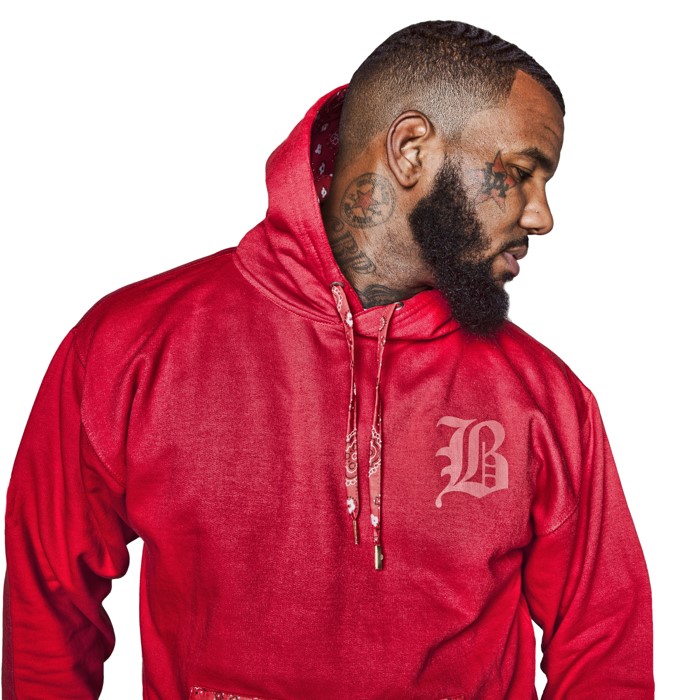
Listen / Follow
Tags
About The Game
The name The Game refers to multiple musical acts: 1. Jayceon Terrell Taylor (born November 29, 1979), known professionally as the Game or simply Game, is an American rapper and actor from Compton, California. He began his career releasing mixtapes with the support of West Coast rapper JT the Bigga Figga. In 2004, he independently released his debut album "Untold Story" before being discovered by producer Dr. Dre, who signed him to Aftermath Records.
The Game: Compton’s Designated Archivist and the Cost of Perpetual Legacy Maintenance
The Game — Jayceon Terrell Taylor, born November 29, 1979, in Compton, California — stands as West Coast hip-hop’s most compulsive self-mythologizer, a rapper whose peak output redefined the geography of gangsta rap’s early-2000s resurgence. Over two decades and across more than a dozen studio projects, Taylor has built a catalog dense with A-list production credits and bi-coastal reference points, toggling between commercial dominance and stubborn independence. His discography, which now stretches toward its eleventh studio entry, functions simultaneously as autobiography and as an ongoing negotiation with a genre that keeps evolving around him — sometimes faster than he does.
Artist Profile
| Origin | Compton, California, USA |
| Years Active | 2000 – present |
| Genre | West Coast hip-hop / gangsta rap |
| Labels | Get Low Recordz · Aftermath Entertainment · G-Unit Records · Interscope · Geffen · DGC · Blood Money · 100 Entertainment · Virgin · Numinati · MNRK |
| Notable Collaborators | Dr. Dre · Kanye West · 50 Cent · Hit-Boy · Mike Dean · DJ Premier · Timbaland · Swizz Beatz · Drake · Big Sean · Anderson .Paak |
| RIAA Certifications | The Documentary (2× Platinum) · “Hate It or Love It” (Gold) · “How We Do” (Gold) · “100” ft. Drake (Platinum) |
| Studio Albums in Catalog | 11 (as of 2026) |
Performance Snapshot — Get Music Catalog
From Compton Sidewalks to Billboard Summits: The Making of a West Coast Voice
Jayceon Terrell Taylor — born November 29, 1979, in Compton, California — entered the music ecosystem through a network of West Coast underground channels, initially releasing a series of mixtapes under the wing of fellow West Coast rapper JT the Bigga Figga.
His first mixtape, You Know What It Is Vol. 1, dropped in 2002 and landed him a deal with Get Low Recordz, the independent label owned by JT the Bigga Figga.
The mechanics of that early tape-circuit grind — Compton block parties, DJ circuits, regional distribution — gave Taylor a practical education in street-level IP development long before any major label entered the equation.
The tape eventually reached Sean Combs, who was on the verge of signing him to Bad Boy Records, but five months later Dr. Dre — having heard the mixtape — signed him to Aftermath Entertainment in 2003.
He independently released his debut album Untold Story in 2004 before that Aftermath deal formalized his commercial trajectory.
It was a rapid ascent rooted in Dre’s ear for a specific Compton-coded tonal register: mid-tempo G-funk architecture, deliberate vocal placement, and bars that treated neighborhood geography as documentary evidence rather than background texture.
The Game rose to mainstream prominence in 2005 with his major-label debut The Documentary, which peaked atop the Billboard 200.
The album earned double platinum certification from the RIAA and yielded two Grammy Award nominations — Best Rap Song and Best Rap Performance by a Duo or Group — for “Hate It or Love It” featuring 50 Cent.
At that moment, Game was widely considered a driving force in returning West Coast hip-hop to mainstream prominence
, rebalancing a genre conversation that had tilted heavily toward the East Coast in the post-Pac, post-Biggie vacuum. The production on The Documentary — handled largely by Dre, Kanye West, and Timbaland — set a formal standard that Taylor’s later work would perpetually reference and struggle to surpass.
Following disputes with 50 Cent, Game departed Aftermath Entertainment and signed with Geffen Records, another label under Universal’s Interscope-Geffen-A&M division, to terminate his G-Unit obligations. His second album, Doctor’s Advocate, released November 14, 2006, debuted at number one on the Billboard 200.
The record contained no production from Dr. Dre
— a pointed declaration of independence that also functioned as proof that Taylor’s appeal was not entirely Dre-dependent, even as his lyricism remained saturated with Dre references.
Discography in Focus: Between Sequels, Statements, and Independent Pivots
The Game’s full discography comprises eleven studio albums, six compilation albums, two soundtrack albums, fifteen mixtapes, and thirty-one singles
— a volume of output that reflects both his prolificacy and his inability to leave career-defining questions unanswered.
His music has moved through major labels including Interscope, Geffen, and DGC, as well as subsidiaries Aftermath Entertainment and G-Unit Records, alongside independent imprints Get Low Recordz and his own Blood Money and 100 Entertainment labels.
That label journey is itself a narrative: major-label resources traded for autonomy, autonomy traded for the pressure of self-funding ambition at scale.
His fifth album, Jesus Piece (2012), served as his final Interscope release and peaked in the chart’s top ten, followed by the self-released The Documentary 2, The Documentary 2.5 (both 2015), and 1992 (2016).
The Documentary 2 — arriving a decade after the original — was Taylor’s most overt attempt at formal sequel-making, a structural bet that his audience’s nostalgia for 2005 was still a bankable demand driver. The 2.5 companion release, dropping weeks later, signaled a streaming-era logic: drip-feed the catalog, keep the algorithm fed, maintain listener inertia.
His tenth studio album, Drillmatic – Heart vs. Mind, released August 12, 2022, via 100 Entertainment and Virgin Music, draws features from Kanye West, Big Sean, and Drake, with production credits spanning Timbaland, Swizz Beatz, Mike Dean, and Hit-Boy across its thirty tracks.
The lead single “Eazy” alone assembled a production team that included Kanye West, DJ Premier, Mike Dean, Hit-Boy, Big Duke, and Cash Jones.
That density of talent is characteristic of Taylor’s approach to album architecture: maximum roster, maximum reference points, maximum surface area for the narrative of his own greatness to expand across. Our catalog entry for the album is available at getmusic.com.tr/album/eazy/.
A further installment, The Documentary 3, was in development with Kanye West serving as executive producer during the period of early singles, including the West-produced track “TINA” (released February 25, 2025), intended for the album.
Press releases confirmed that The Documentary 3 features Drake, Kanye West, Snoop Dogg, Lil Wayne, and more.
The return to the Documentary franchise branding is deliberate: it anchors the album to the highest-demand moment in Taylor’s commercial arc while signaling that the legacy IP is not dormant.
Market Note
The Game’s catalog IP rests on a narrow but durable demand peak: the 2005–2006 window that produced The Documentary and Doctor’s Advocate, two consecutive Billboard 200 number ones. The double-platinum RIAA certification on the debut remains the single largest commercial timestamp in Taylor’s discography and functions as an evergreen sync asset — West Coast production aesthetic, Compton provenance, recognizable hook structure. Streaming velocity on pre-2010 catalog is largely passive but consistent; “Hate It or Love It” and “How We Do” maintain persistent playlist placement in nostalgia-formatted editorial. Newer releases test a different A&R logic: high-profile feature economies that generate attention via collaboration headlines rather than pure streaming output. The “Eazy” single’s production assembly — DJ Premier, Mike Dean, Hit-Boy, and Kanye West on a single track — reflects a feature-stacking strategy designed to distribute listener bases across a shared release. The demographic base skews male, 28–45, with strong affinity among listeners who entered hip-hop during the early-to-mid 2000s West Coast revival. Sync potential is moderate-to-high for period-specific placement (crime drama, documentary, sports retrospective), with catalog longevity anchored to the Compton origin story’s sustained cultural weight.
1 album in our catalog
All releases
Complete release history from MusicBrainz — albums, EPs, singles, live, and more.
Album (19)
- 2025Gangsta Grillz: E.M.N.T - The Credits
- 2024Time
- 2024Paisley Dreams
- 2022DRILLMATIC Heart vs. Mind
- 2019Born 2 Rap
- 20161992
- 2015The Documentary 2
- 2015The Documentary 2.5
- 2013Superman
- 2012Jesus Piece
- 2011The R.E.D. Album
- 2011Red L.A. Times
- 2010N.W.A.
- 2008The Street King
- 2008LAX
- 2006Doctor’s Advocate
- 2005The Documentary
- 2005West Coast Resurrection
- 2004Untold Story
Album (Compilation) (6)
- 2016The Documentary 2 + 2.5
- 2014Blood Moon: Year of the Wolf
- 2010QB 2 Compton Ringtones
- 2008The West Coast Blokk Monster
- 2006G.A.M.E.
- 2005Untold Story, Volume 2