At a glance
Where the world is listening
SUBMARINE: PRESSURE, PRESSURE, RELEASE — THE MARÍAS FIND DEPTH IN HEARTBREAK
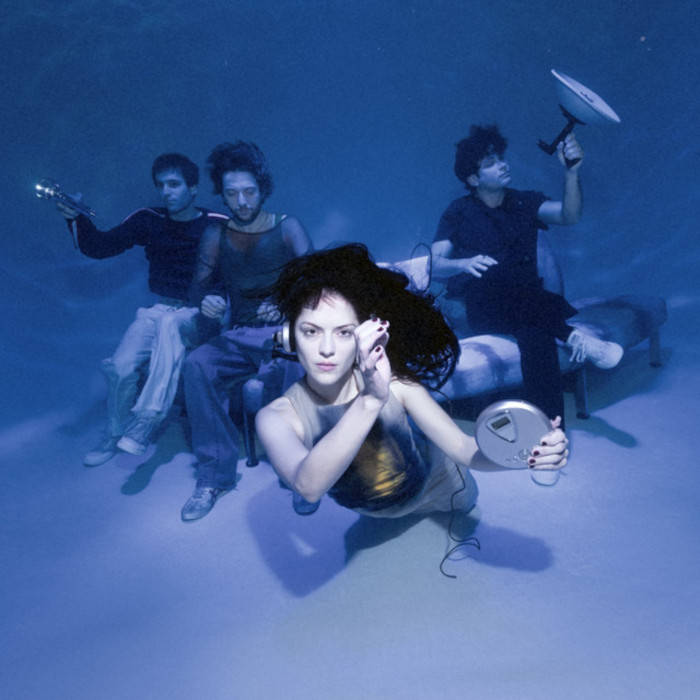
Submarine, the second studio album by The Marías, is an LA-bred dream-pop record that turns a real romantic dissolution into finely engineered sonic craft — fourteen tracks of downtempo jazz-funk, bilingual ache, and meticulous low-end work released May 31, 2024 on Nice Life Recording Company / Atlantic.
After finishing their Cinema tour, vocalist María Zardoya and drummer-producer Josh Conway ended their relationship, and the band took a six-month hiatus in which they spent four months apart before the first sessions that would eventually become Submarine.
The result is an album that earns its depth through restraint rather than drama — pressure sustained over 45 minutes before the hull finally gives.
Album Credits
| Artist | The Marías |
| Released | May 31, 2024 |
| Genre | Dream Pop · Sophisti-Pop · Trip-Hop · Alternative R&B |
| Label | Nice Life Recording Company / Atlantic |
| Producer(s) | Josh Conway · Gianluca Buccellati · Gabriel Steiner (additional) · Doron Zounes (co-prod.) · Ricky Reed (co-prod.) |
| Tracks | 14 |
| Runtime | approx. 45 minutes |
| Lead Single(s) | “Run Your Mouth” (March 7, 2024) · “No One Noticed” · “Echo” · “Hamptons” |
Performance Snapshot
| Global Listeners | 1,850,868 |
| Total Scrobbles | 100,522,049 |
| Countries Charting | 43 |
| Strongest Market | United States — 136,508 listeners |
| Top 3 Markets | United States · Brazil · United Kingdom |
Production Architecture: Low-End Theology and the Aesthetics of Submersion
The Marías have always been a band defined by texture before tempo, and Submarine codifies that instinct into a full album-length argument.
Principal production credit goes to Josh Conway and Gianluca Buccellati
, with
Gabriel Steiner contributing additional and co-production on several tracks, Doron Zounes serving as co-producer, and Ricky Reed taking co-production duties on one cut.
The engineering approach — handled by Conway and Buccellati — is obsessive in its quietude. Every element feels placed rather than layered: bass lines ride slightly ahead of the pocket, giving downbeat-averse grooves a sense of forward lean without surrendering the liquidity that defines the band’s tonal center.
Syncopated, looped vocals act as an alternate drum beat throughout “Hamptons,” a subtle take on reggaeton influence; the ever-so-slight bubbling start to “Echo” and the shimmering guitar that surfaces on “Paranoia” are testament to Conway’s meticulous production on an album that revels in nuance.
That phrase — revels in nuance — is more than critical shorthand here. The kick drum on “Paranoia” sits in a register so close to the bass guitar’s fundamental that the two become one low, pressurized pulse. The effect reads as monolithic until you isolate the guitar’s mixolydian riff riding above it.
“Hamptons” features a hard-hitting syncopated electronic beat that contrasts beautifully with the song’s wispy qualities; “If Only” dips into noirish jazz with its prominent piano, while “Blur” brings surprising intensity through a steady drum beat and a flowing bridge, and “Love You Anyway” opens with the sound of a submerged engine, deepening the record’s aquatic conceptual thread.
Krzysztof Kieślowski’s film Three Colours: Blue inspired many elements of the album, including what the band described as a “very intentional” colour palette shift from red to blue
— a chromatic move that finds its way into the production itself, where warm midrange elements from Cinema are replaced by cooler, wetter reverb tails and flanger-kissed synth pads. Mastering engineer Joe LaPorta and mixing engineer Neal Pogue preserve the inter-track dynamics that make the record cohere as a single 45-minute argument rather than a playlist of discrete moods.
Whereas some forms of dream-pop sound unmistakably like winter, The Marías make music for sweltering poolsides, afternoons encased in air conditioning, and glamorous waterfront locales after dark
— and Conway’s production choices bear that sensibility out down to the sub-bass rolloff.
Like Stereolab before them, and contemporaries Men I Trust and Crumb, The Marías are inspired by lounge jazz, 1960s pop, and bossa nova — but the band takes those influences and pushes them into tight, catchy pop songs that are wholly their own.
That lineage explains why the record resists the bloat that sinks so many dream-pop sophomore efforts: the jazz-economy principle — no wasted notes — holds even when the arrangements are at their most ornate.
Songwriting and Voice: Bilingual Heartbreak at a Precise Emotional Frequency
Formed in Los Angeles by vocalist María Zardoya, drummer-producer Josh Conway, guitarist Jesse Perlman, and keyboardist Edward James, The Marías have developed a unique blend that melds Zardoya’s Puerto Rican heritage and atmospheric, magical pop grooves.
After the Cinema tour ended and Zardoya and Conway’s eight-year relationship dissolved, the band members collectively went to therapy and used the emotional process of the breakup to inform their music.
That autobiographical weight is present in the writing, but the songwriting strategy is not raw confession — it is controlled alchemy.
Frontwoman María Zardoya was born in Puerto Rico and raised outside of Atlanta in small-town Snellville, Georgia, where she developed a breathy, deeply expressive singing style informed by Selena and Norah Jones.
On Submarine, those two poles — Selena’s bilingual ease and Jones’s smoky understatement — govern how Zardoya deploys her register. She rarely reaches; the drama lives in what she withholds.
Zardoya is the band’s smoldering center of gravity, able to breathe songs to life with whispers, coos, and sighs that feel full-bodied even in their quietude.
The bilingualism is not decorative.
With Zardoya singing both in English and Spanish, The Marías fit into a wave of bilingual artists who emerged in the late 2010s, from Cardi B to Cuco.
But on Submarine, the Spanish-language tracks — *Lejos de Ti* (Far from You) and *Ay No Puedo* (Oh I Can’t) — carry specific emotional registers that Zardoya’s English-language writing leaves unoccupied. The switch in language marks a shift in proximity: the Spanish songs feel closer to the body, less mediated by lyrical construction.
Submarine gives the lyrics and the symphony to the word “bittersweet,” thoughtfully detailing the ups and downs of heartbreak, as in “Ay, No Puedo,” where the Spanish text speaks to love and pain beyond measure.
“No One Noticed” is the album’s structural centerpiece and its most fully realized piece of writing.
Zardoya’s narration gives emotional stakes to what could have been empty retail playlist music, stylish but without substance — the floaty slow dance of “No One Noticed” hits hard with an opening line like “Maybe I lost my mind / No one noticed” and then complicates the perspective further.
“Vicious Sensitive Robot” operates differently, using ironic clinical language to anatomize digital-era emotional codependency.
The track develops the pain and discontent in modern relationships, beautifully articulating the toxicity of technology that allows us to be constantly accessible to each other, threatening our autonomy.
And
“If Only” is a tribute to Tom Waits and Kathleen Brennan’s “Green Grass,” interpolating the melody of the original but pushing it to new territory with Zardoya’s delicate vocals, a far cry from Waits’s gravelly original — Waits is credited as a co-writer on the song and is a family friend of Josh Conway.
Market Note: Bilingual IP and the Durability of a Cross-Demographic Catalog
With 1,850,868 global listeners and 100,522,049 scrobbles registered on Last.fm, Submarine demonstrates catalog streaming velocity that significantly outpaces its press cycle — a reliable indicator of algorithm-driven discovery and playlist placement rather than front-loaded release-week demand. The geographic spread across 43 countries, anchored by a 136,508-listener stronghold in the United States and a meaningful 40,704-listener presence in Brazil, maps precisely onto the band’s bilingual IP strategy. The Spanish-language tracks (*Lejos de Ti*, *Ay No Puedo*) function as autonomous demand drivers in Latin American markets while the English-language record maintains its Anglo indie-pop positioning. That duality insulates the catalog against single-market fragility and strengthens sync potential: the album’s controlled emotional register and legal-instrument-forward arrangements make it well-suited for licensing in prestige television, film, and luxury-brand editorial contexts.
The album earned a critic score of 77 on Album of the Year, with the Marías following up their Billboard 200-charting debut Cinema with the thematically lonelier Submarine.
That Billboard heritage, combined with
the “Hush” Adult Alternative Airplay chart-topper from Cinema and the band’s Grammy nomination as featured artists on Bad Bunny’s Un Verano Sin Ti,
gives Submarine an A&R context that most dream-pop records lack: genuine crossover proof-of-concept.
Listen with 30-sec previews
Previews served by iTunes. Press play on any track.
Released the same week
Other albums released near this date, across years.