At a glance
Where the world is listening
SAVIORS: GREEN DAY’S CALCULATED RETURN TO PUNK FIRST PRINCIPLES
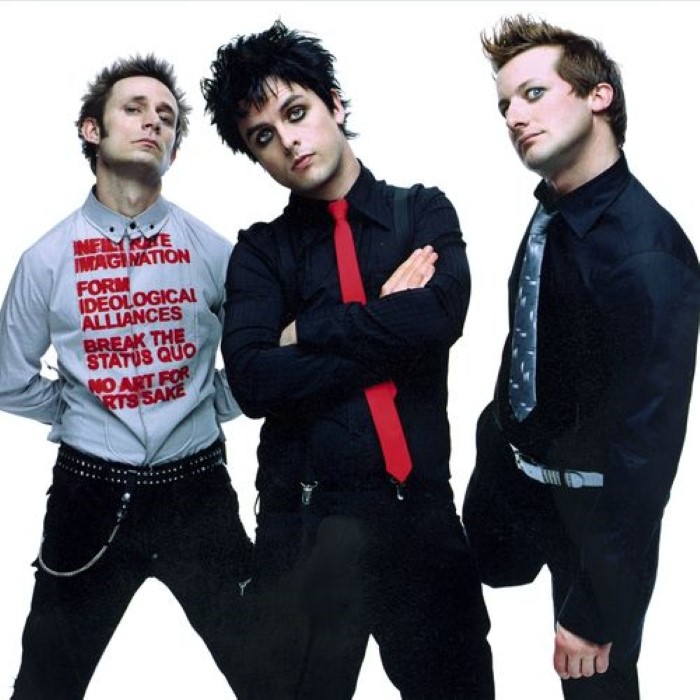
Green Day’s Saviors (2024) is the Bay Area trio’s fourteenth studio album — a 15-track, 46-minute commitment to the stripped-back pop-punk architecture that first made them indispensable. Produced by Rob Cavallo — back in the fold for the first time in roughly a decade — Saviors corrects the overproduced drift of Father of All Motherfuckers (2020) with notable efficiency. It debuted at No. 4 on the Billboard 200, landed at No. 1 in the UK, and collected three Grammy nominations for its release cycle, confirming that the band’s commercial gravity is still very much intact at album fourteen.
Album Credits
| Artist | Green Day |
| Released | January 19, 2024 |
| Genre | Punk Rock / Pop-Punk |
| Label | Reprise Records / Warner Records |
| Producer(s) | Rob Cavallo, Green Day |
| Tracks | 15 |
| Runtime | 45:55 |
| Lead Single(s) | “The American Dream Is Killing Me,” “Look Ma, No Brains!,” “Dilemma,” “One Eyed Bastard,” “Bobby Sox” |
Performance Snapshot
| Global Listeners | 228,954 |
| Total Scrobbles | 6,799,990 |
| Countries Charting | 43 |
| Strongest Market | United States — 99,683 listeners |
| Top 3 Markets | United States, Brazil, United Kingdom |
Production Architecture: Cavallo’s Return and the Art of Constraint
On Saviors, the trio reunited with longtime producer Rob Cavallo for the first time in a decade.
That reunion is the album’s most structurally significant decision — arguably more important than any individual lyric or melody.
The sessions were led by Cavallo, who was back in the fold for the first time since the ¡Uno!/¡Dos!/¡Tré! trilogy.
What Cavallo brings is not nostalgia management but a forensic understanding of how these three musicians interact at tempo: the snap of Tré Cool’s snare sitting just above the mix’s tonal center, Mike Dirnt’s bass occupying a mid-low register that keeps the low end punchy without muddying the kick, and Billie Joe Armstrong’s rhythm guitar running through what sounds like a dry-room chain with minimal reverb tail — keeping transient attack in full relief.
Tracking moved between RAK Studios in London and United Recording and Henson Recording in Los Angeles, with engineer Chris Dugan and mastering by Ted Jensen.
Jensen’s mastering choices deserve attention: the album is loud by modern rock standards, but the dynamic range never fully collapses — there’s still enough headroom in the verses of “Dilemma” and “Coma City” for the chorus surges to register as actual events rather than LUFS-normalized wallpaper.
Armstrong’s urgent venting is delivered within some of Green Day’s catchiest songs since the 1990s, and Cavallo proves just as crucial to the album’s punchy, uncrowded sound as bassist Mike Dirnt and drummer Tré Cool.
The mix philosophy — present, narrow, low-saturation — is the opposite of what made Father of All Motherfuckers so divisive. That 2020 record leaned on filtered vintage breaks, overdriven claps, and glam-rock compression that flattened the band’s natural attack. Here, the production deliberately retreats to give each instrument its own lane. “The American Dream Is Killing Me” establishes the template in the first 90 seconds: two guitars in symmetrical hard-panning, a bass that moves independently of the root on the verse, and a chorus that gains density from arrangement alone rather than from added saturation.
After all, Cavallo helmed the band’s 1994 smash Dookie, and Saviors sneaks in a few nods to that era — “Strange Days Are Here to Stay” evokes the Dookie-era hit “Basket Case” in its chugging chord construction.
The album’s closest parallel in the catalog of adjacent punk acts is The Offspring’s SUPERCHARGED (available on Get Music), which similarly worked through a late-career aesthetic recalibration in 2024. Both records treat brevity as a discipline: song durations hover between two and four minutes, arrangements terminate precisely where momentum peaks, and there is no fat left unreduced.
Songwriting Mechanics and Lyrical Range: Anger, Accountability, and the Occasional Lurch into Sentiment
All lyrics on Saviors are written by Billie Joe Armstrong; all music is composed by Armstrong, Mike Dirnt, and Tré Cool.
This matters structurally: the album is a single authorial perspective across 15 songs, which gives it tonal coherence but also occasional tunnel vision. Armstrong writes best when the personal and political are the same sentence, and several tracks here achieve exactly that compression.
“The American Dream Is Killing Me” is the most unambiguous political statement on the record —
with lyrics describing the pain of America’s way of living, with references to social media, unemployment, and the housing crisis, setting the overall tone for the album.
The song works not because its observations are novel but because Armstrong delivers them at a melodic clip that doesn’t feel like a lecture. The bridge modulation is brief and functional: a half-step shift that creates forward pressure without resorting to a key change for its own sake.
“Dilemma,” the album’s fifth track and third single, is a touching song about Armstrong’s struggle with sobriety.
It is the most emotionally precise track on the record. The song’s structure is almost classical in its restraint: a subdued intro, a verse that builds through harmonic tension rather than volume, and a chorus that pays off the accumulated pressure with melodic release.
The song starts slow but quickly explodes into a catchy riff with thundering guitars, becoming one of the album’s highlights; songs like “Goodnight Adeline” and “Suzie Chapstick” also touch on addiction, depression, love, and longing.
“Bobby Sox” and “1981” operate in Armstrong’s more playful register — retro-nostalgic sketches that function as deliberate palette cleansers between heavier pieces. “Living in the ’20s” lands somewhere between sardonic observation and genuine confusion about the present moment: its lyric sheet reads as a compressed anxiety log of contemporary anxieties, delivered over a rhythm figure that quotes from the album’s tighter, Dookie-adjacent vocabulary.
The album’s thematic scope is wide — touching on disease, war, inequality, influencers, climate change, oligarchs, social media division, and mental health
— but Armstrong is disciplined enough to funnel each of these into three-minute containers that don’t overstay. The risk with this approach is that the register becomes uniform: righteous, slightly weary, occasionally funny. That risk is realized on the album’s back half, where the sequencing loses some of the front-loaded dynamism.
Market Note: IP Longevity and the Value of Catalog-Anchored Releases
Saviors is a textbook example of a catalog-anchored release strategy. With 228,954 global Last.fm listeners and 6,799,990 total scrobbles, the album’s engagement is sustained rather than spiked — suggesting a listener base that returns repeatedly rather than performing a single streaming pass. The United States leads with 99,683 listeners, a figure consistent with the album’s strong domestic commercial performance:
debuting at No. 4 on the Billboard 200 with 49,000 album-equivalent units, including 39,000 pure album sales.
The presence of Brazil (25,311 listeners) as the second-largest market — outperforming the UK’s 21,584 — points to a consistently underweighted demand driver in Latin America for legacy rock IP.
The album debuted at No. 1 in the UK with 31,361 album-equivalent units,
demonstrating that catalog longevity translates equally well in markets where Green Day’s touring presence remains dense. Sync potential is high across the album’s sharper political cuts, particularly “The American Dream Is Killing Me” and “Dilemma,” which carry both narrative specificity and melodic hookload suited to dramatic placement.
The Saviors Tour encompassed 87 shows across five continents,
generating the kind of live-revenue halo that amplifies streaming velocity months after release. The 43-country footprint across charting data signals robust IP expansion potential well beyond the core Anglophone markets.
Geographic Resonance: Why Saviors Travels Further Than Its Predecessors
The performance geography of Saviors reveals something counterintuitive about Green Day’s current position in the global rock ecosystem. The United States dominating at 99,683 listeners is expected — this is, after all, a band whose lineage runs directly through the Berkeley DIY scene of the early 1990s, whose records were formative texts for an entire generation of American suburban teenagers. What demands more analytical attention is Brazil sitting at 25,311 listeners, materially ahead of the UK (21,584), Canada (12,563), and Germany (7,161).
Brazil has been one of the most active Latin American markets for legacy punk and alternative rock for over two decades — a structural characteristic of the country’s rock culture that sustains catalog consumption well past the release window. Green Day’s direct lineage from the Ramones-rooted pop-punk tradition gives them a specific purchase in this market: the band’s melodic directness translates across language barriers in a way that more lyrically dense acts do not. The three-chord architecture of Saviors‘ best songs — the open-position power chords on “Look Ma, No Brains!,” the I-IV-V sequencing on “Fancy Sauce” — is internationally legible without requiring contextual cultural knowledge to appreciate the formal gesture.
Germany at 7,161, the Netherlands at 4,971, and Poland at 3,951 represent the European continental spread that
the Saviors Tour confirmed directly, with the European leg beginning in May 2024 and featuring openers including Nothing But Thieves, the Hives, the Interrupters, Donots, and Maid of Ace.
Poland is a particularly interesting data point: Central European rock markets have historically indexed strongly for guitar-led rock with a countercultural political valence, and Saviors‘ anti-establishment lyrical posture gives it a natural resonance in that milieu. Argentina at 2,841 rounds out the Latin American cluster, suggesting that the Brazilian performance is not an outlier but the apex of a broader regional pattern.
The tour also included festival performances and a shorter second European leg, as well as performances in Asia, Australia, and South Africa.
Australia at 9,006 listeners is the fifth-largest market — a figure that aligns with the country’s long-standing appetite for classic punk and post-punk guitar rock, and one that positions Saviors as part of a broader Pacific-Rim expansion of rock IP that several contemporary punk acts, including AFI (whose Silver Bleeds the Black Sun… is cataloged here on Get Music), are currently navigating.
Critical Assessment: The Album That Mostly Does What It Sets Out to Do — and the Costs of That Clarity
Saviors received a score of 73 out of 100 on Metacritic based on 21 critics’ reviews, indicating “generally favorable” reception.
That score is accurate in what it measures and somewhat misleading in what it implies. A 73 on a 15-track punk record from a band in their fourth decade, after a predecessor that was widely considered a creative stumble, represents genuine critical rehabilitation — not a perfunctory pass.
The strongest reviews located the album’s value in its compression discipline.
AllMusic’s Stephen Thomas Erlewine noted that “Green Day sound exactly like what they are: rock & roll lifers settling into middle age, irritated by some shifts in culture but still finding sustenance in the music they’ve loved for decades.”
DIY’s Emma Swann called the album “an outstanding record that showcases that same still unrivalled ability to incorporate biting social commentary within perfect, three-minute pop (punk) songs.”
NME’s Andrew Trendell called it Green Day’s best album since American Idiot, describing it as “an act of defiance met with a shrug; a band saying, ‘We’re still here and we’re still fucked’.”
The more measured readings pointed to a structural tension in the album’s ambition: its very efficiency becomes a ceiling.
One critic observed that had it been trimmed to ten or eleven tracks, we’d be talking about one of Green Day’s strongest releases — as it stands, Saviors turns out to be a confident return to form, but one that also fails to build upon the records that inspired it.
That is a fair reading. The back third of the album — from “Strange Days Are Here to Stay” through “Fancy Sauce” — contains no structural surprises, no harmonic detours, no arrangement risk. The formula runs on autopilot.
It’s Armstrong’s alternating earnestness and sarcasm, combined with typically hummable tunes, that make Saviors something of a return to form for the trio, which drifted a little too far into pop territory on 2020’s Father of All Motherfuckers.
What works on Saviors works decisively: the first six tracks form one of the most cohesive front-of-record sequences the band has produced since American Idiot‘s opening run. “The American Dream Is Killing Me” through “1981” sustains both melodic and thematic momentum without a single structural misfire. The problem is that the album then needs to travel another nine tracks on the same reserve of ideas, and the diminishing returns are audible.
The album was nominated at the 67th Annual Grammy Awards for Best Rock Album,
with further nominations in Best Rock Song for “Dilemma” and Best Rock Performance for “The American Dream Is Killing Me.”
These were the first Grammy nominations Green Day received since ¡Cuatro! (2013) was nominated for Best Music Film in 2014.
That 11-year gap in Grammy recognition — and its closure with Saviors — is as good a measure as any of where this record stands in the band’s late-period catalog. It is not a reinvention. It is a recalibration, executed with purpose and craft, and it earns its nominations on the strength of the songs rather than reputation alone.
Frequently Asked Questions
Where can I stream or purchase Green Day’s Saviors?
Saviors is available on all major streaming platforms including Spotify, Apple Music, Tidal, and Amazon Music, as well as for purchase on digital download platforms. Physical formats — CD, vinyl, and cassette — were released alongside the album;
several exclusive vinyl editions were produced, including neon pink with neon green splatter and black ice with hot pink splatter pressings, each limited and pressed once.
A deluxe edition titled Saviors (édition de luxe) was released on May 23, 2025, featuring additional tracks including the previously unreleased “Underdog.”
How was Saviors received critically and commercially?
The album received a Metacritic score of 73 out of 100 from 21 critics, indicating generally favorable reception.
Commercially, it debuted at No. 4 on the Billboard 200 with 49,000 album-equivalent units,
and
reached No. 1 in the UK with 31,361 album-equivalent units.
As of April 2024, the album had sold 108,000 album-equivalent units in the United States and nearly 200,000 worldwide.
Which tracks stand out most on the album?
“Dilemma” is the album’s most emotionally precise cut — a song about Armstrong’s personal struggle with sobriety that builds from structural restraint into a melodic payoff that earns its catharsis. “The American Dream Is Killing Me” carries the album’s strongest political and hookload combination, while “Look Ma, No Brains!” demonstrates that the band can still write a two-minute pop-punk formal exercise with economy and wit.
Armstrong himself stated in an interview that “Look Ma, No Brains!” was his favorite track off the album and one of the greatest punk songs he’d ever written.
What albums are similar to Saviors for listeners who want more?
Listeners drawn to Saviors‘ stripped-back punk economy and political directness will find a productive companion in The Offspring’s SUPERCHARGED (2024), which navigates a comparable late-career aesthetic recalibration in the pop-punk adjacent space. For a deeper catalog reference that maps the lineage Green Day explicitly invokes throughout Saviors, the Ramones’ Greatest Hits provides the formal grammar that Armstrong has been annotating since Kerplunk!.
Girls Choice Music · Curation and Analysis
authored on May 28, 2026
Listen with 30-sec previews
Previews served by iTunes. Press play on any track.
Similar albums

Released the same week
Other albums released near this date, across years.