At a glance
Where the world is listening
COWBOY CARTER: Americana Reclaimed, Genre Dissolved, History Rewritten
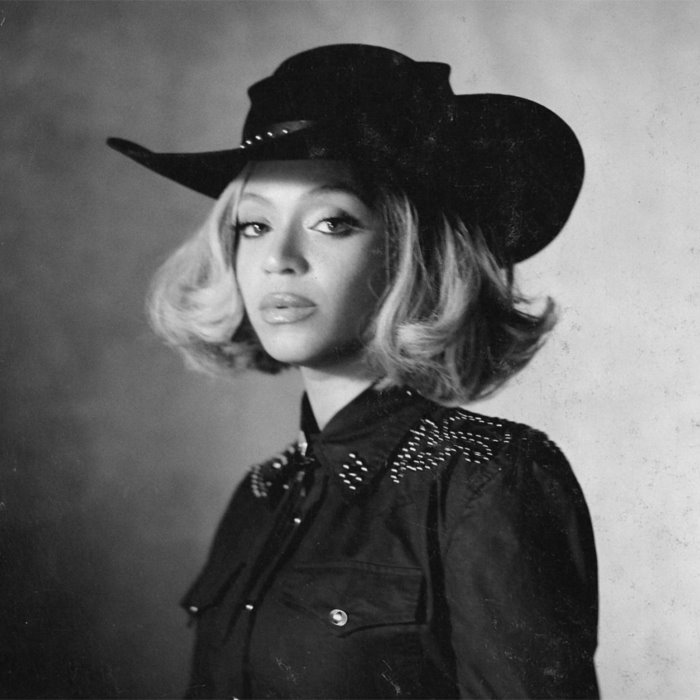
Beyoncé’s COWBOY CARTER (Parkwood Entertainment / Columbia Records, March 29, 2024) is the most argued-over, most rigorously constructed American album of the 2020s — a 27-track act of ethnomusicological recovery that interrogates who gets to own country music and who built it.
The eighth studio album by Beyoncé, it was released on March 29, 2024, through Parkwood Entertainment and Columbia Records.
The second of a planned trilogy, it follows Renaissance (2022), and was conceived as a journey through a reinvention of Americana, spotlighting the overlooked contributions of Black pioneers to American musical and cultural history.
What resulted is not a country record and not merely a pop record — it is a document, a corrective, and one of the defining albums of the decade.
Album Credits
| Artist | Beyoncé |
| Released | March 29, 2024 |
| Genre | Country / R&B / Americana / Blues / Rock |
| Label | Parkwood Entertainment / Columbia Records |
| Producers | Beyoncé (exec.), Raphael Saadiq, Pharrell Williams, The-Dream, No I.D., Sounwave, Swizz Beatz, NOVA WAV, Tyler Johnson, Dave Hamelin, Derek Dixie, Ian Fitchuk |
| Tracks | 27 |
| Runtime | Approx. 78 minutes |
| Lead Singles | “Texas Hold ‘Em” / “16 Carriages” (Feb. 11, 2024); “II Most Wanted” feat. Miley Cyrus (Apr. 12, 2024) |
Performance Snapshot
| Global Listeners | 935,428 |
| Total Scrobbles | 81,369,356 |
| Countries Charting | 43 |
| Strongest Market | United States — 103,993 listeners |
| Top 3 Markets | United States (103,993) · Brazil (69,010) · United Kingdom (26,679) |
Production Architecture: Where American Music Was Always Black
A genre-blending album rooted in country music, COWBOY CARTER is influenced by Beyoncé’s upbringing in Texas, incorporating eclectic styles of music of the Southern United States.
But to describe it as a “country album” is to accept the reductive premise the record exists to dismantle. The production — assembled by a constellation of collaborators that is unusually broad even for a Beyoncé project — moves from banjo-driven pastoral textures to heavy-soul bass tones, from blues-drenched dobro to the rolling snares of Blaxploitation film scores, without once losing structural coherence.
Among the credited producers are Pharrell Williams, The-Dream, No I.D., NOVA WAV, Sounwave, Swizz Beatz, Raphael Saadiq, Ian Fitchuk, and Tyler Johnson
— a room that spans hip-hop’s architecture, neo-soul’s lineage, and Nashville’s session culture simultaneously. Raphael Saadiq’s fingerprints are most legible on “16 Carriages,” where a spare chord progression in a mixolydian-adjacent tonality frames Beyoncé’s most restrained vocal of the album. The track breathes at the pace of a work song, and the parallel compression on the low end keeps it rooted while Beyoncé’s upper register floats free of the mix. Ian Fitchuk — whose Nashville co-production resume runs through Kacey Musgraves — brings a similar structural discipline to the mid-album sequences, grounding the wilder genre pivots within legible folk-pop frameworks.
Beyoncé took inspiration from films including “Five Fingers For Marseilles,” “Urban Cowboy,” and “The Hateful Eight,” often having them playing during recording sessions, with some percussion ideas drawn from the bluegrass-inflected “O Brother, Where Art Thou?” soundtrack.
That filmic quality is audible throughout: “AMERIICAN REQUIEM” opens with a cinematic swell that signals not a song but a thesis statement. “DAUGHTER” functions as an operatic interlude, its register shifts and arioso phrasing sitting at an oblique angle to anything Nashville has produced in the last half-century.
On “YAYA,” Beyoncé interpolates the Beach Boys’ “Good Vibrations” and Nancy Sinatra’s version of “These Boots Are Made for Walking” simultaneously
— a gesture toward the shared Americana inheritance that is equal parts musicological joke and genuine historiography. The album’s production philosophy is less about genre fidelity and more about establishing lineage: almost every sonic reference traces back to a Black origin.
Listeners seeking a single analogous release in the catalog might consider Cleo Sol’s Gold (2023) — available on our catalog at getmusic.com.tr/album/gold-2/ — which similarly locates the emotional core of Black American music traditions within a meticulously produced contemporary frame. The comparison clarifies what distinguishes COWBOY CARTER at scale: where Sol works in intimate close-up, Beyoncé operates in full panorama.
Songwriting and Vocal Performance: The Corrective Record
Born out of an experience Beyoncé described as one where she “did not feel welcomed,” COWBOY CARTER finds the artist embracing the musical roots of her Southern heritage while paying homage to country greats who came before her — from Willie Nelson to Linda Martell, each of whom recorded voice messages introducing different genre-warping tracks on the album.
That structural conceit — the radio broadcast frame, the disc-jockey interludes — is not merely theatrical. It positions the album as a transmission: something broadcasting from a frequency that mainstream country has long refused to tune into.
Linda Martell, referenced in her own dedicated track, was the first Black woman to achieve commercial success in the country genre.
She saw a 127,430 percent increase in streams of her music following the album’s release.
That number alone speaks to the curatorial and restitutional function of the record: its songwriting is not content to acknowledge history; it forces that history back into circulation. “BLACKBIIRD,” a reworking of The Beatles’ 1968 track with Black female country artists Tanner Adell, Brittney Spencer, Tiera Kennedy, and Reyna Roberts, repurposes Paul McCartney’s original liberation metaphor — written in response to the Little Rock Nine — and returns it to the register for which it was, arguably, always intended.
Vocally, COWBOY CARTER is the most elastically performed album of Beyoncé’s career. Her approach throughout is not to demonstrate range for its own sake but to calibrate timbre precisely to each song’s emotional and generic argument. On “JOLENE” — her reworking of Dolly Parton’s 1973 composition — she shifts the power dynamic of the original by hardening the narrator’s resolve, moving from pleading to warning. The tonal center drops, the chest register opens, and the track becomes something different in genre and in meaning from its source material. On “LEVII’S JEANS” with Post Malone, she flips entirely into a relaxed country-soul mode, her vowels elongated in a way that maps the Houston accent back onto the Texas country tradition it helped build.
Critics noted some of Beyoncé’s best vocal work on record across the album, with her voice as an instrument wielded most strikingly at the album’s opening, as she glides across country and R&B inflections with apparent ease.
The songwriting density rewards repeated listening: she co-wrote the majority of the album’s 27 tracks,
appearing on 23 Billboard Hot 100 entries simultaneously, credited as co-writer on 20 and co-producer on 21.
The album moves from singing cowboy and Blaxploitation to Spaghetti westerns and fantasy, with Beyoncé weaving between personal experiences, honoring Black history, and exaggerated character building.
The connective tissue is a singular lyrical intelligence that refuses self-pity in favor of declaration. Even the more personal tracks — “PROTECTOR” (featuring her daughter Rumi Carter) and “MY ROSE” — operate within the album’s larger argumentative frame, grounding public historiography in private love.
Market Note: Catalog Velocity, Cross-Genre IP Strength, and the Country Adjacency Premium
COWBOY CARTER‘s 81,369,356 total scrobbles across 43 countries on Last.fm represents a striking catalog burn rate for a studio album now entering its third year of release. The 935,428 global listener count signals sustained passive listening rather than front-loaded event consumption — a pattern consistent with strong sync potential and playlist-algorithm durability.
In its first week, the album moved 407,000 album-equivalent units in the United States
, placing it among the decade’s strongest commercial debuts.
It held the Billboard 200’s top position for a second consecutive week, earning 128,000 equivalent album units in its second chart frame.
The cross-genre placement — country, R&B, pop, Americana — multiplies its sync surface area considerably, with advertiser-friendly tracks like “LEVII’S JEANS” already demonstrating brand-partnership IP strength through a high-profile Levi Strauss & Co. global campaign.
The clothing company identified the album as an opportunity to better market their brand to a female audience
, a model that illustrates the album’s demand driver properties beyond pure streaming revenue. Brazil’s 69,010 listener count — second only to the United States — points to an underserved Lusophone market with genuine organic affinity for the album’s Black diasporic register, one that an A&R strategy focused exclusively on Nashville adjacency would overlook entirely.
Listen with 30-sec previews
Previews served by iTunes. Press play on any track.
Similar albums




Released the same week
Other albums released near this date, across years.