At a glance
Where the world is listening
BEAUTIFUL CHAOS: GENRE COLLISION AND THE LIMITS OF ENGINEERED AMBITION
KATSEYE’s BEAUTIFUL CHAOS (HYBE / Geffen Records, June 2025) arrives as the group’s most commercially decisive move yet — a five-track EP that lands their first Billboard 200 top ten and their first Hot 100 entry simultaneously, while testing whether K-pop production methodology can sustain a genuinely Western pop identity across multiple genre registers.
It is the second extended play by the girl group, released on June 27, 2025, through HYBE UMG and Geffen Records.
As Daniela described in an interview with i-D, they are “the first American girl group to make American pop music but trained to do the crazy choreography of K-pop.”
That tension — between pop craft and idol infrastructure — is exactly what BEAUTIFUL CHAOS makes audible, for better and for worse.
Album Credits
| Artist | KATSEYE (Daniela Avanzini, Lara Raj, Manon Bannerman, Megan Skiendiel, Sophia Laforteza, Yoonchae Jeung) |
| Released | June 27, 2025 |
| Genre | Pop / Dance-Pop / Contemporary R&B / Hyperpop |
| Label | HYBE / Geffen Records / UMG |
| Producer(s) | Dan Crean, “hitman” Bang (Bang Si-hyuk), John Ryan, KillaGraham, Pink Slip, RISC, Sam Homaee, Slow Rabbit, Tim Randolph, watt (Andrew Watt) |
| Tracks | 5 (Gnarly / Gabriela / Gameboy / Mean Girls / M.I.A.) |
| Runtime | 14:24 |
| Lead Single(s) | “Gnarly” (April 30, 2025); “Gabriela” (June 20, 2025); “Gameboy” (June 27, 2025) |
Performance Snapshot
| Global Listeners | 723,039 |
| Total Scrobbles | 20,231,050 |
| Countries Charting | 43 |
| Strongest Market | United States — 75,614 listeners |
| Top 3 Markets | United States, Brazil, United Kingdom |
Five Tracks, Five Genre Addresses: Production and Sonic Identity
BEAUTIFUL CHAOS is KATSEYE’s second EP, released on June 27, 2025, and built around five tracks and three simultaneous title singles: “Gnarly,” “Gabriela,” and “Gameboy.”
The decision to promote a triple-A-side format is itself a statement of intent — and a kind of confession. The group and their label team know the EP does not cohere into a single aesthetic, so rather than conceal that, they lean into the plurality. Whether that reads as artistic ambition or A&R overreach depends largely on which track you open with.
“Gnarly” opens the EP as a hyperpop song crafted from a demo created by Alice Longyu Gao.
The production — handled here by watt (Andrew Watt) and KillaGraham — compresses vocal harmonics into a distorted, almost industrial register, with sidechain compression doing structural work that melody ordinarily would. The arrangement deliberately avoids resolution: verses slam into a pre-chorus that never quite releases the tension it builds. It is the most formally daring thing on the record, and it sounds like it was designed to prove a point.
“Gnarly” became the group’s first entry on the Billboard Hot 100.
The EP opens with the cacophonous “Gnarly,” then quickly veers into romantic Latin territory with “Gabriela” and hyperpop-lite on “Gameboy” and “Mean Girls,” ending in under 15 minutes with another surge of energy in the closer “M.I.A.”
“Gabriela” is produced in a reggaeton-adjacent mid-tempo pocket — warm kick patterns, minor-third guitar motifs, and a melodic bridge that recalls late-2010s Latin trap more than it does anything in the K-pop-influenced space KATSEYE nominally occupies. Slow Rabbit’s touch is subtler here, favoring texture over structural novelty. “Gameboy” and “Mean Girls” both operate in the compressed, bright-frequency zone of hyperpop-lite, all glassy synth leads and vowel-stretched delivery — closer in spirit to early 100 gecs than to anything on a HYBE server, which makes their inclusion both refreshing and slightly incongruous.
The production roster — which spans “hitman” Bang, John Ryan, RISC, Sam Homaee, Tim Randolph, Dan Crean, and Pink Slip alongside the already noted contributors — is sprawling enough to explain the genre pluralism. Each producer carries a distinct fingerprint, and rather than blending those fingerprints into a unified palette, the EP presents them in sequence. For an artist like청하 (Chungha), whose album Querencia demonstrated how an idol-trained soloist can negotiate multiple genre registers within a single cohesive project, the comparison sharpens what BEAUTIFUL CHAOS almost achieves but never quite consolidates.
Writing for the Body and the Moment: Lyrics, Vocal Performance, and Persona
The lyrical architecture of BEAUTIFUL CHAOS is resolutely present-tense. These are songs that exist in the flash of an experience — the adrenaline of “Gnarly,” the pull of attraction in “Gabriela,” the nostalgic-digital ennui of “Gameboy” — and they do not attempt retrospection. The writing credits include Justin Tranter, Ali Tamposi, Madison Love, and Charli XCX (on “Gabriela”), a collective whose shared sensibility tends toward punchy, emotionally direct hooks with just enough specificity to feel personal.
The Latin-inspired “Gabriela” was co-written with Charli XCX and released one week ahead of the EP’s worldwide release date.
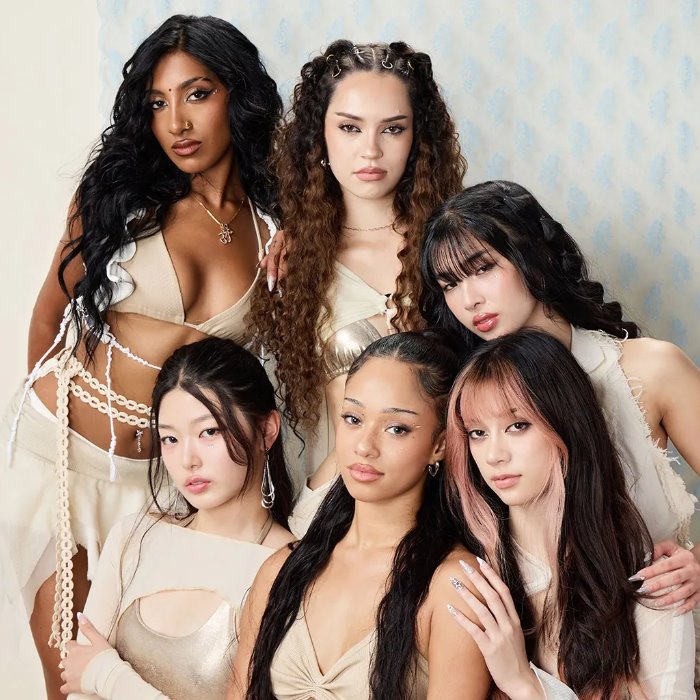
The six members — Daniela, Lara, Manon, Megan, Sophia, and Yoonchae —
come from the Philippines, South Korea, Switzerland, and the United States, and are often described as a “global girl group.”
That geographic range is not merely a marketing proposition; it materially shapes the harmonic blend. Sophia’s Filipina R&B training and Yoonchae’s Seoul-forged vocal precision sit against Manon’s Swiss-European pop sensibility and Daniela’s Afro-Latina timbre in a way that generates genuine textural variety in the group’s unison passages. “Gabriela” is where this blend operates most naturally, the members’ tones weaving around a melody that leaves room for individual character without fragmenting the line.
“Mean Girls” is the EP’s most straightforward piece of writing — a social-pressure narrative dressed in hyperpop clothing — and it functions exactly as designed: it is clean, rhythmically propulsive, and built for choreographic performance. The problem is not that it lacks quality; the problem is that it lacks distinctiveness. The EP’s closer, “M.I.A.,” recovers some of the opener’s formal daring, driving hard into an electro-noise section that earns its brief runtime. Between the two, “Gameboy” positions itself as the EP’s most personal-sounding track, its lyrics navigating the friction between digital intimacy and emotional distance — a theme that, given the group’s fandom culture and parasocial infrastructure, resonates more than its surface treatment suggests.
Across all five tracks, the vocal performance is disciplined without being sterile.
Musically, KATSEYE has cited The Pussycat Dolls, Spice Girls, and Le Sserafim as influences.
That lineage is audible in how the group thinks about the relationship between group harmony and individual spotlighting — leads and bridges are distributed to showcase different timbres rather than defaulting to a single dominant vocalist, a structural decision that sustains listener attention across a record this short.
Market Note: EP Format as IP Velocity Strategy
With 723,039 global listeners and over 20.2 million total scrobbles across 43 countries, BEAUTIFUL CHAOS demonstrates the demand headroom KATSEYE had accumulated between their debut EP and this release.
The project debuted at #4 on the Billboard Top 200 Albums chart and spent 26 weeks on the chart.
Upon its release, the EP entered weekly music charts in fourteen regions, including reaching the top ten in Belgium, South Korea, and the US — marking KATSEYE’s first entry in the top ten of the Billboard 200 and demonstrating the group’s growth since their first EP.
The triple-single rollout — “Gnarly” on April 30, “Gabriela” on June 20, “Gameboy” on June 27 — kept streaming velocity high across an eight-week pre-release window, maximizing catalog exposure at each drop. With sync potential concentrated in “Gabriela” (Latin crossover placement, telenovela adjacency, Spanish-language market receptivity) and “Gnarly” (brand and gaming contexts, hyperpop adjacency), the IP carries multiple licensing vectors simultaneously.
To support the EP, KATSEYE embarked on their first concert tour, the Beautiful Chaos Tour, in November 2025.
That live activation further extends catalog longevity beyond the streaming cycle, feeding back into scrobble counts and social discovery. The 14:24 runtime is itself a demand driver: it lowers the barrier to repeat full-listens, inflating per-listener stream ratios and keeping per-track averages high.
Geography of Fandom: Where KATSEYE’s Reach Actually Lives
The Performance Snapshot tells a specific story about where KATSEYE’s market penetration is deepest — and where it is still maturing. The United States leads with 75,614 listeners, which is expected given the group’s Los Angeles base and English-language output. But the second-largest listener base is Brazil at 60,643 — and that figure is not incidental.
With auditions held across South Korea, the United States, Japan, and the United Kingdom in 2022, the partnership aimed to create a group that would “transcend national, cultural, and artistic boundaries,” with HYBE founder Bang Si-hyuk expressing his intentions to promote the resultant group to the American market.
Brazil was never the primary design target, but “Gabriela” — with its reggaeton-adjacent production and a music video featuring Jessica Alba — functioned as an effective Latin-market entry point, and the scrobble data confirms that the strategy landed.
The United Kingdom third at 17,925 listeners, followed by Mexico (9,218), Canada (9,081), and Australia (7,572), sketches a classic Anglophone fan-base distribution with a notable Latin America overlay. The presence of Argentina (4,323) and Mexico in the top ten alongside Brazil indicates that the Latin market engagement is regional rather than country-specific — it tracks with “Gabriela” finding genuine traction across Spanish- and Portuguese-speaking audiences.
The group includes the first Indian, Filipina, Latina, and Black artists to be signed under HYBE: Lara, Sophia, Daniela, and Manon, respectively.
That membership diversity is not just a representation metric — it functions as a geographic demand driver, anchoring authentic fandom in communities that see themselves in the lineup.
Germany (4,990) and Poland (4,730) are the European outliers, and their presence in the top ten is consistent with the broader K-pop and K-pop-adjacent fandom patterns that have made Central and Eastern Europe among the most active streaming markets for idol-trained acts. France (4,225) rounds out the ten, adding a Francophone dimension that aligns with Manon Bannerman’s Swiss-French background — a reminder that group composition and market geography are not unrelated variables for a project this deliberately engineered.
In the UK, BEAUTIFUL CHAOS debuted at #55 on the Official Albums Chart.
That placing, while modest by mainstream UK standards, is consistent with an act still building its Western European base — and the scrobble data suggests that engagement depth, particularly in Germany and Poland, outpaces what the chart positions alone indicate.
Critical Assessment: What Holds, What Splinters
BEAUTIFUL CHAOS is a record that does several things well and one fundamental thing poorly. What it does well: it delivers a small number of genuinely distinctive pop moments, confirms the group’s vocal range as a real compositional asset, and demonstrates chart leverage that no amount of critical ambivalence can dismiss.
The EP debuted at #4 on the Billboard Top 200 and spent 26 weeks on the chart
— that is not the performance of an act whose audience is waiting for critical validation.
What it does poorly is coherence.
In a review for Pitchfork, Joshua Minsoo Kim gave the album 5.5 out of ten and described BEAUTIFUL CHAOS as “awfully ordinary,” “disappointing,” and “inoffensive music for the incurious listener.”
Kim noted “Gnarly” as the EP’s standout moment, saying that it “provides a glimpse into what KATSEYE could do to live up to their promise.”
The critique is fair as far as it goes, though it underweights the commercial context. An EP that opens with a hyperpop Alice Longyu Gao demo, pivots to reggaeton in track two, and ends in electro-noise has not failed to find a sound — it has chosen, perhaps strategically, not to settle on one yet. That choice has a cost: the project does not accumulate. Each track lands in its own register and then the next begins in another, without the transitional logic that would make the sum greater than its parts.
AllMusic gave BEAUTIFUL CHAOS two out of five stars and wrote that it was “anything but [beautiful], with a confusing smattering of genre and mood that doesn’t quite hold together,” adding that “Gnarly” and “M.I.A.” were the “only interesting tracks” and that the others “could have been performed by any number of other artists.”
The AllMusic read is harsher but not without foundation, particularly on “Mean Girls,” which is competent without being characterful. “Gabriela” is where the strongest counterargument lives: the Latin production is specific enough, the group blend warm enough, and the Charli XCX co-write structurally elegant enough that it functions as the EP’s emotional center even if it wasn’t designed as such.
Album of the Year aggregated a critic score of 48 based on 2 reviews, with a user score of 59 from nearly 3,000 ratings.
What the critical conversation largely sidesteps is the question of what KATSEYE is being asked to do with five tracks and 14 minutes.
The group was formed through the 2023 reality competition series Dream Academy, a collaboration between HYBE and Geffen Records, and their formation process was later chronicled in the Netflix docuseries Popstar Academy: Katseye.
The infrastructure behind them — the training system, the label machinery, the parasocial fandom architecture — is built for sustained IP development across multiple releases, not single-album auteur statements. BEAUTIFUL CHAOS is best read as a capability demonstration across genre registers, a stress test for the group’s range rather than a definitive sonic statement. Compared to the formal ambition of ENHYPEN’s catalog (see THE SIN : VANISH for a recent benchmark in K-pop-adjacent EP construction) or the cohesion of 전정국’s GOLDEN, KATSEYE’s second EP operates in a different register entirely — not better or worse, but deliberately open, a record that asks where the group might go rather than announcing where it has arrived.
Frequently Asked Questions
Where can I stream BEAUTIFUL CHAOS by KATSEYE?
BEAUTIFUL CHAOS is available across all major streaming platforms, including Spotify, Apple Music, Amazon Music, and YouTube Music. The physical edition was released in three versions — Beautiful, Chaotic, and Vinyl — through HYBE’s official retail channels and standard physical distributors globally.
The digital extended version of the album is available exclusively for US customers on KATSEYE’s official online shop.
How did BEAUTIFUL CHAOS perform commercially and critically?
BEAUTIFUL CHAOS debuted at #4 on the Billboard Top 200 Albums chart and spent 26 weeks on the chart.
Its first single, “Gnarly,” became the group’s first entry on the Billboard Hot 100.
Critically, the reception was mixed:
Album of the Year aggregated a critic score of 48 based on reviews from outlets including Pitchfork, alongside a user score of 59 from nearly 3,000 ratings.
The commercial performance significantly outpaced the critical consensus.
Which tracks stand out on BEAUTIFUL CHAOS?
Critical consensus and fan data point to “Gnarly” as the EP’s most formally ambitious track — a hyperpop opener built from an Alice Longyu Gao demo that generates genuine tension through distorted vocal processing and unresolved harmonic structure.
Pitchfork’s Joshua Minsoo Kim specifically noted “Gnarly” as the standout moment, saying it “provides a glimpse into what KATSEYE could do to live up to their promise.”
“Gabriela,” co-written with Charli XCX, functions as the EP’s warmest and most broadly accessible piece, while the closing “M.I.A.” recovers the opener’s energy in a tight electro-noise finish.
What albums are similar to BEAUTIFUL CHAOS and where can I find them?
Listeners drawn to BEAUTIFUL CHAOS’s genre-fluid K-pop-influenced pop production should explore 청하’s Querencia, which demonstrates how an idol-trained soloist navigates Latin, R&B, and dance-pop registers with greater structural cohesion — a useful reference point for where KATSEYE’s aesthetic ambitions might lead. For fans of the HYBE ecosystem and English-language K-pop-adjacent material, 전정국’s GOLDEN offers a point of comparison for cross-market idol-pop with strong individual vocal identity.
Girls Choice Music · Curation and Analysis
Authored on May 27, 2026
Listen with 30-sec previews
Previews served by iTunes. Press play on any track.
Similar albums






Released the same week
Other albums released near this date, across years.